

Political tension rises in Pakistan as talk of governor’s rule in KP intensifies
Kamran Khan says Islamabad’s narrative on governor’s rule in KP alarms PTI leaders, who warn the move will deepen political turmoil

News Desk
The News Desk provides timely and factual coverage of national and international events, with an emphasis on accuracy and clarity.
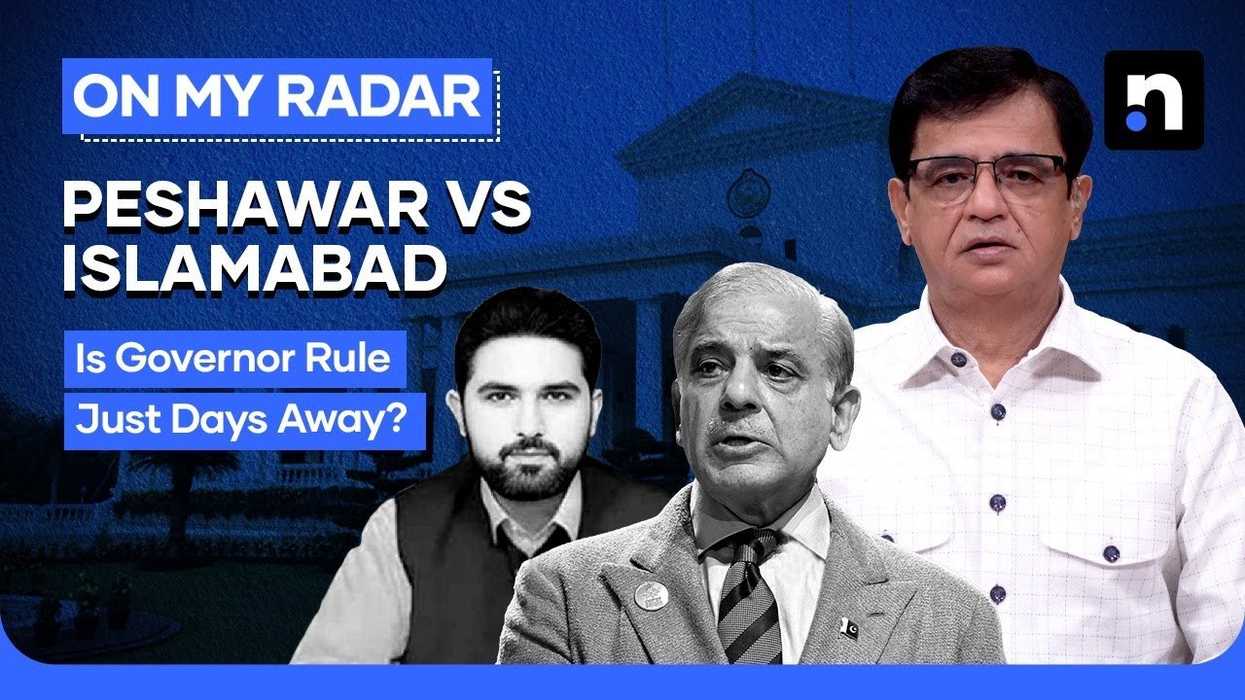
Pakistan’s political crisis is entering a turbulent phase as the federal government signals a possible move to dismiss the Pakistan Tehreek-e-Insaf administration in Khyber Pakhtunkhwa and impose governor’s rule in the province.
The debate — once confined to legal circles — has shifted to center stage over the past 48 hours after federal ministers publicly questioned the performance of the KP government under Chief Minister Suhail Afridi.
During a recent episode of his show “On My Radar,” Kamran Khan said the “most pressing question” in national politics today is whether Prime Minister Shehbaz Sharif and Pakistan’s powerful state institutions have already decided to dissolve the PTI-led government in KP and declare governor’s rule.
He noted that Law Minister Azam Nazir Tarar, Information Minister Attaullah Tarar and Minister of State for Law Barrister Aqeel Malik have each defended the political and legal rationale behind the drastic step.
The narrative has gained traction as Islamabad struggles with a spike in militant violence, largely concentrated in the northwest. Khan said federal officials have long been frustrated with what they view as KP’s failed governance and controversial past engagement with the Tehreek-e-Taliban Pakistan.
The debate intensified after interviews by two of Imran Khan’s sisters on Indian news channels stirred fresh tensions. Khan said the federal government’s renewed push for governor’s rule could also be seen as a political response to those controversial media appearances, which drew a backlash during an already strained period in Pakistan-India relations.
But there is a striking reversal unfolding. Leaders from the ruling Pakistan Muslim League-Nawaz, who fiercely opposed governor’s rule when it was imposed on Punjab in 2009, now argue that dissolving an elected government in KP is both necessary and entirely constitutional.
Supporters of the move insist governor’s rule is not a form of martial law, but a lawful measure permitted under Pakistan’s constitution.
Governor’s rule is not new in Pakistan. In February 2009, the Pakistan Peoples Party-led federal government suspended the PML-N provincial administration in Punjab and handed control to then-Governor Salman Taseer. Shehbaz Sharif, now prime minister, was among those removed from office at the time.
This time, the political winds are blowing toward KP rather than Punjab — and they are being driven by PML-N in Islamabad. For the first time in nearly 17 years, rising friction between the center and a provincial government has revived questions about when and how governor’s rule can be used.
Under the constitution, provincial governors typically serve symbolic roles. Policy decisions and governance fall under the authority of the elected provincial government. But if governor’s rule is declared, those powers shift entirely to the governor, while the chief minister and provincial assembly become inactive.
Two constitutional provisions — Articles 232 and 234 — outline the conditions for imposing an emergency or governor’s rule. If the president believes a part of Pakistan faces war, external threats or an internal crisis beyond the ability of provincial authorities to control, he can declare an emergency.
Before enforcement, the provincial assembly would ordinarily be required to approve the decision.
However, if the president moves unilaterally, the government must obtain majority approval from both houses of Parliament. In that case, the governor may assume full administrative authority for an initial period of two months, with the option to extend the measure twice, each time for two additional months, with parliamentary approval.
Crucially, Article 236 bars courts from hearing challenges against governor’s rule once it is imposed.
Khan said this means the legal mechanism is clear — and with the PML-N and PPP coalition holding a majority in Parliament, the numbers are on the government’s side. But he warned that the political consequences in KP could be severe and far-reaching.
Even critics of the PTI government acknowledge governance failures in KP, stalled development projects and the province’s struggle to counter militant attacks. Still, Khan argued that sidelining an elected administration may throw gasoline onto Pakistan’s already volatile political landscape.
PTI leaders are sharpening their response. Former National Assembly Speaker Asad Qaiser warned the government not to “fall for illusions” about governor’s rule, saying any escalation could spiral beyond its control.
Chief Minister Afridi delivered an even sharper message: KP is already under the “rule of PTI’s founder,” and no other authority is needed. “If they have the courage, let them impose governor’s rule,” he said.
PTI retains strong public backing in the province and a comfortable assembly majority after winning a third consecutive term in KP — an unprecedented achievement in Pakistan’s political history.
Khan concluded that while governor’s rule may be constitutional, democratic norms demand a different solution. KP’s problems, he said, require better governance — not an emergency decree that risks deepening instability nationwide.



Comments
See what people are discussing