

Pakistan’s top court adjourns 26th Amendment case hearing for two weeks
Court heard arguments on whether a full court should be constituted to hear petitions challenging the 26th constitutional amendment

Aamir Abbasi
Editor, Islamabad
Aamir; a journalist with 15 years of experience, working in Newspaper, TV and Digital Media. Worked in Field, covered Big Legal Constitutional and Political Events in Pakistan since 2009 with Pakistan’s Top Media Organizations. Graduate of Quaid I Azam University Islamabad.
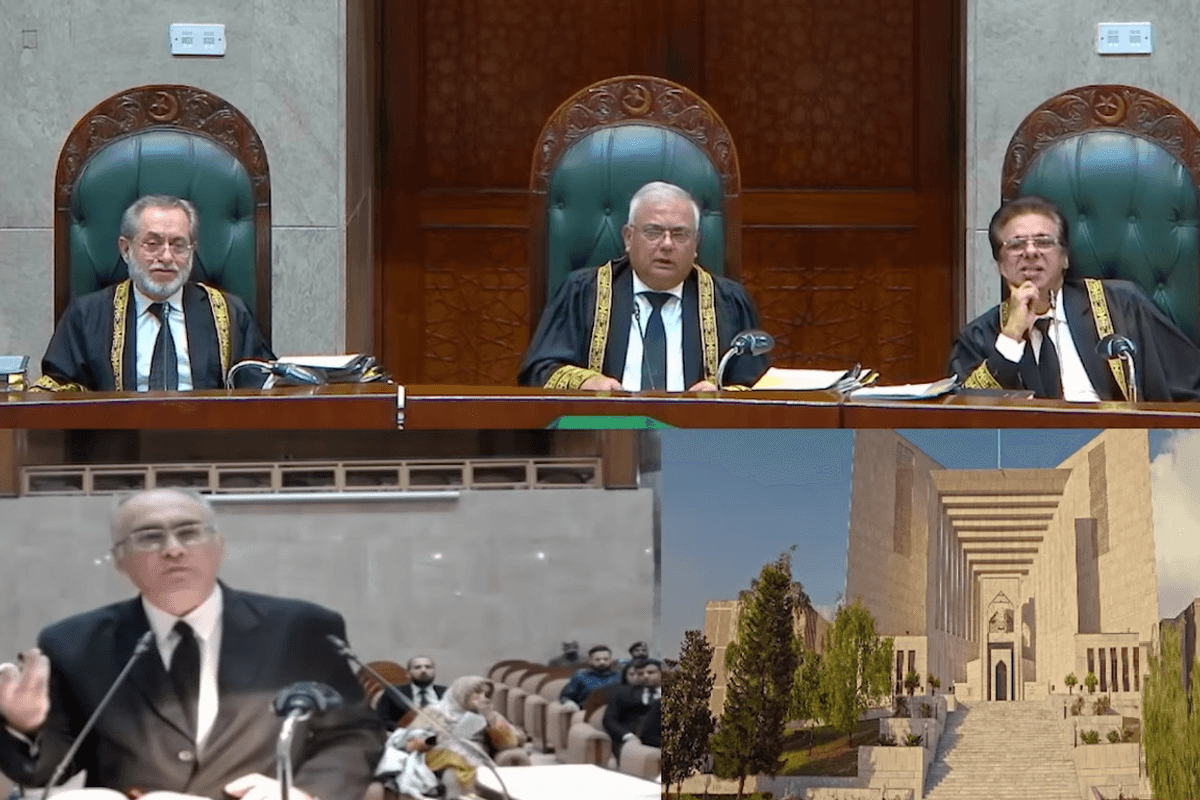
A lawyer presents his arguments before the Supreme Court bench on Thursday.
Screengrab
Pakistan’s Supreme Court on Thursday continued hearings on petitions challenging the 26th Constitutional Amendment, as lawyers urged the formation of a full court to deliberate on the case and the bench sought justification for such a request.
The court adjourned proceedings until November 10, allowing counsel to continue arguments at the next hearing.
Passed by parliament and signed into law on October 21, 2024, the 26th Amendment introduced a new parliamentary mechanism for selecting the Chief Justice and fixed a three-year term for the position.
The legislation has faced strong criticism from opposition parties and legal experts, who argue it undermines judicial independence and violates the Constitution’s basic structure.
Since its enactment, the amendment has drawn multiple legal challenges in the Supreme Court and provincial high courts. Political parties, bar associations, and civil society groups — including the Pakistan Tehreek-e-Insaf (PTI) — have sought to annul key provisions. Hearings began in late 2024 and resumed two weeks ago after a brief pause.
The hearing
An eight-member constitutional bench, led by Justice Amin-ud-Din Khan, conducted Thursday’s proceedings. The bench included Justices Jamal Khan Mandokhail, Muhammad Ali Mazhar, Ayesha Malik, Hasan Azhar Rizvi, Musarrat Hilali, Naeem Akhtar Afghan, and Shahid Bilal Hassan.
The hearing opened with Advocate Shahid Jamil, who was questioned by the bench on whether his petition was distinct from others. Justice Muhammad Ali Mazhar noted, “Your petition is against a constitutional amendment,” while Justice Amin-ud-Din remarked, “We are currently hearing your objections.”
Justice Ayesha Malik inquired whether all petitions referred to the same letter, to which Jamil replied that his plea sought implementation of the Practice and Procedure Committee’s decision.
Justice Amin-ud-Din advised him to present arguments later, after learning Jamil would be out of the country until November 2. Justice Mandokhail quipped, “We’ll also be fresh by then,” prompting laughter when Jamil replied, “I’m fresh even now.”
The court then invited Advocate Uzair Bhandari to the rostrum. He began by emphasizing the “crucial” status of the amendment, arguing that the bench should consider whether only a full court could hear the case. Justice Mandokhail interjected, “Before proceeding, tell us — who will hear these petitions?”
Bhandari maintained that the bench’s concern stemmed from Article 191A, which, he argued, limits referring matters to a full court. When asked by Justice Shahid Bilal to define a “full court,” Bhandari asserted that it was a permanent body under Article 176, not one that must be reconstituted each time.
Justice Amin-ud-Din advised him to “stay within legal reasoning” and cautioned, “Just don’t end up asking us to set aside the amendment.” Justice Mazhar pressed, “How can Article 191A be ignored when this bench itself has been constituted under it?” Justice Shahid Bilal added, “You want us to pass an order while disregarding the very Article under which this bench exists?”
Bhandari argued that the Practice and Procedure Committee’s decision of October 31 was binding, requiring the formation of a full court. Justice Ayesha Malik clarified that Article 191A did not restrict the powers of other forums but granted authority to the Supreme Court itself.
In a lighter moment, after Bhandari noted that only male judges were questioning him, Justice Musarrat Hilali interjected, “The ladies have already understood the point,” drawing laughter. Justice Mandokhail added, “Women judges are wiser than I am,” to which Bhandari replied, “If you want something done, ask a woman.” Justice Malik smiled, saying, “Justice Hilali has already explained it best.”
Concluding his arguments, Bhandari cited several legal precedents, including one from the U.S. Supreme Court, noting that “jurisdiction belongs to the Supreme Court, not to its benches.”
After hearing the arguments, the court adjourned proceedings until November 10, directing that the Sunni Ittehad Council’s counsel would continue his submissions at the next hearing.
Legal experts weigh in
Senior legal observers say the case has far-reaching implications for the judiciary’s structure and authority.
Speaking to Nukta, former Deputy Attorney General Tariq Khokhar said the public was closely following the proceedings, noting that “many things are being exposed” during the hearings. He pointed out that Justice Amin-ud-Din Khan, who heads the bench, will retire in about 20 days from the next hearing date.
“If any member of the bench becomes unavailable, the hearing cannot continue,” Khokhar said, suggesting it was unlikely that a verdict would be delivered before the judge’s retirement. He also noted that since no stay order has been issued, the system established by the 26th Amendment continues to function. “If a future bench later strikes down the law, all actions taken in the interim would still remain protected,” he added.
Senior lawyer and parliamentarian Kamran Murtaza echoed the sentiment, suggesting that Justice Amin-ud-Din appeared disinclined to conclude the case before his retirement. When asked whether a 27th Amendment could be passed to extend the judge’s tenure, he dismissed the idea as impractical. “It’s not possible in such a short time,” he said, explaining that even under expedited conditions, a constitutional amendment would take several weeks.
Currently, the proceedings remain focused on procedural and jurisdictional questions, not the merits of the 26th Amendment itself. The key issue before the court is determining which bench has the constitutional authority to hear the petitions:
- the current eight-member constitutional bench,
- the previous 16-member full court before the amendment, or
- the present 24-member full court of the Supreme Court.
The question of whether the 26th Amendment violates the Constitution’s basic structure will be addressed at a later stage of the case.





Comments
See what people are discussing