

Sindh government faces scrutiny over 62-member political setup
Kamran Khan questions whether Sindh needs 62 political appointees as public services face persistent challenges

News Desk
The News Desk provides timely and factual coverage of national and international events, with an emphasis on accuracy and clarity.
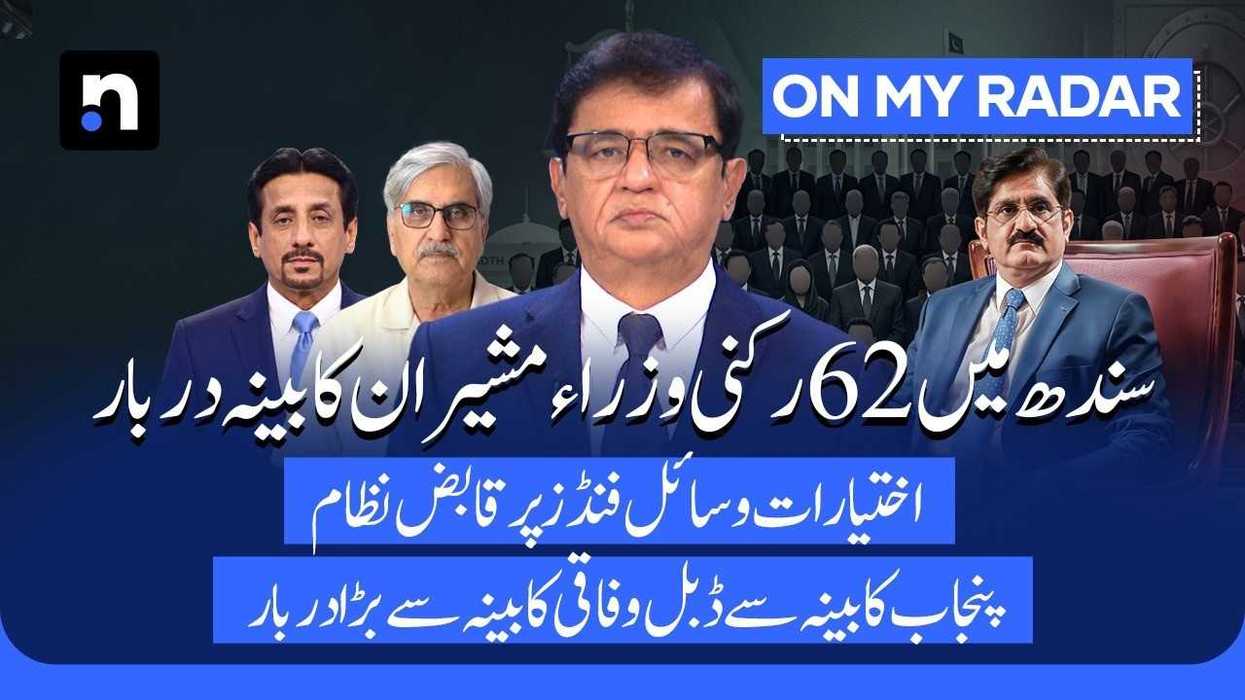
Pakistan's Sindh government has come under scrutiny over the size of its political setup, with Kamran Khan saying Chief Minister Murad Ali Shah is running the province with at least 62 political appointees.
In the latest episode of his On My Radar program, Khan said the figure includes 19 ministers, five advisers, 24 special assistants and 14 spokespersons, describing the arrangement as an example of what he called an expanding centralized system of governance in Sindh.
“Sixty-two people,” Khan said, emphasizing the size of the political setup.
The discussion comes amid a broader debate in Pakistan over possible changes to the country's system of governance and the distribution of powers between the federal, provincial and local governments. Khan argued that the 18th constitutional amendment transferred substantial powers and funds from the federal government to the provinces but said Sindh had failed to translate that devolution into better governance at the local level.
The Pakistan Peoples Party has been a major supporter of the 18th Amendment, which devolved powers from the federal government to the provinces. At the same time, Khan noted that Article 130, Clause 6 of the Constitution places a limit on the size of a provincial cabinet and allows a chief minister to appoint no more than five advisers.
The Constitution, however, does not impose a numerical limit on special assistants and spokespersons. Khan argued that this has created room for additional political appointments carrying government privileges, protocol and other benefits.
“If a provincial government needs 24 special assistants and 14 spokespersons, then we should ask what work the Sindh government is doing that other governments in the country are doing without a setup of this size,” Khan said.
Sindh setup larger than Punjab
Khan compared Sindh's political structure with those of Punjab and the federal government.
According to the 2023 census, Punjab has a population of about 127.7 million, compared with about 55.7 million in Sindh. Punjab's population is therefore more than twice that of Sindh, while its provincial assembly is also considerably larger.
Yet Punjab currently has about 25 ministers, advisers and special assistants combined, Khan said.
He also compared Sindh with the federal government, which administers the entire country and oversees areas including defense, foreign affairs, finance, energy, trade, national security, railways, aviation and communications.
“According to the report, even the 56-member federal administration is smaller than these 62 political positions in Sindh,” Khan said.
He questioned whether the 24 special assistants and 14 spokespersons were an administrative necessity.
“Of course not,” Khan said. “This is only a system for honoring political loyalties and protecting privileges.”
Governance questions
Khan also revisited Murad Ali Shah's pledge after first becoming chief minister in 2016 to put the “right man for the right job” and establish an effective system of governance.
He contrasted that promise with persistent problems across Sindh.
“Mr. Shah, this is the same Sindh where Karachi is struggling with a water crisis,” Khan said, adding that the province's public transport system had remained inadequate for decades.
He said issues involving government land, building controls, the Board of Revenue and other government institutions continued to face questions. In rural Sindh, he said, education, health care, clean water, drainage and municipal services remained major challenges.
“The political administration is growing, but the government being delivered to ordinary citizens does not appear to be improving,” Khan said.
He also questioned what happened to a plan announced by PPP Chairman Bilawal Bhutto Zardari for ministers to undergo performance reviews every six months.
Cost of the political structure
Khan said the financial cost of the government's political and administrative structure was another issue.
According to Sindh government's budget documents cited in the program, about 1.35 billion rupees is allocated annually for the chief minister's secretariat and residence.
The setup includes about 500 sanctioned positions at the chief minister's secretariat, Khan said.
Beyond that, ministers, advisers, special assistants and other political officeholders have separate offices and staff, along with vehicles, security and protocol, he said.
According to the report cited by Khan, related expenses for the provincial executive approach about 1.75 billion rupees, while up to 1 billion rupees is spent on the chief minister's helicopter and VIP flights.
Khan said the issue was therefore not simply the number of political appointees but the broader model of governance.
Debate over devolution
The discussion comes as political debate continues over the creation of new administrative units in Pakistan.
Khan said the PPP, which has been in power in Sindh for 18 years, argues that the province does not need to be divided into new administrative units. At the same time, he said, the provincial government's own central structure continues to expand.
“Powers will remain concentrated in Karachi. Political positions will continue to grow in Karachi. The budget will be distributed in Karachi. But when it comes to transferring powers to districts, cities and local governments, a wall goes up,” Khan said.
He argued that the debate over new administrative units should not simply be viewed as a question of dividing Sindh.
“The question is about making government smaller, closer, accountable and effective,” he said.
Khan said the 18th Amendment had transferred powers from Islamabad to the provinces, including Sindh, but argued that those powers had not been sufficiently devolved from the chief minister's office to cities and districts.
“If federal control over the provinces was wrong, then how can the provincial capital's control over cities and districts be right?” Khan asked.
The program featured comments from special correspondent Akhtiar Khokhar and PILDAT President Ahmed Bilal Mehboob.




Comments
See what people are discussing