

Sindh Local Government Act 2026 raises questions over devolution
Kamran Khan examines whether Sindh’s new law delivers the local powers promised under Article 140-A.

News Desk
The News Desk provides timely and factual coverage of national and international events, with an emphasis on accuracy and clarity.
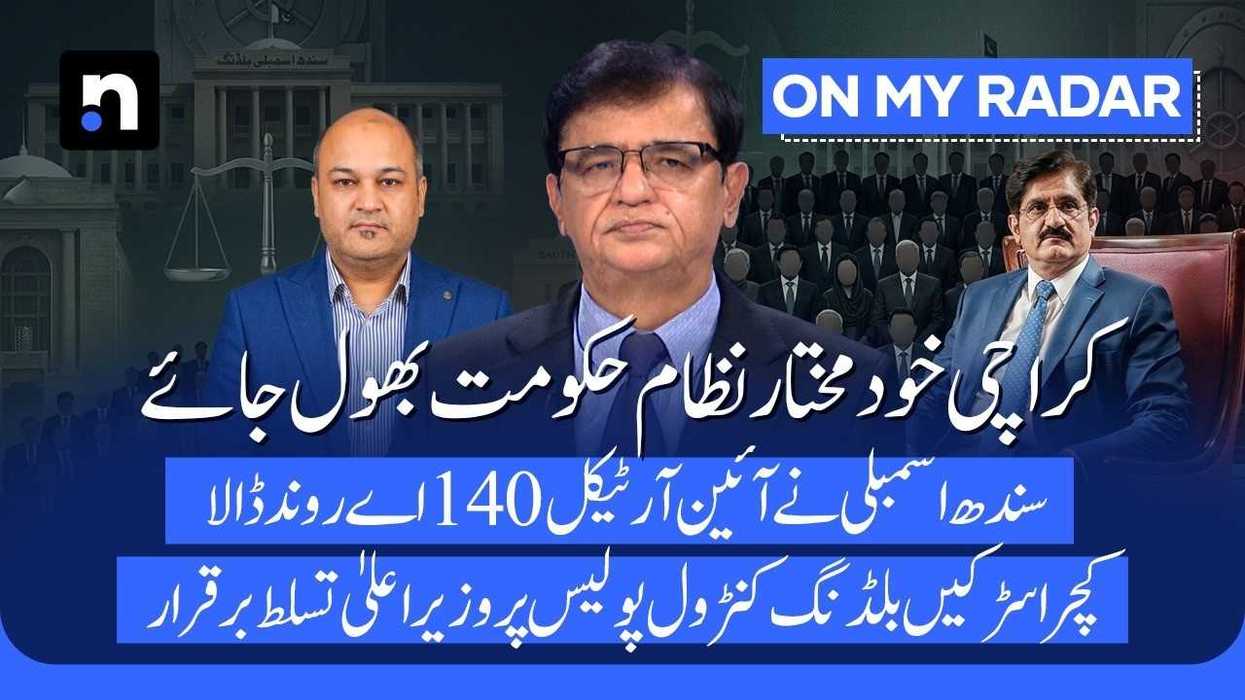
Sindh’s new Local Government Amendment Act 2026 has triggered criticism over whether it fulfills Pakistan’s constitutional requirement to transfer political, administrative and financial powers to elected local governments, with Karachi’s governance structure at the center of the debate.
Article 140-A of Pakistan’s Constitution clearly requires provinces to devolve political, administrative and financial authority to elected local governments. At a time when a national debate is underway over whether smaller provinces or new administrative units are needed to bring power closer to cities, districts, towns and union councils, Sindh’s latest legislation has raised questions about the extent of that devolution.
The Sindh government, led by the Pakistan Peoples Party, approved the amended local government law two days ago. Critics argue that the legislation largely leaves major powers with the provincial government while giving elected local representatives roles focused on coordination, identification of problems and filing complaints.
Kamran Khan, in his latest episode of “On My Radar,” highlighted the debate and questioned whether the new law meaningfully advances the spirit of Article 140-A.
The Sindh government has been in power under the PPP for 18 years and holds a clear majority in the provincial assembly. While that majority gives the government the authority to legislate, the passage of the Local Government Act 2026 has sent a message to Karachi residents, according to critics, that they may have to look elsewhere to seek greater control over their city’s powers and resources.
The central question is what powers have actually been transferred to elected local governments.
Building control? No.
Police? No.
Full control of the solid waste system? No.
Full command of mass transit? No.
Major development authorities? No.
Key powers over urban land and planning? No.
“So where is the transfer of powers?” asked Ali Khursheedi, opposition leader in the Sindh Assembly.
Under the amended law, a union council chairman can identify an illegal building and report it to the relevant authorities. But critics say this does not amount to a transfer of building-control powers because the chairman could already report such violations.
The same applies to policing. Giving a union council chairman the ability to contact a station house officer does not give the elected representative authority over police operations, critics argue.
Similarly, the chairman can now report garbage-related problems, but the overall solid waste system remains outside the local government’s control. The elected representative can identify a problem, inform a provincial institution and then wait for that institution to decide whether to act.
Article 140-A, however, does not direct provinces simply to create offices for coordination, according to Khursheedi. It requires the transfer of political, administrative and financial authority to elected local governments.
The amended law also contains a provision allowing mayors and chairmen to remain in office after their legal term ends by serving as administrators.
That raises another question: If a local government’s constitutional and legal term has expired, what new public mandate allows the same mayor or chairman to continue exercising authority as an administrator?
If local elections are delayed for six months or a year, critics say the law should clearly establish a firm, nonextendable timetable for elections rather than allowing an expired mandate to continue indefinitely through an administrative arrangement.
The issue is particularly significant for Karachi’s administrative structure.
If a mayor is elected by voters but the actual bureaucratic command of the metropolitan administration remains with a government official, a basic contradiction emerges. Voters elect the mayor, question the mayor and hold the mayor responsible for failures, while officials, institutions and several key municipal powers remain under other authorities.
“That is not accountability; it is a division of accountability,” Khursheedi said.
He argued that Karachi has paid the price of this divided structure for years, pointing to K-IV, Safe City, building control, garbage, sewage, transportation and urban planning.
In each of these areas, he said, authority is divided among different institutions, making it difficult for one person or institution to accept full responsibility.
After 18 years in power, Khursheedi said the PPP must answer a basic question: If the party genuinely wants to strengthen local governments, which powers is the provincial government prepared to give up?
A meaningful reform, he said, would give city governments a clear share of financial resources, authority over their officials, control over building regulation and solid waste management, and central responsibility for urban transportation and planning.
Major urban institutions should also operate under a clearly defined elected system, he said.
That, according to Khursheedi, would demonstrate that Sindh was advancing the spirit of Article 140-A.
Instead, if the country is debating the need to transfer power fully to the grassroots while legislation leaves elected representatives primarily responsible for coordination, monitoring and complaints, critics say it cannot be considered genuine governance reform.
Khursheedi said the Sindh government and the PPP now face a clear choice: either acknowledge that control over Karachi and other cities will remain with the provincial government, effectively abandoning meaningful devolution, or strengthen elected local governments.
“The model is no longer defensible in which the provincial government has the power while the mayor has the accountability,” Khursheedi said.
“If the mayor is responsible, then give the mayor the authority as well. If the provincial government does not want to give up its powers, then at least accept responsibility for the destruction of Karachi,” he said.



Comments
See what people are discussing