

Trump’s political strength tested by falling approval and public discontent
Kamran Khan says Trump is increasingly losing the confidence of the American public despite retaining political power.

News Desk
The News Desk provides timely and factual coverage of national and international events, with an emphasis on accuracy and clarity.
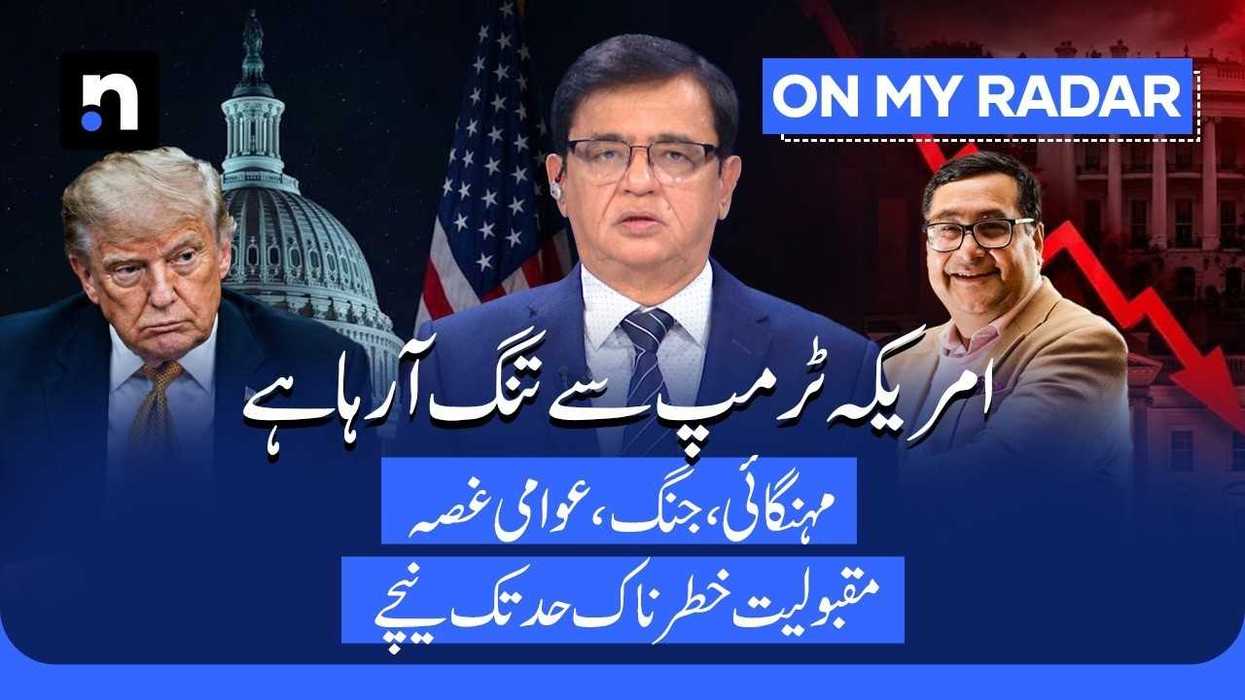
President Donald Trump still commands the power of the White House and a fiercely loyal political movement, but his standing with the wider American public is showing signs of strain. Falling approval ratings, concerns over the cost of living, opposition to the war with Iran and growing support for Democrats among independent voters are creating a difficult political landscape for Trump as the November midterm elections approach.
Kamran Khan, speaking on the latest episode of On My Radar, said Trump was increasingly losing the confidence of the American public despite holding the presidency and retaining considerable political power.
A Reuters/Ipsos poll conducted in late August found that only 33% of Americans approved of Trump's performance, while 64% disapproved — the lowest approval rating of his political career.
Trump's biggest challenge is the cost of living, which continues to weigh heavily on ordinary Americans. Seventy-one percent of respondents said they disapproved of the way Trump was handling the issue. Another poll found that 36% of Americans trusted Democrats more than Republicans to deal with the cost of living, compared with 28% who favoured the Republican Party.
The rising cost of food, housing, petrol and energy has become a major concern for Americans — and a growing political liability for Trump. In 2024, the economy and inflation were among his strongest arguments against his political opponents. Today, those same issues are increasingly becoming a weakness for his administration.
The second major challenge is the war with Iran. A Reuters/Ipsos poll conducted in early September found that only 25% of Americans believed the costs of the war were worth bearing. Higher military spending, tensions in the Gulf, rising oil prices and fears of another prolonged conflict could further damage Trump's political standing.
The issue also cuts against Trump's longstanding claim that he is a president who would keep the United States out of new wars.
The third challenge is independent voters, who can play a decisive role in US elections. According to the Reuters/Ipsos poll, 36% of independent voters said they would vote for Democrats if elections were held today, compared with just 22% who said they would support Republicans.
Those numbers are significant as the November midterm elections draw closer. Historically, the president's party often loses ground in midterm elections as voters use them to express dissatisfaction with the administration in power.
So, has Trump become one of the most unpopular presidents in US history?
The answer is yes, but with an important qualification. If the lowest approval rating recorded at any single point is considered, Trump is not at the bottom. Harry Truman's approval rating fell to 22% in 1952, Richard Nixon's dropped to 24% during the Watergate scandal, Jimmy Carter's reached 28%, while George H.W. Bush's fell to 29%.
Trump's historical record, however, is unusual for another reason. According to Gallup, his average approval rating during his first term was just 41.1% — the lowest average recorded for any completed US presidential term.
By comparison, Truman averaged 45.4%, Carter 45.5%, Barack Obama 47.9%, Nixon 49% and Ronald Reagan 52.8%.
In other words, Trump's unpopularity is not simply the result of a single scandal or crisis. It reflects a longer-running trend.
Trump nevertheless remains one of the most powerful political figures in the world. He controls the White House, commands a strong political movement and continues to enjoy the passionate support of his core supporters.
But political power and public popularity are not the same thing.
If the current trend of public dissatisfaction continues through the November midterms, the question will go beyond Trump's approval rating. The bigger question will be whether American voters are preparing to deliver their first major political verdict on Trump's second term.





Comments
See what people are discussing