


Azhar Khan
Producer, Karachi Desk
Azhar Khan is a journalist with over 14 years of experience across print, electronic, and predominantly digital media. He has recently held key editorial roles at leading media organizations.
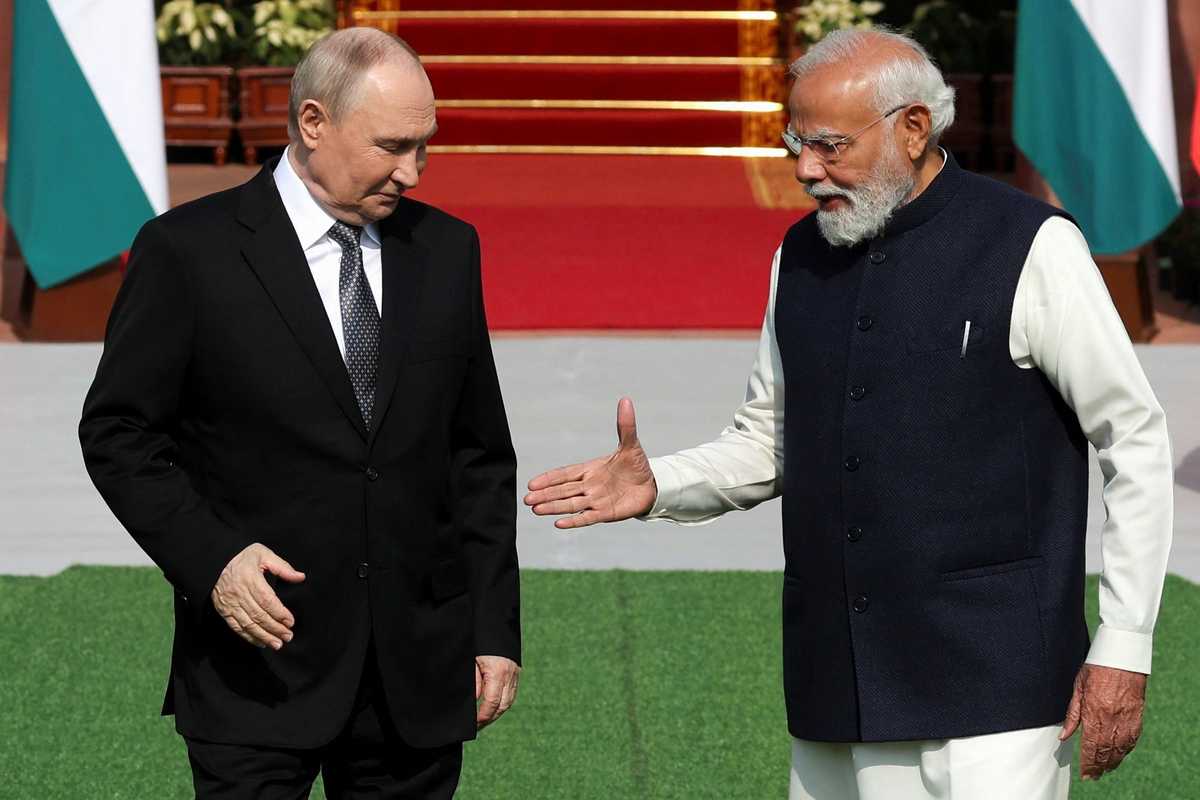
Putin and Modi meet at Hyderabad House in New Delhi ahead of bilateral talks, December 5, 2025.
Reuters
When Vladimir Putin stepped onto the New Delhi tarmac and was met with a warm embrace from Narendra Modi, the moment seemed carefully choreographed - a reminder of a partnership that has endured wars, sanctions and shifting geopolitical loyalties.
Yet behind the public warmth was a far more delicate balancing act: India’s effort to secure defense upgrades, ensure uninterrupted energy flows and expand trade, all while navigating mounting pressure from Washington.
Putin’s trip - his first to India since Russia’s 2022 invasion of Ukraine - comes at a moment when New Delhi is attempting to maintain strategic autonomy even as it negotiates with the U.S. administration to roll back punitive tariffs imposed over its continued purchases of Russian oil.
Modi described Russia as “a guiding star” in India’s diplomatic orbit, emphasizing that the partnership was built on “mutual respect and deep trust.” Putin echoed the sentiment, promising “uninterrupted fuel supplies” and highlighting progress on the Kudankulam nuclear power plant, set to become India’s largest. A joint statement reinforced the theme: “Russian-Indian ties remain resilient to external pressure.”
Russia hopes to boost bilateral trade to $100 billion by 2030, partly by increasing imports of Indian goods. Current volumes are $68.7 billion, heavily tilted in Moscow’s favor due to India’s substantial crude purchases.
Early defense focus
The defense agenda was among the first elements to take shape in the visit. India is exploring expansion of its S-400 air-defense shield, potentially adding two or three more regiments - a priority after the May clashes with Pakistan exposed gaps in India’s air-defense readiness.
Speaking to Nukta, Dr Qamar Cheema - Executive Director of the Pakistan-based Sanober Institute, a think tank specializing in foreign and security policy - said New Delhi may seek additional S-400 units because “earlier deliveries did not fully meet its requirements.” He added that India is simultaneously pushing Moscow for deeper technology transfer, a longstanding demand tied to India’s ambitions for self-reliance.
“India wants technology transfer that Washington is unwilling to provide,” Cheema said, noting that while platforms like the Su-57 stealth fighter have been discussed before, any such purchase could expose New Delhi to potential U.S. sanctions for buying equipment from American adversaries.
Building India’s military at home
Friday’s talks saw both sides agree to restructure defense cooperation to expand joint research, development and production — an essential component of Modi’s “Make in India” initiative. India relies heavily on Russian-origin platforms, and domestic co-production of spare parts and critical components is a priority as it works to reduce dependence on foreign supply chains.
Analysts say the effort reflects both urgency and regional signaling.
“India is signaling both modernization and deterrence,” said Harsh V. Pant of King’s College London. “These moves are about capability and about sending a message to regional actors, including Pakistan.”
Cheema said India’s long-term ambition is to build and export advanced military hardware — a goal that will require decades due to “high threat levels and bureaucratic red tape.” He noted that India already exports the BrahMos missile and is in discussions with Russia to enhance its range, making it more competitive globally.
Trade diplomacy under American pressure
The summit unfolded as New Delhi works behind the scenes with Washington to roll back the tariffs imposed by President Trump over India’s reliance on Russian oil. India calls the measures “unjustified and unreasonable,” pointing out that the U.S. and EU continue to import billions of dollars’ worth of Russian commodities, including enriched uranium.
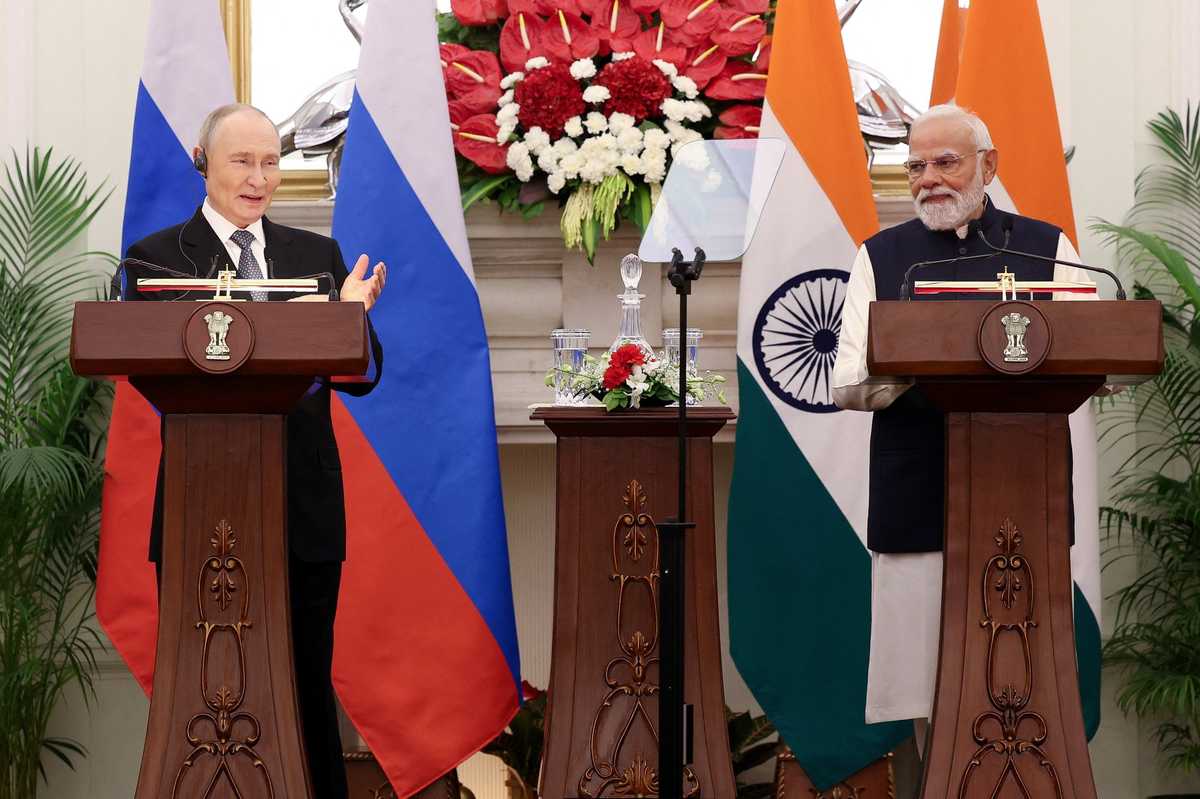 Russian President Vladimir Putin and India's Prime Minister Narendra Modi attend a presentation of a joint statement after their delegation level talks at Hyderabad House in New Delhi, India, December 5, 2025. Reuters
Before the Ukraine war, India imported less than 2 percent of its oil from Russia; last year, the figure was around 40 percent. Although imports have dipped under U.S. pressure this year, Indian officials insist the reduction is temporary.
Putin sharpened the rhetoric in a televised interview aired on Thursday. “If the U.S. has the right to buy our nuclear fuel, why shouldn’t India have the same privilege?” he said, suggesting he would raise the issue directly with Trump.
Cheema said any fresh Indian purchases of major Russian systems “could trigger U.S. pressure,” adding that New Delhi remains stuck on the recurring question of technology transfer — something neither Washington nor Moscow is enthusiastic to deliver at the scale India desires.
Beyond defense, the two leaders signed a labor mobility pact enabling more Indian workers to move to Russia, a significant step as Moscow faces a projected shortage of more than three million skilled workers by 2030. Additional agreements included a joint-venture fertilizer plant and expanded cooperation in agriculture, healthcare and shipping.
India, for its part, is pushing to grow exports in pharmaceuticals, automobiles and industrial services in an effort to rebalance a trade relationship long dominated by energy.
Regional ripples and Pakistan’s view
Expanded Indian air-defense coverage, renewed arms co-production and a deepening Moscow-Delhi axis could affect regional strategic calculations.
However, Cheema said Islamabad sees little cause for alarm.
“Pakistan recognizes that India and Russia have maintained an eight-decade partnership dating back to the Cold War,” he said. “In my assessment, there is nothing for Pakistan to worry about in this visit. This trip is mainly aimed at boosting Modi’s profile.”
Nandan Unnikrishnan of the Observer Research Foundation told AFP that the visit “reinforces India’s strategic autonomy while signaling to Pakistan and the region that New Delhi remains committed to modernizing its forces.”
Michael Kugelman of the Atlantic Council wrote that India still faces its longstanding dilemma: “If it strengthens ties with Moscow or Washington, it risks setting back ties with the other.”
Pant added that the visit was an attempt “to reset their relationship at a critical geopolitical moment for both.” For India, he noted, the optics reflect a renewed assertion of strategic autonomy. For Putin — who rarely travels — the trip signals the relationship’s enduring importance.
A summit of signals
Whatever the tangible outcomes, the summit indicated that Russia and India intend to maintain cooperation across trade, energy and defense even as global tensions sharpen.
Yet the broader implications remain uncertain, with the partnership constrained by U.S. tariffs, regional sensitivities and structural limits on how far either side can move without affecting other strategic relationships.



Comments
See what people are discussing