

Amnesty International accuses Indian police of using excessive force against youth protesters
Amnesty International released a report accusing Indian police of utilizing excessive force, including electric shock devices and pellet guns, against youth-led demonstrations that forced Union Education Minister Dharmendra Pradhan to resign

News Desk
The News Desk provides timely and factual coverage of national and international events, with an emphasis on accuracy and clarity.
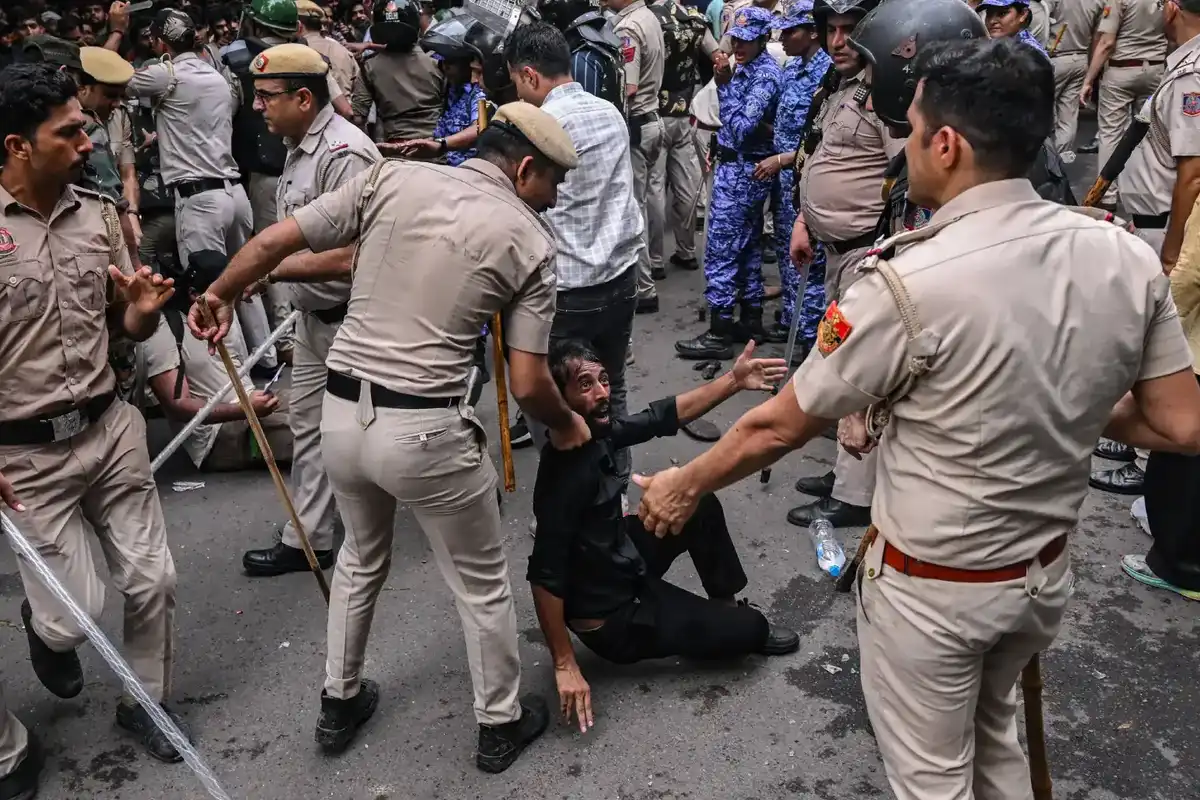
A supporter of the Cockroach Janta Party argues with police during a protest demanding the resignation of India's Education Minister Dharmendra Pradhan over alleged NEET exam irregularities in New Delhi on July 20, 2026.
AFP
Amnesty International issued a report on Monday accusing Indian law enforcement agencies of deploying excessive and unlawful force against youth-led demonstrations in the national capital.
The rights organization stated that security forces utilized electric shock devices, pellet guns, and chemical irritants against protesters during demonstrations that ultimately led to the resignation of Union Education Minister Dharmendra Pradhan last month.
What did Amnesty International uncover regarding police conduct?
According to Amnesty International's verified findings, police and paramilitary units deployed pellet-firing shotguns, tear gas canisters, shock batons, and electric shock devices against crowds in New Delhi and Bihar’s Siwan district. The rights group documented multiple instances where crowd-control measures violated both domestic policing guidelines and international human rights standards.
The report directly challenges statements submitted by Delhi Police to the Supreme Court. While law enforcement officials maintained that force was applied only after crowds turned violent and injured security personnel, Amnesty concluded that isolated stone-throwing incidents were met with state-sanctioned violence masked as routine crowd management.
The release of the report follows a decision by the Supreme Court of India on Thursday, August 20, to establish an independent panel to investigate potential human rights violations and clashes between police and demonstrators. Opposition leader Rahul Gandhi also joined a sit-in outside a Delhi police station on Friday alongside a 19-year-old student injured by pellets during the July 20 march, successfully pressing authorities to register a formal police case.
How did the youth-led protests impact India's political landscape?
The nationwide movement originated in response to widespread irregularities and paper leaks surrounding the 2026 national medical entrance exam (NEET-UG).
Spearheaded by the Cockroach Janta Party (CJP)—a youth movement founded online in May 2026—the movement rapidly expanded from exam-related grievances into nationwide demonstrations against rising youth unemployment and governance standards.
The agitation culminated on July 20 when tens of thousands of demonstrators attempted to march toward Parliament. Continued political pressure forced Union Education Minister Dharmendra Pradhan to step down on July 25, marking the first time during Prime Minister Narendra Modi's tenure that a cabinet minister resigned following youth-led protests.





Comments
See what people are discussing