

Bilawal Bhutto's democratic demands raise questions about PPP's own record
Kamran Khan examines Bilawal’s calls for democratic reforms against the PPP’s political record, stance on the 27th Amendment and governance challenges in Karachi

News Desk
The News Desk provides timely and factual coverage of national and international events, with an emphasis on accuracy and clarity.
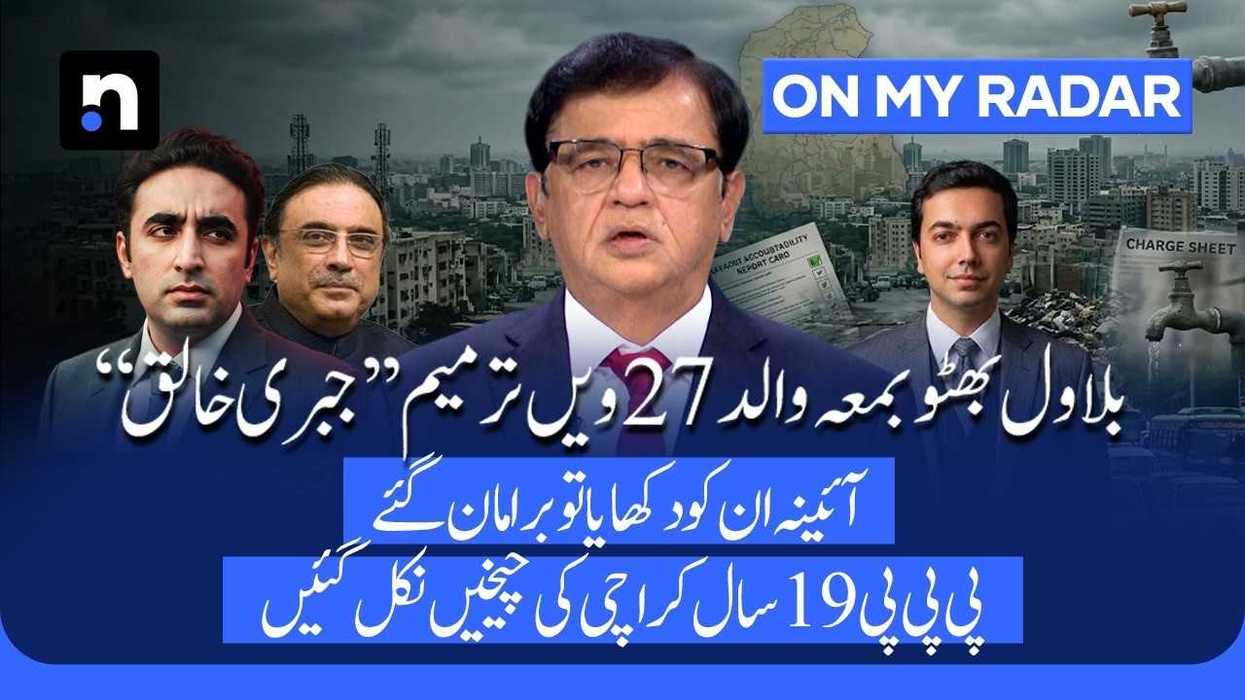
Pakistan Peoples Party (PPP) Chairman Bilawal Bhutto Zardari has called for a political reset, demanding greater parliamentary independence, public confidence in state institutions, judicial credibility and protection of political prisoners. But his speech has also raised questions about his own party's role in the political system, its support for controversial constitutional changes and its nearly two decades in power in Sindh.
In a strongly worded address, Bilawal argued that Pakistan's political system had not collapsed on its own but had been deliberately pushed towards collapse. He called for the restoration of legitimacy to parliament, the Election Commission, the judiciary and the media, saying the country needed a fresh political understanding.
In the latest episode of On My Radar, Kamran Khan examined Bilawal's demands for democratic reforms and political reconciliation, contrasting his criticism of the existing system with the PPP's own record in government, its position on the 27th Constitutional Amendment and the persistent governance challenges facing Karachi.
Calling the Pakistan Tehreek-e-Insaf (PTI) an important political stakeholder, Bilawal said its allegations of electoral rigging should be examined seriously. He called for the restoration of its electoral symbol, the return of its reserved seats and recognition of Imran Khan as a major political stakeholder.
He also accused the National Accountability Bureau (NAB) of being used for political victimization, criticized the passage of the 27th Constitutional Amendment without political consensus, and called for lawmakers to vote freely and for political prisoners to be released.
Opposing any forced division of Sindh, he warned that such a move could fuel political tensions and even lead to bloodshed.
Bilawal's speech appeared to make a case for democracy, constitutional rights and political reconciliation. But it raises a fundamental question: do these principles apply consistently, or do they become important only when political power and interests are at stake?
The PPP has been part of the federal coalition government for the past four years and has governed Sindh for nearly 19 years. Is Bilawal prepared to assess his party's role in government, its involvement in the passage of the 27th Constitutional Amendment and its governance record in Sindh, particularly Karachi, by the same standards he demands of others?
One of the most striking parts of his speech concerned the judiciary. Bilawal said that nobody except the government had confidence in the courts, questioning how the judicial system could function under such circumstances. He also criticised the passage of the 27th Constitutional Amendment, saying it had been pushed through with a brute majority rather than political consensus.
But Bilawal appears to have overlooked his own role in securing the passage of the very amendment he is now criticising. He had previously stood in the National Assembly to claim credit for its approval, describing it as a historic achievement.
The amendment became part of the Constitution on November 13, 2025, after being signed by his father, President Asif Ali Zardari.
It established a Federal Constitutional Court with powers to interpret the Constitution, resolve constitutional disputes and hear related appeals. It also transferred jurisdiction over major constitutional matters from the Supreme Court to the new court, whose decisions were made binding on other courts.
The amendment further granted the president immunity from criminal proceedings and arrest for life under Article 248. It gave the army chief the additional position of Chief of Defence Forces and introduced lifetime ranks, privileges and the right to retain uniforms for the Field Marshal, Marshal of the Air Force and Admiral of the Fleet, along with certain legal protections and powers equivalent to those of the president.
We remember every detail, whether you choose to remember it or not.
Bilawal also spoke forcefully about the treatment of PTI, saying its allegations of electoral rigging deserved serious consideration. He described the withdrawal of its electoral symbol as a joke played on the people, arguing that voters had resented the decision and responded through the ballot box.
Yet when the Supreme Court ruled on PTI's bat symbol in January 2024, Bilawal had supported the decision. At the time, he argued that the Election Commission had favoured PTI by forcibly allotting the party its electoral symbol.
Bilawal also criticized the handling of PTI's reserved seats, describing it as another injustice against the opposition. He accused the government of taking opposition seats for itself, securing two constitutional amendments through its parliamentary strength and now considering a third. He said PTI's reserved seats should be returned.
But, it was Pakistan Peoples Party that joined hands with the Pakistan Muslim League-Nawaz (PML-N) to challenge the Supreme Court's ruling on PTI's reserved seats.
The PPP's counsel, Farooq H. Naek, had argued that PTI was not entitled to those seats under any circumstances.
The irony is that the same Bilawal Bhutto Zardari now invoking democratic principles and constitutional rights leads a party that has been part of the federal government for the past four years. The PPP has participated in government decisions and benefited from the same political arrangement.
Now that criticism has turned towards his own party, democracy has suddenly become a central concern. Constitutional amendments once supported by the PPP are being questioned, while the treatment of political prisoners has become a cause for condemnation.
President Asif Ali Zardari, the country's constitutional head, is also the PPP's co-chairman.
The party currently governs three administrative regions, including Gilgit-Baltistan, while its members hold the offices of governor in Punjab and Khyber Pakhtunkhwa.
The PPP also holds the Senate chairman's office and the National Assembly deputy speaker's position. It heads 18 of the Senate's 45 committees and 14 National Assembly committees, more than any other political party.
In other words, the party enjoys a substantial share of power and influence across the country's political and parliamentary institutions.
There are several questions Bilawal Bhutto Zardari needs to answer.
What political pressure or injustice did the PPP face during the passage of the 27th Constitutional Amendment? His party helped secure its approval, celebrated its passage and accepted the outcome. Why, then, is he questioning the process now?
Karachi is regularly ranked among the world's worst-performing cities. When will the PPP, which has governed Sindh for nearly 19 years, accept responsibility for its condition?
Why doesn't Bilawal accompany the chief minister on a visit to Karachi's streets, even once, to see the mountains of garbage and deteriorating civic conditions for himself?
Why do taps in Karachi's homes still run dry?
How does Karachi's mass transit system compare with the public transport networks of Lahore, Peshawar and Multan?
Can any citizen transfer property through a registrar's office without paying a hefty bribe?
Can any builder secure approval for a legitimate commercial project from the Sindh Building Control Authority without paying a bribe?
Can any landowner get legitimate work done through the Board of Revenue's Land Utilisation Department without paying under the table?
If the PPP opposes the administrative division of Sindh, why did its own government divide Karachi into five administrative districts?
What action has been taken over the alleged embezzlement of Rs7.5 billion provided by the World Bank for the Red Line project? Has anyone accepted responsibility for the project's failure and the alleged wastage of funds? Has the Sindh government repaid the money to the World Bank from its own treasury?
Where are the Red Line, Yellow Line, Orange Line and Karachi Circular Railway projects? How much longer must Karachi's residents wait for these long-promised transport schemes?
Karachi's Safe City project has remained in limbo for 17 years. Cameras have been installed in a handful of selected areas, but an estimated 80 to 90 per cent of the city still lacks adequate surveillance coverage.




Comments
See what people are discussing