

China and Russia condemn 'destructive external interference' in Eurasia during Li Qiang's visit
In a joint statement issued during Chinese Premier Li Qiang’s diplomatic visit to Russia, Beijing and Moscow denounced external coercion and foreign interference across Eurasia

News Desk
The News Desk provides timely and factual coverage of national and international events, with an emphasis on accuracy and clarity.
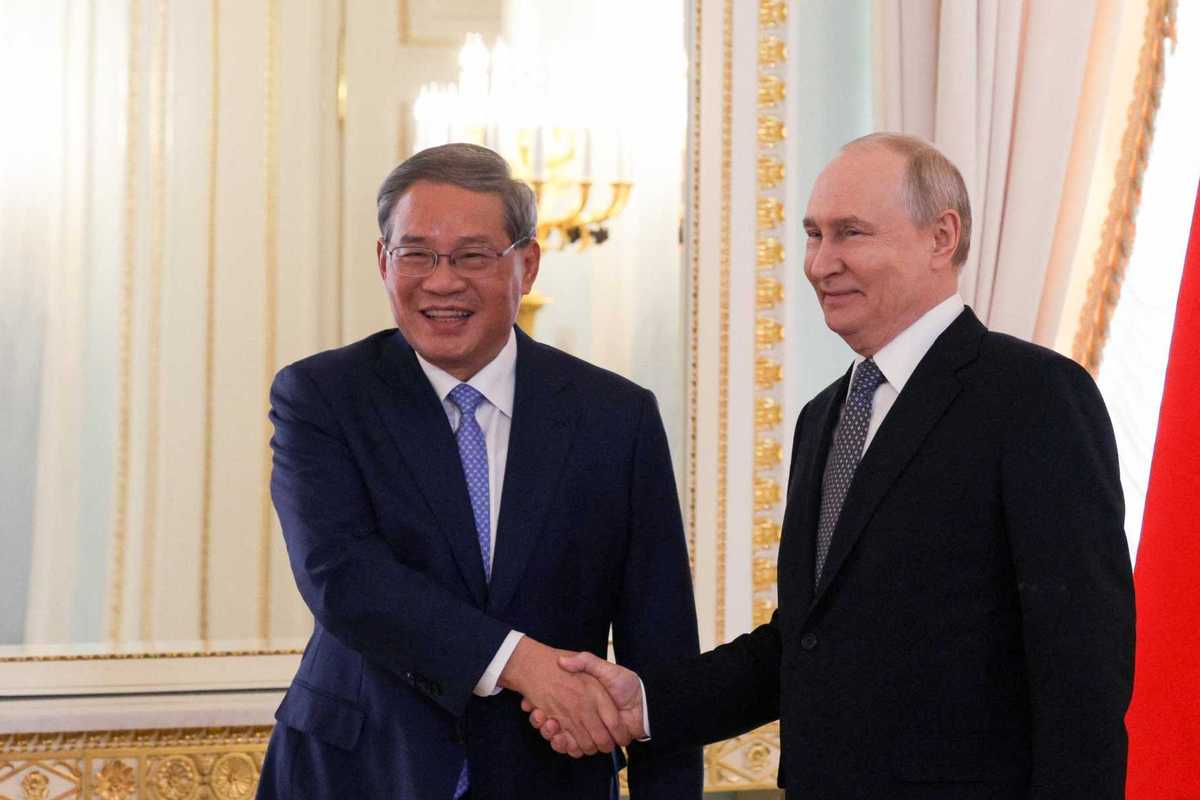
Russia's President Vladimir Putin (R) shakes hands with China's Premier Li Qiang (L) during their meeting in Saint Petersburg on October 21, 2026.
AFP
China and Russia on Thursday, October 22, issued a joint communique condemning "destructive external interference" as the primary threat to stability across the Eurasian continent, following high-level bilateral talks between Chinese Premier Li Qiang, Russian President Vladimir Putin, and Russian Prime Minister Mikhail Mishustin.
What did joint communique declare regarding Eurasian security and core interests?
The joint statement, released following the 31st regular meeting between Chinese and Russian heads of government in St. Petersburg, underscored a deepening strategic alignment against outside geopolitical pressure. "The two sides pointed out that destructive external interference is the primary factor currently undermining stability across the Eurasian continent," the text published by state news agency Xinhua stated.
The communique added that both Beijing and Moscow "firmly condemn any acts of external coercion involving the use of force which are aimed at disrupting the process of Eurasian solidarity," pledging reciprocal backing on matters concerning each nation's core national interests.
Reaffirming Beijing's diplomatic support for Moscow, the document declared that China supports Russia in safeguarding its national security, stability, internal unity, economic development, and sovereignty, while explicitly opposing external forces interfering in Russia’s domestic affairs.
Both governments reiterated their commitment to upholding the United Nations-centered international order and opposing the division of the global system into competing military or regional blocs.
How does joint posture intersect with proposed Shenzhen trilateral summit?
While the communique focused on Eurasian cohesion and bilateral economic cooperation, the published text made no explicit mention of the proposed trilateral summit involving Putin, Chinese President Xi Jinping, and US President Donald Trump. The omission comes despite confirmation from Moscow on Wednesday that diplomatic preparations are advancing to facilitate a historic meeting of the three heads of state on the sidelines of the Asia-Pacific Economic Cooperation (APEC) leaders' summit scheduled for November in Shenzhen, China.
Kremlin foreign policy aide Yuri Ushakov told reporters that "a possible first-ever meeting of the leaders of China, Russia and the United States... is being prepared," to integrate the trilateral engagement into the official APEC schedule.
Although Trump earlier signaled readiness to take part in three-way talks centered on global denuclearization and the conflict in Ukraine, Beijing has remained measured in public statements regarding summit logistics, emphasizing bilateral strategic trust with Moscow while pushing back against perceived Western containment across Eurasia.
According to reporting by Xinhua, and Channel NewsAsia, Premier Li and Prime Minister Mishustin also concluded a series of commercial and infrastructure agreements before wrapping up the intergovernmental session.





Comments
See what people are discussing