

China, Russia, India seek economic cooperation at BRICS summit
BRICS summit leaders from China, Russia and India wrapped talks in New Delhi, backing global growth and calling for calm in the Middle East.

News Desk
The News Desk provides timely and factual coverage of national and international events, with an emphasis on accuracy and clarity.
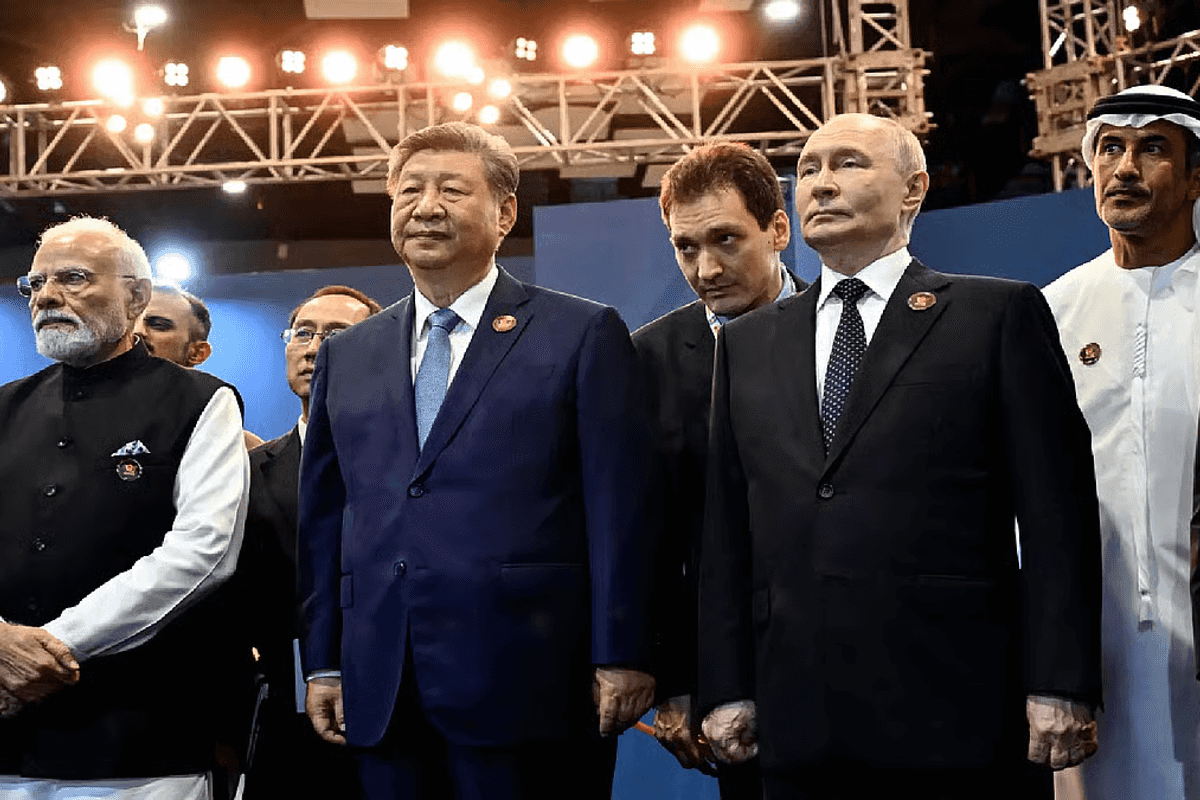
India’s prime minister Narendra Modi (front left) stands alongside China’s Xi Jinping and Russia’s Vladimir Putin during the 18th BRICS Summit in New Delhi.
AFP
BRICS leaders from China, Russia and India concluded a two-day summit in New Delhi on Sunday, agreeing to pursue inclusive global growth. The bloc, which also includes Iran and other emerging economies, reached a rare joint statement calling for calm in the Middle East after intense diplomatic efforts by host India.
What is the relationship between India and BRICS?
India is a member of BRICS, a bloc created in 2009 to give major emerging economies more influence in institutions long dominated by Western powers. Modi says it represents half the world's population and 40 percent of global GDP, and used the summit to push for deeper cooperation and inclusive growth among its diverse members.
Modi called for greater cooperation within the bloc during his address to fellow leaders, including Chinese President Xi Jinping and Russian President Vladimir Putin. "The power of BRICS lies in our diversity and cooperation," he told the summit. He added that member states "may be rooted in different realities" but "rise through cooperation and blossom for humanity."
Putin said the bloc was working to build a "new, more just, multipolar world order." Xi struck a similar tone, warning that "a world without rules is like an intersection without traffic lights" where "chaos and disorder are inevitable." Modi said BRICS had "tried to push inclusive global growth" throughout the summit.
What did BRICS agree on the Middle East?
The first day of the summit on Saturday focused heavily on the conflict in the Middle East. BRICS foreign ministers had failed to agree on a joint statement in New Delhi in May, as Iran, Saudi Arabia and the United Arab Emirates remained divided over the war that began with US-Israeli strikes on February 28.
Leaders at the summit, who also included Iranian President Masoud Pezeshkian, eventually issued a joint statement after intense diplomatic efforts by host India. The statement said BRICS members "express deep concern over the continued escalation of tensions in Middle East/West Asia" and called for "exercising maximum restraint."
Modi maintains cordial relations with both Iran and US ally Israel, and has worked to strike a delicate balance in India's ties with Washington. India has also navigated the energy crisis caused by the US-Iran war partly by turning to Russia, despite Moscow's war in Ukraine and pressure from Western capitals.
Did Xi Jinping attend BRICS in India?
Yes, Xi Jinping attended the BRICS summit in New Delhi, marking his first visit to neighboring India since 2019. The trip marks the biggest step yet in a cautious thaw between the nuclear-armed rivals, coming six years after a deadly military clash along their disputed Tibetan border.
Ties between the two countries have gradually improved through restored flights, visas and high-level contacts. "Although our two countries are different in many respects, they are fully capable of complementing each other's strengths, supporting one another, achieving mutual success and advancing together," Xi said as he met Modi, according to a video released by New Delhi.
The underlying territorial dispute remains unresolved, and both sides retain heavy military deployments along their roughly 3,500-kilometre high-altitude border. India's foreign ministry said after the meeting that the two leaders "expressed commitment to a fair, reasonable, and mutually acceptable resolution of the boundary question."
Deep mistrust persists between the two countries, compounded by a widening trade deficit and strategic rivalry. Xi said both sides should "work hand-in-hand to promote high-quality major financial cooperation, advocate an equal and sustainable global order, and foster an economic globalization that is open and inclusive."
Xi's visit drew protests from dozens of Tibetans in New Delhi, exiles who follow their Buddhist leader, the Dalai Lama. The spiritual leader has lived in India since fleeing a Chinese crackdown in 1959.



Comments
See what people are discussing