

Dispute over ownership of Karachi Cotton Exchange Building: What do we know so far?
Karachi’s iconic Cotton Exchange Building stands sealed as rival claims surface over leases, forged records and trust laws

Ali Hamza
Correspondent
Ali; a journalist with 3 years of experience, working in Newspaper. Worked in Field, covered Big Legal Constitutional and Political Events in Pakistan since 2022. Graduate of DePaul University, Chicago.
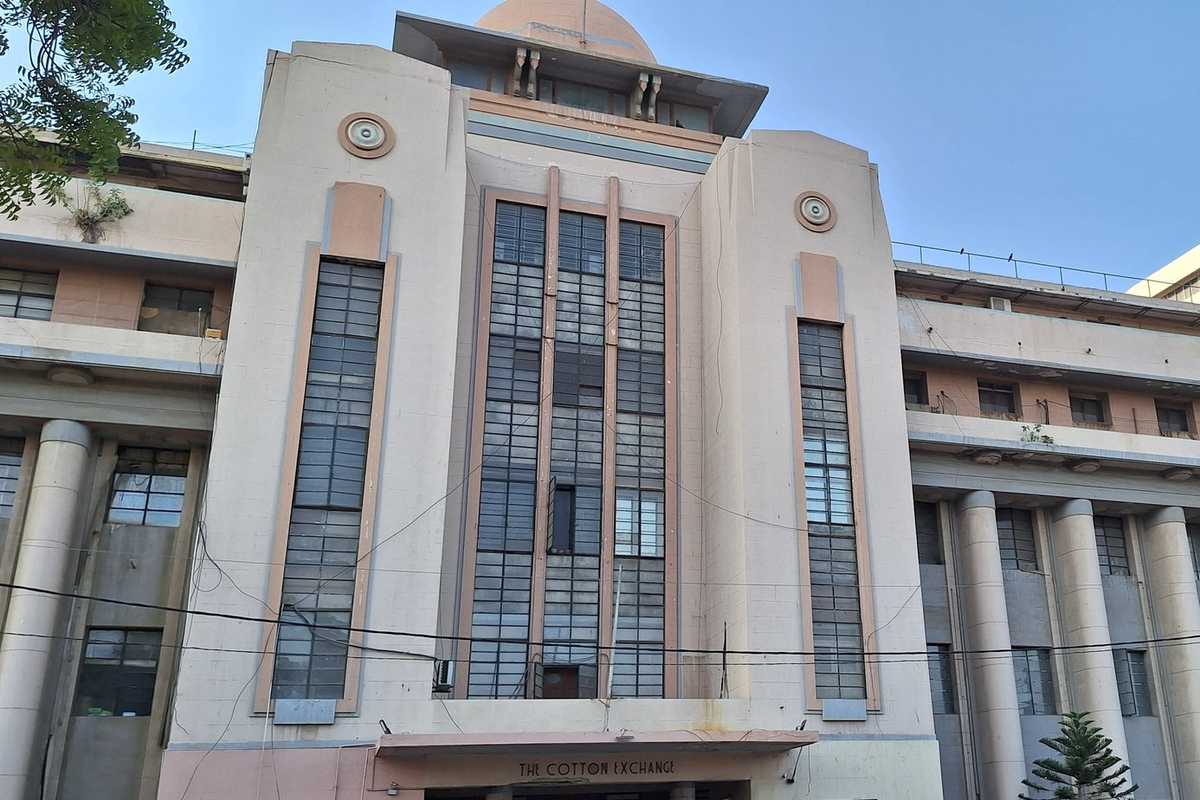
The Cotton Exchange Building on I.I. Chundrigar Road in Karachi.
Courtesy: Wikimedia Commons
A longstanding property dispute involving the Karachi Cotton Exchange Building on I.I. Chundrigar Road, often referred to as the Wall Street of Pakistan, has escalated following a federal operation last month to recover the premises, which authorities claim is evacuee trust property.
The action, led by the Federal Investigation Agency in assistance to the Evacuee Trust Property Board, resulted in the sealing of the building and raised concerns from the Karachi Metropolitan Corporation and stakeholders in the cotton trade over its impact on business and livelihoods.
The story unfolds like a thriller, blending colonial-era legacies with modern-day investigations. At its core is a property notified as federal evacuee trust land more than six decades ago, yet occupied and commercialized by the Karachi Cotton Association until a raid last month.
Partition-era roots
The saga traces back to Pakistan’s creation in 1947, when millions migrated across newly drawn borders, leaving behind vast properties owned by Hindus who moved to India.
To manage these abandoned assets, the government enacted a series of laws, beginning with the Evacuee Property Management Ordinance in 1947, followed by acts in 1948 and 1949. These laws categorized properties into personal holdings and trusts, often linked to temples, dharamshalas or Hindu corporations.
The Karachi Cotton Association was founded in 1933 by Lala Niranjan Prasad, a Hindu businessman who served as its first president. The association aimed to regulate cotton trading in British India, with Karachi emerging as a major hub.
Its original membership, around 90 individuals, consisted mostly of Hindus along with a handful of foreigners. Inductions were allowed until 1935 under its memorandum. By 1946, the governing board was dominated by Hindu members, with only two or three foreigners.
Partition altered the association’s composition. As Hindu members migrated, Muslim traders were inducted, and by 1947 they had effectively taken control of the KCA. The building itself, leased by the pre-partition Karachi Municipal Corporation from 1883 to 1982 for 99 years, became a symbol of this transition.
In 1963, the Evacuee Trust Properties Board issued a gazette notification listing hundreds of properties as evacuee trusts, including the Cotton Exchange Building. It appeared as Entry No. 355: Karachi Cotton Association, per President Lala Niranjan Prasad, at Plot No. 6, Survey Sheet SR-4, Serai Quarters.
The notification invited claims within one month, warning that unclaimed interests would be waived. According to FIA records, no valid claim was filed by either KMC or KCA to remove the property from federal ownership.
Under the Evacuee Trust Properties (Management and Disposal) Act of 1975, such properties vested in the federal government and could not be sold or transferred. Urban-developed properties could only be leased through auctions advertised in newspapers and overseen by a board based in Islamabad, comprising federal and religious affairs ministry representatives.
Despite this, the KCA continued to operate from the building. Over time, it evolved from a full-fledged exchange with futures and hedge trading — locally referred to as satta — to a largely symbolic role after such practices were declared un-Islamic.
In later years, its primary function was issuing daily cotton spot rates based on data from local ginners, weavers, textile mills and international markets — a function not tied to a specific physical location.
FIA probe, forged records and 2021 Supreme Court order
The dispute deepened in 1983 when the original 99-year lease expired. No renewal took place, as the property had already been declared federal under the 1963 gazette. However, in 2003, the KCA produced an extract from KMC records claiming a fresh 99-year lease from 1983 to 2082, a document that later became central to the controversy.
FIA investigations found that the extract did not match KMC’s primary records. When questioned, KMC’s custodian stamped the document “fake/forged” and submitted a statement under Section 161 of the Criminal Procedure Code confirming that no such entry existed.
The FIA is now examining how the KCA retained possession of the property after 1963 and is questioning former ETPB and KMC officials for possible facilitation. Investigators noted that the building’s prime location, spread over about one acre and valued at more than PKR 1 billion, made it vulnerable to exploitation.
According to FIA, only about 10% of the premises were used by the KCA. The remaining 90%, divided into 10 units, was rented out to 213 tenants, generating millions of rupees in monthly rent deposited into KCA bank accounts.
Informal pagri transfers allegedly allowed the KCA to take a 15% cut, with offices bought and sold illegally, generating billions of rupees over decades.
The turning point came in November 2021, when the Supreme Court of Pakistan, in a landmark order including suo motu case no. 1 of 2014 and related petitions, directed the FIA to investigate ETPB properties nationwide, recover illegally occupied assets and hold officials accountable.
In February 2025, the ETPB issued eviction notices to occupants, including the National Bank of Pakistan’s Cotton Exchange Branch. The KCA responded on February 27 through legal consultants, asserting ownership based on the 2003 extract.
Tensions escalated on December 12, 2025. Acting on an ETPB request dated December 11, the FIA and ETPB launched a joint operation to seal the building. A team led by an FIA deputy director, with inspectors and sub-inspectors, evicted KCA staff and tenants.
Occupants were allowed to retrieve belongings before offices were locked under tenants’ keys. Records seized during the operation allegedly showed illegal tenancies, rent collections and pagri transactions.
In a press release the same day, the FIA and ETPB described the operation as the recovery of federal trust property illegally occupied by the KCA and advised claimants to approach designated enquiry officers.
The following day, the FIA registered FIR No. 37/2025 at its Anti-Corruption Circle. Those named included former ETPB Deputy Administrator Rafique Ahmed, KMC’s assistant district officer for land revenue in 2003, Law Officer Syed Mujahid Ali Hashmi, past and present KCA management, and 213 tenants or occupants.
Charges included criminal breach of trust, cheating, forgery, abetment, violations of anti-corruption laws and encroachment statutes. Sub-Inspector Adnan Dilawar was assigned to investigate, alongside parallel financial probes under anti-money laundering laws.
Economic fallout and competing claims
On December 30, Karachi Mayor Barrister Murtaza Wahab wrote to the FIA Sindh director, calling the sealing “unilateral, hasty and unlawful.” He cited a December 13 meeting with KCA representatives and argued that the property had a municipal history, having been transferred to the KCA in 1936 and renewed in 2006 through Suit No. 293 of 2006.
Wahab said the FIA ignored KMC records, causing economic harm to sectors reliant on cotton trading, including banking, textiles and exports. He urged authorities to unseal the building to prevent losses to thousands of people.
In a recent conversation with Nukta, Wahab reiterated that the property belonged to KMC and that claims of it being evacuee trust property were incorrect. He did not respond to further queries sent by Nukta.
FIA Director Muntazir Mehdi responded the same day, defending the operation as compliant with the Supreme Court’s 2021 directive. He cited the unchallenged 1963 gazette notification, the forged 2003 extract — verified by KMC itself — and the building’s commercial exploitation.
Mehdi said prior ETPB notices had been ignored and requested KMC records supporting any claims filed in 1963 or lease renewals in 2003. He urged restraint to avoid interfering with the investigation.
The FIA also rejected claims that the operation disrupted cotton spot rates, noting these are not building-specific and can be issued from any location using available data.
'Our family depends on this place'
Amid the legal battle, personal stories have emerged. Naseem Usman, a third-generation cotton broker whose family has operated in the building since 1950-51, told Nukta the closure had devastated livelihoods.
“Our family — my father, me and now my children — depends on this place,” he said. With 213 offices and 320 registered brokers handling crores in daily business, Usman said the halt in spot rates was sending a negative signal internationally.
Banks that rely on these rates for financing mills and ginners have repeatedly contacted him since December 13, he said, adding that the entire textile chain had been affected.
Usman backed KMC’s claim that the lease was renewed from 1982 to 2081 and defended rent collection and pagri payments — including a 15% share for the KCA — as necessary for maintenance, security and staff salaries in a building valued in the billions.
He claimed around 5,000 people depended on the exchange and were now jobless. Pakistan was losing billions of rupees daily in government revenue, he added.
Usman said occupants were evicted abruptly on December 12 without alternatives. While praising the mayor’s support, he expressed regret over withdrawing a Sindh High Court petition, alleging pressure from authorities.
“They said if we pursued it, things wouldn’t go well,” he said, adding that one proposal under discussion was returning the building to the ETPB and paying rent.
As investigations continue into alleged forged documents, complicit officials and financial trails, the case underscores Pakistan’s complex evacuee property legacy.
Under ETPB law, such properties can only be leased with board approval and through open auctions, typically for a minimum of 30 years at market rates.
With the building sealed for weeks, cotton spot rates disrupted for the first time in 52 years and negotiations underway amid widespread business concern, stakeholders are watching closely.
Whether the building reopens under a federal lease or the dispute escalates further in court remains to be seen.



Comments
See what people are discussing