

Government’s push for dialogue clashes with resistance to Imran Khan court order
Kamran Khan flags a political contradiction as the government pursues dialogue with the opposition while challenging a court order involving Imran Khan

News Desk
The News Desk provides timely and factual coverage of national and international events, with an emphasis on accuracy and clarity.
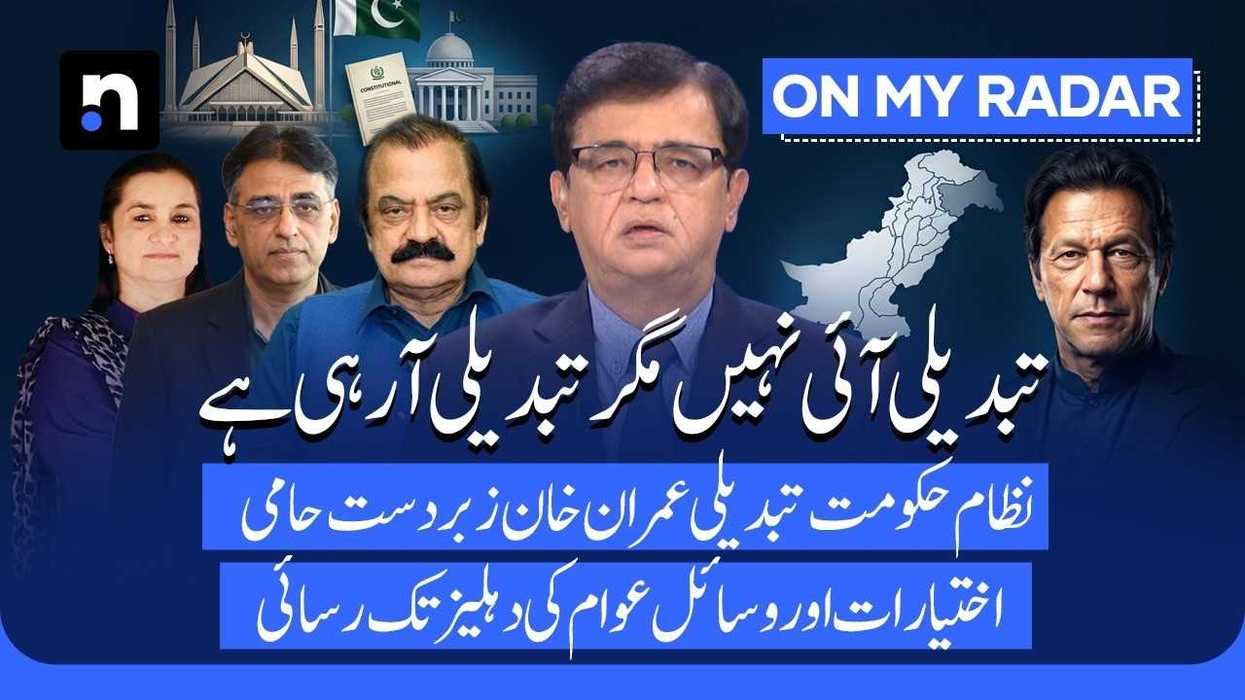
Pakistan's political landscape is marked by a growing contradiction: while the government calls for dialogue with the opposition and discusses sweeping governance reforms, it is simultaneously resisting a Supreme Court order concerning jailed former prime minister Imran Khan.
The tensions highlight the wider political divide that could complicate efforts to build consensus around major institutional and constitutional reforms.
In the latest episode of On My Radar, Kamran Khan said the government's approach reflects a broader contradiction in its political strategy, with the administration seeking dialogue with the opposition while resisting a court order involving Imran Khan.
The Supreme Court on Aug. 18 ordered Imran Khan's transfer from Adiala Jail to Shifa International Hospital. The government's review petition against the ruling was returned by the Supreme Court registrar's office on Thursday over technical objections. While the petition can be filed again, it does not suspend or overturn the original order, meaning the ruling remains binding unless the court itself changes it.
According to the latest reports, Imran Khan remained in Adiala Jail as the court's 48-hour deadline for his transfer approached its expiry on Thursday night.
The Pakistan Tehreek-e-Insaf (PTI) has said it will approach the court if Khan is not transferred to the hospital by midnight. Failure to comply with the order within the stipulated period could also expose the government to contempt of court proceedings.
The issue has unfolded alongside Prime Minister Shehbaz Sharif's invitation to the opposition to hold talks. PTI Chairman Barrister Gohar Ali Khan welcomed the offer but said he hoped it would lead to concrete action rather than remain a verbal commitment, as he said had happened in the past.
The contrasting developments point to a larger political question. Imran Khan is not simply a detained political leader but remains a major force in Pakistani politics, making it difficult to address the country's wider political crisis without engaging with his political constituency.
Interestingly, some of the governance reforms now being discussed by the government also overlap with ideas previously advocated by Khan.
During his tenure as prime minister, Khan proposed creating more provinces by turning administrative divisions into provinces. He argued that smaller administrative units would make governance more efficient and allow governments to respond more effectively to people's problems.
Khan had cited the example of residents of Bhakkar and Mianwali having to travel to Lahore to resolve administrative issues. He argued that more administrative units, combined with an effective local government system, could bring decision-making closer to citizens.
The current government has also acknowledged the need for greater decentralization. PML-N leaders, including Ahsan Iqbal, Rana Sanaullah and Defense Minister Khawaja Asif, have spoken in favor of devolving powers from provincial governments to districts and local administrations and creating new administrative units.
Khawaja Asif said on Wednesday that there would be no need to wait for the next general election to establish new administrative units and that the issue could be settled before the election.
Yet implementing such reforms would require political consensus well beyond the capacity of a single government. Creating new provinces, restructuring administrative units, redistributing powers and strengthening local governments would involve major constitutional changes requiring a two-thirds majority in parliament and broader political agreement.
That presents a significant challenge for the government, particularly as its key coalition partner, the Pakistan Peoples Party (PPP), has opposed the creation of new provinces.
At the same time, independent lawmakers aligned with Imran Khan's PTI form the largest opposition bloc in the National Assembly after the PML-N. This makes engagement with Khan's political camp potentially important for building the parliamentary consensus needed for major constitutional reforms.
The issue therefore goes beyond the question of Imran Khan's transfer to hospital. Pakistan is facing both a political crisis and a deeper crisis of governance. If the government is serious about restructuring the system, major political forces will need to find common ground on fundamental reforms.
Against that backdrop, the case for political reconciliation has arguably become more pressing than ever.





Comments
See what people are discussing