

Heavy rain and strong winds sweep UAE as authorities issue warnings
National forecasters predict more rain through Friday with travel disruptions expected

Dubai Desk
The Dubai Desk reports on major developments across the UAE, covering news, culture, business, and social trends shaping the region.
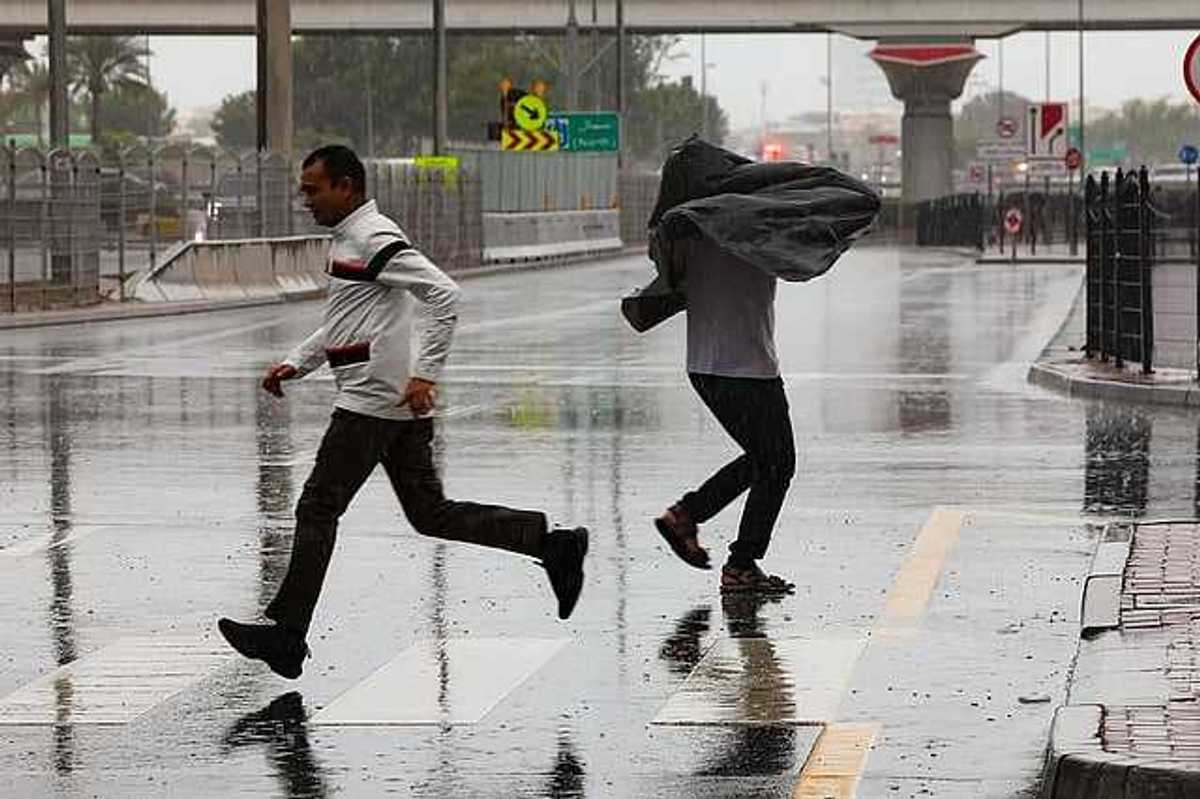
Unstable weather continued across the United Arab Emirates on Tuesday, with rain, strong winds and thick cloud cover expected to persist until Friday, the National Center of Meteorology said.
Authorities nationwide issued safety advisories, reduced speed limits on key roads and introduced precautionary measures to minimize risks, according to Gulf News.
Heavy rain fell for the second consecutive day across Abu Dhabi, its suburbs and the Al Dhafra region. The downpour was accompanied by lightning, thunder, reduced visibility and cooler temperatures as cloud formations moved in from the west.
Meteorological sources said a new wave of clouds began moving in after midnight, advancing toward Al Dhafra and Abu Dhabi during the morning hours.
Convective cloud activity is expected to continue across much of the UAE, bringing rainfall of varying intensity. Further rain is forecast on Wednesday over northern and eastern regions.
The National Center of Meteorology said the highest rainfall totals recorded by Monday included 93.3 millimeters in Manama in Ajman, 91 mm in Ghayathi in Abu Dhabi, 88.2 mm in Al Wathba in Abu Dhabi, 78.7 mm in Mohammed bin Zayed City in Abu Dhabi, and 75 mm in Ruwais in the Al Dhafra region.
Authorities urged residents to remain alert, follow official weather updates and drive cautiously during wet conditions.
Precautionary measures included free public parking in Sharjah and flexible work guidance for companies.
Airlines warn of delays
Passengers traveling from the UAE between March 23 and 27 were advised to allow extra time for their journeys, as airlines warned of potential delays due to rain, strong winds and reduced visibility. Travelers were encouraged to check flight status, update contact details and arrive early at airports.
Emirates advised passengers departing from Dubai International Airport to check flight status online, arrive at least two hours early and update contact details.
Flydubai said travelers should travel only with confirmed bookings, check flight status, arrive four hours early and verify baggage and gate information through its booking system.
Air Arabia said limited flights from Sharjah, Abu Dhabi and Ras Al Khaimah could be affected. Passengers were urged to verify bookings, allow extra travel time and update contact details.
Workplace safety and seasonal outlook
The Ministry of Human Resources and Emiratization urged private sector companies to enhance workplace safety and take preventive measures during adverse weather, particularly at outdoor worksites where severe conditions could disrupt operations.
The ministry said compliance with occupational health and safety standards is a shared responsibility to maintain business continuity. It commended companies promoting safe workplaces and raising employee awareness about emergency weather protocols, while coordinating with authorities to circulate guidance nationwide.
Awareness campaigns are continuing in partnership with government and private sector entities, with enforcement measures in place for violations.
The UAE is expected to experience periods of unstable spring weather until early May, a seasonal pattern locally known as “Sarayat” or “Marawih,” according to Ibrahim Al Jarwan, chairman of the Emirates Astronomical Society and a member of the Arab Union for Astronomy and Space Sciences.
Al Jarwan said the transitional spring period between mid-March and early May is typically marked by rapid and recurring weather fluctuations, including thunderstorms, heavy rainfall and fast-developing convective clouds.
He said the disturbances can form quickly, sometimes producing intense thunderclouds and heavy downpours within short periods. The UAE may also be affected by a regional cloud belt extending from central and eastern Africa across the Arabian Peninsula and the Arabian Gulf, bringing rain accompanied by thunder and lightning.
According to Al Khaleej newspaper, Al Jarwan said the UAE and the wider Gulf region began feeling the effects of an active low-pressure system toward the end of March, bringing scattered cloud cover, rainfall and occasional thunderstorms between March 21 and 27.
He added that similar spring systems produced record rainfall in recent years, including a deep low-pressure system between March 8 and 10, 2024, and severe rainfall between April 14 and 17, 2024, when precipitation exceeded 200 millimeters in several areas.


Comments
See what people are discussing