


Kamran Ali
Correspondent Nukta
Kamran Ali, a seasoned journalist from Khyber Pakhtunkhwa, Pakistan, has a decade of experience covering terrorism, human rights, politics, economy, climate change, culture, and sports. With an MS in Media Studies, he has worked across print, radio, TV, and digital media, producing investigative reports and co-hosting shows that highlight critical issues.
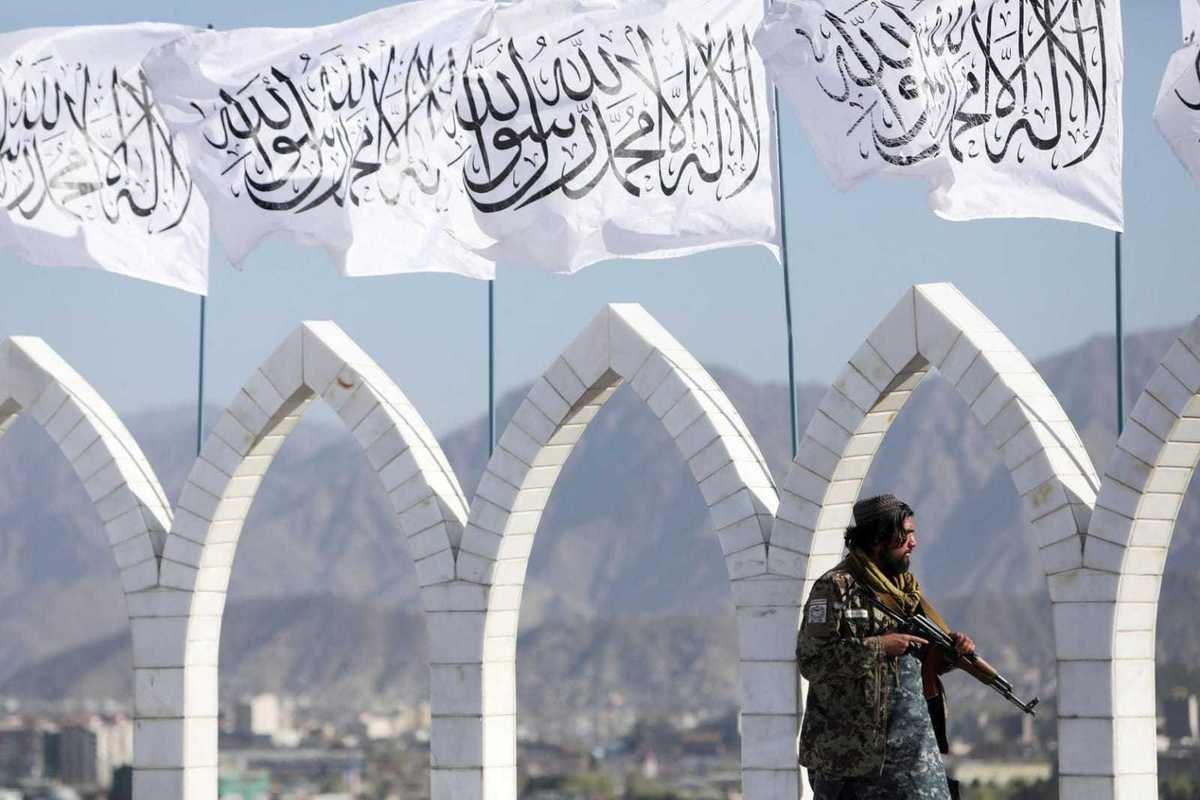
A Taliban fighter is seen at the Taliban flag-raising ceremony in Kabul, Afghanistan, March 31, 2022.
Reuters
Afghanistan’s national flag has never been just a flag. It has been a battlefield of identity, a mirror of power and a symbol rewritten every time the country has turned a political page. From monarchy to republics, communist revolutions to religious rule and now under the Taliban once again, the banner above Kabul has changed as often as the governments beneath it.
Today, that long history of shifting symbols has taken a new turn.
The Afghan Taliban have banned the printing and sale of all flags except the official flag of the Islamic Emirate of Afghanistan, officials said - a decision that underscores not just a policy shift, but a familiar pattern in a country where national identity has repeatedly been redrawn through its most visible emblem.
What prompted the ban?
Tahir Khan, a senior journalist and analyst on Afghan affairs, told Nukta that following the Taliban takeover, authorities removed all other flags from government and private buildings as part of an effort to reinforce their rule through a unified national symbol. “They consider their flag as the sole source of authority,” he said.
Khan added that by banning alternative flags, the Taliban aim to eliminate symbols associated with previous governments, opposition groups, or rival ideologies.
Referring to international recognition, he said the global community continues to identify with the Afghan tricolor and other political symbols. “Afghanistan’s sports teams, including star bowler Rashid Khan, have publicly displayed the black, red, and green flag as an expression of patriotism, even painting it on their faces during matches,” he added.
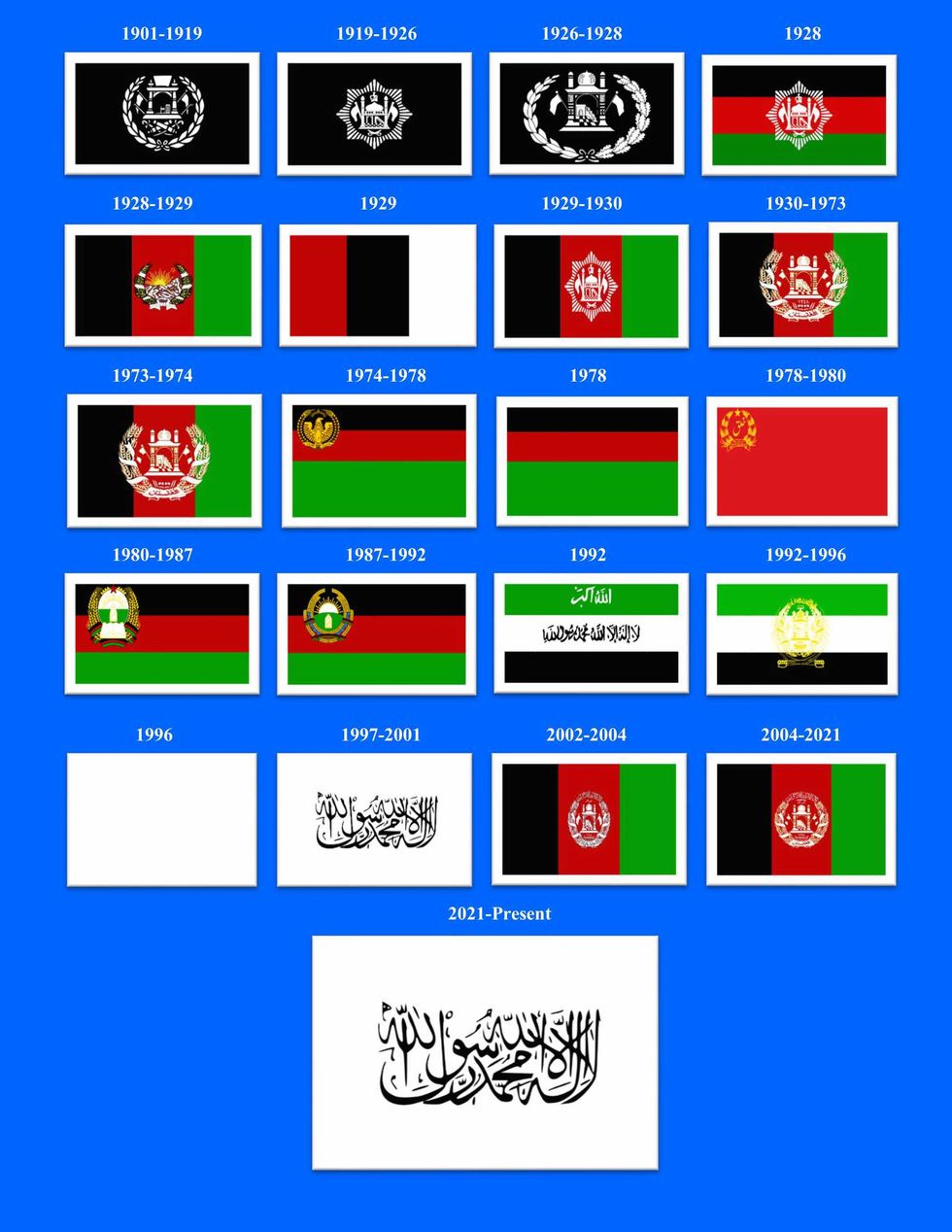 Afghanistan flag over the years
He further noted that different flags often represent resistance groups or political movements, so restricting their use reduces the visibility of opposition and discourages organized dissent, while reinforcing the message that no symbol other than the Taliban’s flag is permitted.
The current flag of Afghanistan consists of a white field bearing the black inscription of the Shahada at its center. Adopted on August 15, 2021, it replaced the former black, red, and green tricolor flag, marking a major shift in national identity and governance following the Taliban’s return to power after the withdrawal of the United States from Afghanistan.
Identity under strain
Tawab Abdullah, an Afghan political analyst, said the country’s black, red, and green tricolor reflects key stages of Afghanistan’s modern history. He explained that black symbolizes earlier eras and resistance to colonial rule, red represents sacrifice and bloodshed, while green stands for Islam, hope, and renewal. “It is not just a set of colors, but it embodies a broader national narrative of struggle, shared suffering, and aspirations for the future,” he said.
Abdullah added that national symbols often become a point of political rivalry during periods of conflict and transition, noting that changes in government in Afghanistan’s recent history have frequently been accompanied by changes in national symbols. “Such changes can undermine unity when a flag is perceived as representing only certain groups, leaving others feeling excluded,” he warned.
He said the promotion of flags representing groups, parties, and movements, rather than a single national flag, can deepen societal divisions. According to him, such symbols reflect limited constituencies, whereas a national flag should function as a unifying emblem for all citizens.
Reflection of instability
Dr. Jovan Kurbalija, executive director of the Diplo Foundation and a researcher on diplomacy and governance, said changes to national flags are not uncommon globally. However, he noted that Afghanistan has changed its national banner around 30 times over the past 102 years, including six revisions in 1929 alone.
He said these repeated changes reflect a society in near-constant transition and political instability, while also highlighting the country’s social diversity and competing interests. “Flags are among the most powerful and concentrated symbols of identity, speaking directly to collective emotions and the human need for belonging and self-identification,” he added.
A history of Afghan flags
The Independence Day of Afghanistan is observed on August 19, marking the 1919 Treaty of Rawalpindi.
Under King Amanullah Khan, the treaty recognized Afghanistan’s full sovereignty and restored control over foreign affairs from Britain following the Third Anglo-Afghan War.
1919-1926
In 1919, during the reign of King Amanullah Khan, Afghanistan adopted a new flag design. He modified the flag introduced by his father, Habibullah Khan, around 1901, which featured a black background with a white emblem showing a stylized mosque above two crossed swords.
Amanullah Khan removed the cannons and replaced the wreath with radiating lines forming an octagram around the seal, influenced by symbols used in the Ottoman Empire.
The Black Banner is an Islamic flag associated in Muslim tradition with the Prophet Muhammad.
The mosque symbol had been used earlier as a national emblem, but its incorporation into the flag in 1901 is regarded as the first official adoption of a state emblem. Since then, most Afghan flags have continued to feature this emblem in some form.
1926-1928
After becoming the first king of Afghanistan, Amanullah Khan introduced further changes to the national emblem. He replaced the star with a wreath, which in different versions featured olive or oak leaves.
The swords and kolah were removed, while the mosque symbol was redesigned in a more detailed and complex form.
1928-1929
In 1928, Amanullah Khan introduced Afghanistan’s first tricolor flag, replacing the black banner. The new design featured three horizontal stripes in black, red, and green. These colors are commonly interpreted as representing the past, the blood shed for independence, and hope for the future.
Historians suggest the design may have been influenced by his visit to Europe, particularly the Weimar Republic of Germany, which at the time used a black, red, and gold tricolor flag.
Khan later introduced another variation, becoming the first vertical tricolor. Its redesigned emblem, influenced by socialist heraldry, featured a rising sun over mountains and wheat, symbolizing enlightenment and agricultural self-sufficiency.
In 1929, the Saqqawist armed group led by Habibullah Kalakani advanced toward Kabul, forcing the king to abdicate in favor of his brother. During his brief three-day rule, Inayatullah Khan is reported to have raised earlier flags featuring a plain black background.
1929-1933
In 1929, the Saqqawists captured Kabul and Kalakani established the Emirate of Afghanistan. They introduced a red, black, and white tricolor flag, similar to the one used by the Mongols during their 13th-century presence in Afghanistan, symbolizing rejection of modernization in favor of traditional and religious authority.
The interregnum ended in October 1929 when Mohammad Nadir Shah, a cousin of Amanullah, captured Kabul and founded a new dynasty. He pursued a “middle path,” restoring some modernization policies and reintroducing Amanullah’s tricolor flag with its original central seal. He restored the mosque emblem and modified it with a wreath of wheat, symbolizing Afghanistan’s agricultural heritage.
1933-1973
In 1933, Mohammad Nadir Shah was assassinated, and his son Zahir Shah ascended the throne.
The same flag remained in use throughout his 40-year reign until 1973, reflecting a period of relative stability and gradual state development.
1973-1978
In 1973, Mohammad Daoud Khan overthrew the monarchy in a military coup, abolished it, and established the Republic of Afghanistan. The initial flag remained largely unchanged except for the removal of the year “1378,” likely due to limited resources and early administrative constraints.
In 1974, a new flag was introduced to mark a clear break from the monarchy while retaining the same colors. It featured a stylized eagle in the canton, symbolizing sovereignty and drawing on the legend of Jamshid, the first king of ancient Ariana (Afghanistan), along with religious and agricultural motifs including a minbar, wheat, and sun rays representing the republic.
1978-1980
In 1978, after the overthrow and killing of President Daoud Khan, the People’s Democratic Party of Afghanistan (PDPA) established a communist state. After briefly retaining the previous flag without its emblem, the regime introduced a near-solid red flag inspired by the Soviet model, featuring a golden canton emblem with the word “Khalq” (“Masses”), surrounded by wheat and a star symbolizing national groups.
1980-1992
After the Soviet invasion and installation of Babrak Karmal as president, the government reinstated the black, red, and green tricolor in a horizontal layout. A new emblem combined traditional and ideological elements, including a rising sun, pulpit, book (science and culture), cogwheel, and a red star symbolizing communism.
As the Soviet Union began withdrawing, President Mohammad Najibullah introduced a “National Reconciliation” policy and revised the flag to reduce overt communist symbolism. In 1987, the red star and open book were removed, and the emblem was simplified, giving the flag a more national and less ideological appearance.
1992-2002
After the collapse of the Najibullah regime in 1992, Mujahideen forces entered Kabul and established the Islamic State of Afghanistan. They introduced a flag emphasizing Islamic identity with the Takbir and Shahada, removing the red color associated with socialism.
Under Burhanuddin Rabbani, the flag was further revised to resemble other Muslim countries, featuring the Shahada within an emblem and incorporating monarchical elements alongside crossed swords symbolizing Mujahideen victory.
In 1996, after the Taliban captured Kabul, they declared the Islamic Emirate of Afghanistan and initially adopted a solid white flag symbolizing the “purity” of their rule. By 1997, they added the Shahada in black calligraphy, reinforcing the central role of Islamic faith in state identity.
2002-2021
Following the 2001 U.S. invasion and establishment of the Interim Authority under Hamid Karzai, Afghanistan adopted a flag intended to unify its divided historical legacy. In 2002, the black-red-green vertical tricolor was officially restored, along with a revised national emblem removing swords and adding the date 1298 (Solar Hijri) to mark independence in 1919.
The 2004 constitution finalized an updated emblem closer to the late monarchy-era design, while earlier adjustments approved by the Loya Jirga included a gold-colored coat of arms.





Comments
See what people are discussing