


News Desk
The News Desk provides timely and factual coverage of national and international events, with an emphasis on accuracy and clarity.
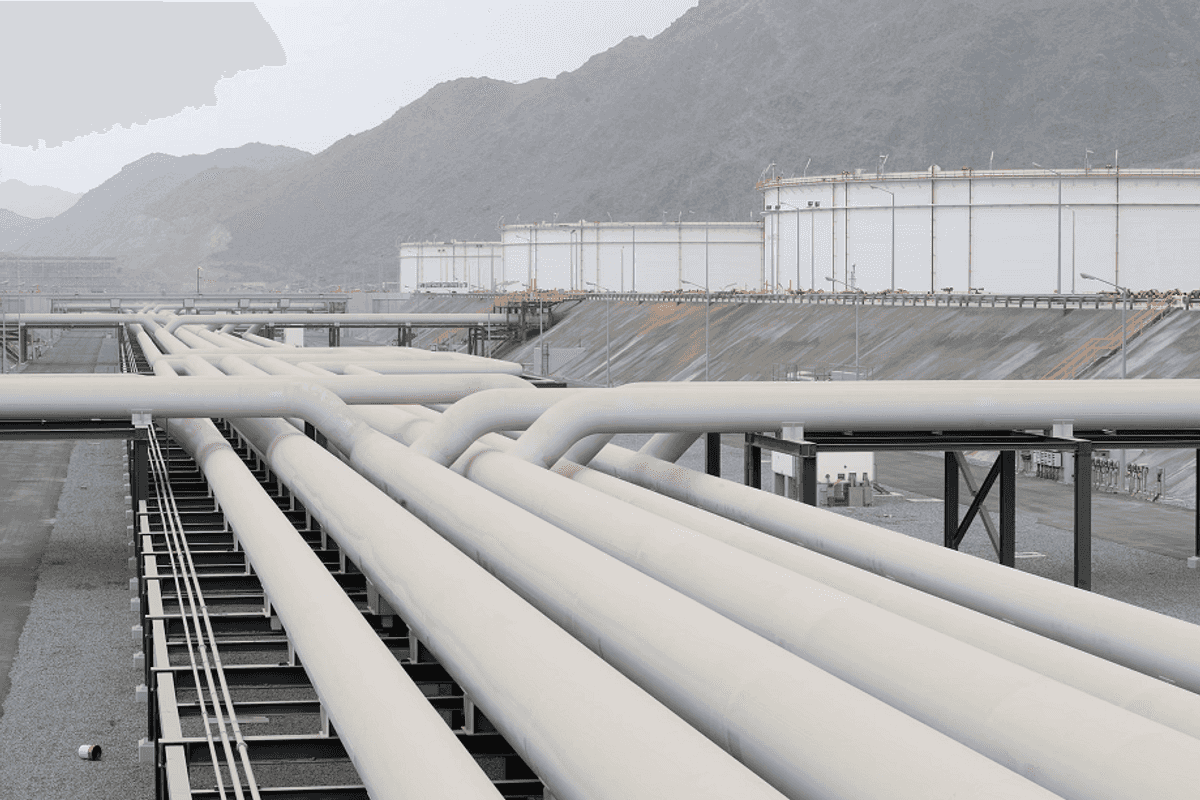
The pipeline will carry Abu Dhabi crude to Fujairah, bypassing the Strait of Hormuz.
Courtesy: Bloomberg
The United Arab Emirates has accelerated work on a second crude oil pipeline designed to bypass the Strait of Hormuz, with construction now about 50% complete and delivery targeted for 2027, Khaleej Times reported quoting senior officials.
ADNOC CEO Sultan Ahmed Al Jaber confirmed the progress during a live-streamed interview with the Atlantic Council. The project comes as the Strait of Hormuz remains severely disrupted following the US-Israeli war on Iran.
What is the UAE pipeline bypassing the Strait of Hormuz?
The new pipeline will transport crude from Abu Dhabi's onshore fields to Fujairah, a major oil hub on the Gulf of Oman, bypassing the Strait of Hormuz entirely.
The project effectively doubles the UAE's export capacity through the eastern corridor. Al Jaber said construction began in 2025 and is being accelerated toward a 2027 completion date.
Why is the UAE building a second pipeline to bypass Hormuz?
Al Jaber said the UAE began investing more than a decade ago in infrastructure aimed at reducing reliance on the Strait of Hormuz, a chokepoint through which around 20 million barrels of oil per day normally transit.
The strait's partial closure following the US-Israeli war on Iran earlier this year has already resulted in losses exceeding one billion barrels globally, with depletion continuing at roughly 100 million barrels per week. Brent crude prices remain significantly above pre-disruption levels.
The project reflects a broader shift in global energy security thinking, Al Jaber said, moving beyond production capacity to include transport routes, storage, and system redundancy.
The UAE has also expanded exports via Fujairah on the Indian Ocean as an alternative route during the disruption. Al Jaber cautioned that prolonged dependence on a single maritime corridor for critical energy flows carries serious strategic risks.
What is the global energy security picture according to Al Jaber?
Al Jaber warned that global upstream energy investment remains insufficient, estimating annual spending at around $400 billion, barely enough to offset natural production declines.
He said global spare oil capacity stands at about three million barrels per day, arguing it should be closer to five million to ensure stability. Recent drawdowns from global inventories have reduced emergency coverage to roughly 30 to 35 days.
The impact of the Hormuz disruption extends beyond oil, Al Jaber said, affecting LNG, petrochemicals, metals, fertilizers, and supply chains linked to global manufacturing and transport.
Even after a conflict resolution, oil flows would likely take months to stabilize, with a return to near-normal levels potentially stretching into 2027. He warned that prolonged disruption could permanently reshape global trade expectations around maritime energy routes.





Comments
See what people are discussing