

IMF says Pakistan must turn stabilization into durable growth through tax reform
Jihad Azour says broader, fairer and more predictable taxation is central to Pakistan’s IMF-backed reform program and efforts to unlock private investment

Business Desk
The Business Desk tracks economic trends, market movements, and business developments, offering analysis of both local and global financial news.
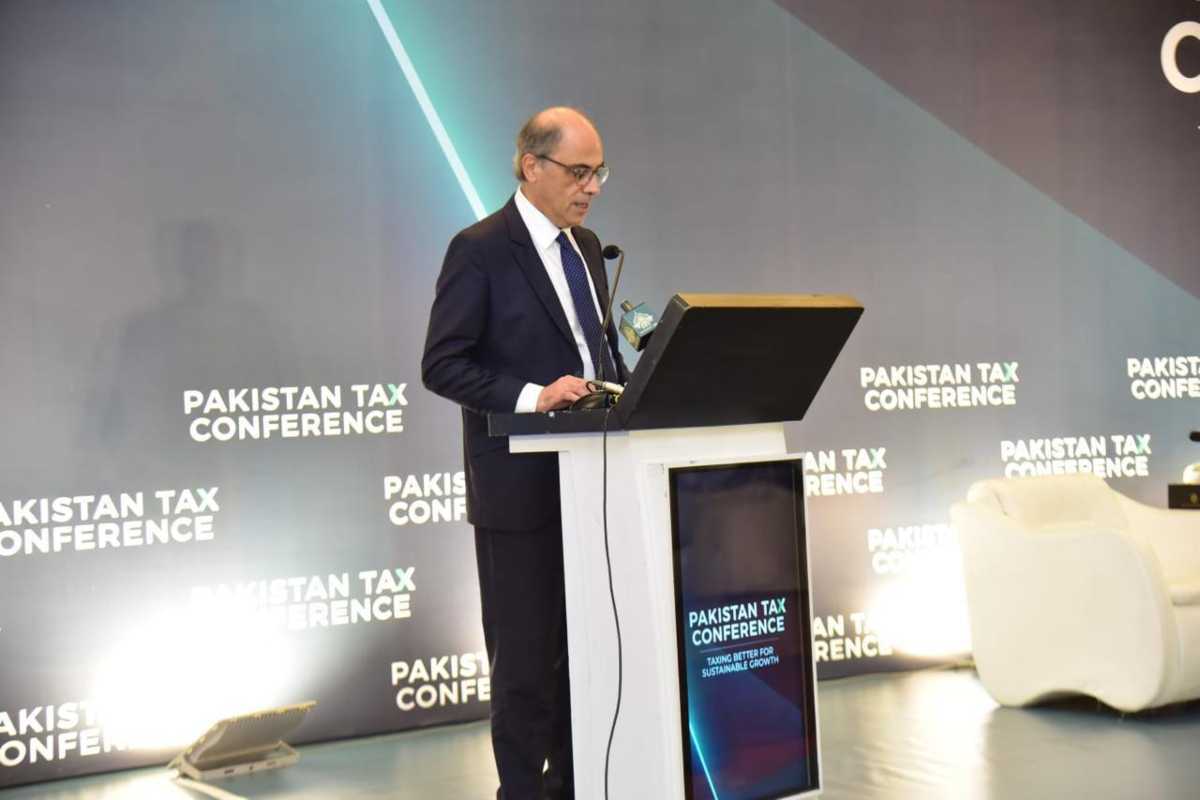
IMF Middle East and Central Asia Director Jihad Azour addresses the Pakistan Tax Conference in Islamabad on October 20, 2026.
Ministry of Finance
Pakistan needs to turn its recent macroeconomic stabilization into stronger and more durable growth, with tax reform playing a central role in improving investment, productivity and fiscal sustainability, IMF Middle East and Central Asia Director Jihad Azour said Tuesday.
Azour said Pakistan had made important progress in restoring macroeconomic stability, rebuilding confidence, strengthening external buffers and supporting a gradual economic recovery despite repeated shocks and uncertainty.
Speaking at a workshop on “Reforms for a Modern and Growth-Friendly Tax System in Pakistan” in Islamabad, attended by Finance Minister Muhammad Aurangzeb, government officials, private-sector representatives, experts and development partners, Azour said the next challenge was to move beyond recurring adjustment cycles toward a more competitive, investment-friendly and inclusive economy.
The government's reform agenda is supported by the IMF through Pakistan's Extended Fund Facility.
Why does the IMF see tax reform as critical for Pakistan?
The IMF sees a broader, fairer and more predictable tax system as essential for sustaining public finances while reducing distortions that discourage investment, productivity and formal employment. It wants Pakistan to widen the tax base, strengthen revenue administration, reduce tax expenditures and protect priority public spending.
Azour said fiscal policy needed to do more than meet primary-balance targets and preserve debt sustainability. It should also strengthen policy credibility, support the recovery and create room for public investment and social spending.
Pakistan remained exposed to higher energy and food prices, disruptions to trade and supply chains, weaker external demand and an abrupt tightening in global financing conditions, increasing the importance of preserving stability while supporting the recovery, he said.
IMF outlines four priorities for tax reform
Azour identified four themes for Pakistan’s reform agenda: credibility, growth, fairness and implementation.
On credibility, he said Pakistan needed to continue meeting fiscal and external objectives while ensuring reforms were sustained and institutionally anchored. A medium-term tax strategy could help by setting clear objectives, sequencing reforms and assigning implementation responsibilities.
On growth, Azour said simpler, more neutral and predictable taxation could lower the cost of operating formally, improve resource allocation and give businesses greater confidence to invest and grow.
The EFF-supported program recognizes that “stabilization is necessary but not sufficient,” Azour said. Pakistan also needed reforms that raised productivity, improved competitiveness and encouraged private investment.
Fairness was central to successful reform. Azour called for addressing under-taxed sectors, rationalizing concessions and reducing disproportionate tax burdens while ensuring rules were transparent and did not reward informality or preferential treatment.
Implementation would require coordination between the federal government and provinces, engagement with the private sector and civil society, effective communication and stronger administrative capacity.
Tax policy and administration must move together
Azour said tax policy and tax administration needed to advance together, arguing that simpler policies make administration easier while stronger administration makes policy reform more credible.
He said the reform process needed to address practical trade-offs, including how to broaden the tax base without undermining the recovery, simplify taxation while protecting revenues, coordinate federal and provincial responsibilities and use technology without increasing mistrust.
The aim of the workshop, he said, was not merely to agree on broad principles but to identify policies, sequencing and follow-up mechanisms that could form a coherent reform roadmap.
Pakistan's recent stabilization gains had created an opportunity that now needed to be reinforced through broader structural reforms, Azour said.
“Tax reform is at the heart of it,” he said, describing the workshop as a potential catalyst for the reform process.





Comments
See what people are discussing