

Pakistan sees possible signs of political thaw as court orders Imran Khan's hospital transfer
Kamran Khan says the Supreme Court’s decision to transfer Imran to Shifa International Hospital could open the door to political reconciliation and ease tensions

News Desk
The News Desk provides timely and factual coverage of national and international events, with an emphasis on accuracy and clarity.
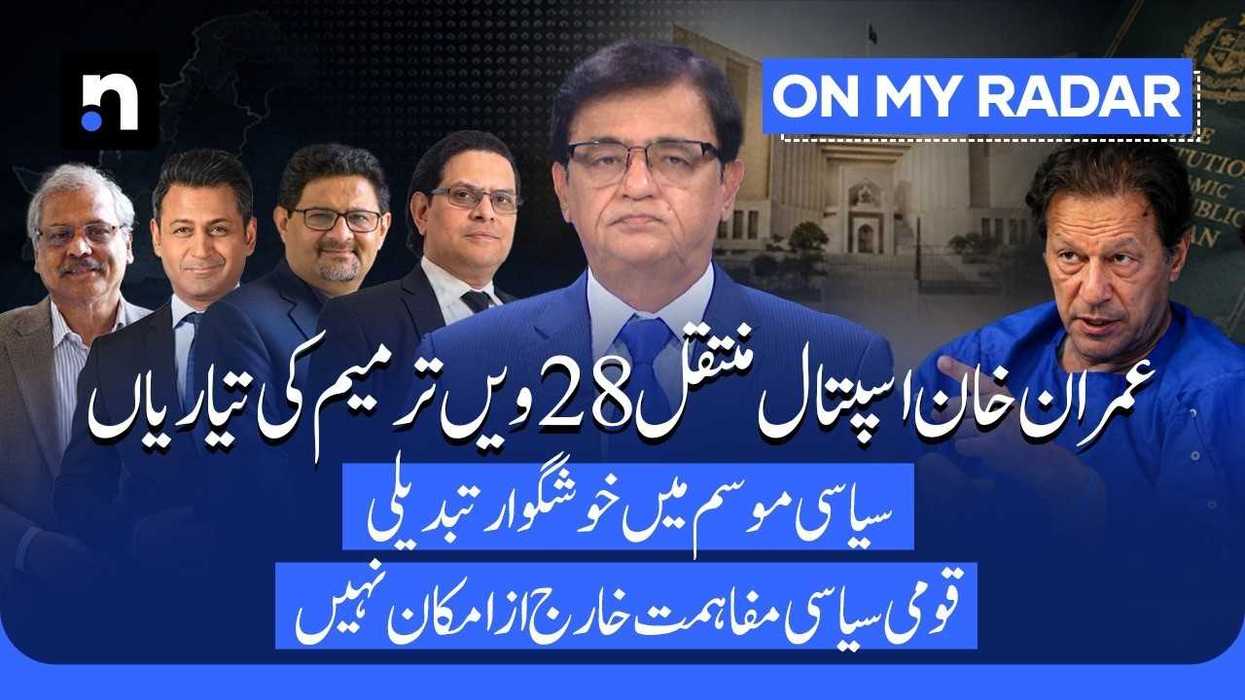
Pakistan’s political landscape may be entering a period of cautious change, with a Supreme Court order to move jailed former prime minister Imran Khan to a hospital, renewed calls for dialogue between the government and PTI, and growing discussion over major constitutional and administrative reforms. The developments come after three years of intense confrontation that have deepened political divisions and strained relations between the state, political parties and the public.
In the latest episode of On My Radar, Kamran Khan said the Supreme Court’s decision to transfer Imran to Shifa International Hospital could mark an important opening for political reconciliation and a reduction in tensions. He argued that the development comes at a time when Pakistan’s international standing has improved significantly, even as domestic political instability and persistent terrorism continue to pose challenges.
The Supreme Court on Tuesday ordered Imran’s transfer to Shifa International Hospital in Islamabad within 48 hours for a comprehensive medical examination. The three-member bench, headed by Justice Shahid Waheed and comprising Justice Naeem Akhtar Afghan and Justice Ishtiaq Ibrahim, also ordered the formation of a special medical board to oversee his treatment.
The court further allowed Imran’s personal physician, Dr Faisal Sultan, to be associated with his treatment and his sister, Dr Uzma Khan, to remain involved in his medical care. It also directed that his family be allowed to meet him once a week and that he be permitted to speak to his sons by telephone twice a week. The court ordered that he remain in hospital until the next hearing, scheduled for September 16.
The ruling has already produced a tangible change in access to the jailed PTI founder. On Tuesday, his sister Noreen Niazi was allowed to enter Adiala jail and meet him, while his other sisters were stopped at a nearby checkpoint.
The court’s intervention follows growing concern over Imran’s health. Medical information presented to the court has referred to problems including fluctuating blood pressure, palpitations, headaches and restlessness, prompting calls for further specialist assessment.
Former president and senior PTI leader Arif Alvi has also voiced concern over Imran’s condition, calling for his transfer to hospital and examination by independent doctors. Alvi said three years of imprisonment and isolation had taken a significant toll on the former prime minister and argued that the coming months would be important for determining his recovery.
The court ruling also carries significance beyond Imran’s medical treatment, coming as signs of a possible thaw emerge after years of confrontation, with developments now visible in both the judicial and political spheres.
Those signs include a recent meeting between Deputy Prime Minister Ishaq Dar and PTI Chairman Barrister Gohar, alongside renewed government calls for political dialogue. Prime Minister Shehbaz Sharif has repeatedly invited PTI to talks, including an appeal on the floor of parliament for the party to “come, sit down and talk”.
The prospect of dialogue is significant after three years of political confrontation that have affected state institutions, political parties and the wider public. Any sustained reduction in tensions could therefore have implications well beyond PTI and the government, potentially creating space for broader political reconciliation.
Debate over constitutional and administrative reforms
At the same time, discussion over a possible 28th Constitutional Amendment has added another dimension to the political debate. Proposals reportedly under discussion include changes to the administrative structure, the creation of new provinces or administrative units and reforms aimed at strengthening local governments.
However, the prospects and contents of any such amendment remain contested. Government officials have previously played down reports of an imminent 28th Amendment, while political figures in Sindh, particularly from the Pakistan Peoples Party, have opposed any move that could undermine provincial autonomy or lead to the division of Sindh.
Any such restructuring would require constitutional changes and political agreement, making consensus among the major political forces crucial.
Another major element of the proposed reforms is the creation of a stronger local government system. Discussions have focused on giving elected local bodies greater administrative and financial authority and changing the way local elections are conducted.
The broader argument is that Pakistan’s governance problems cannot be addressed solely through changes at the federal or provincial level. A more empowered local government structure could bring decision-making closer to citizens and give municipalities greater responsibility for managing rapidly growing urban populations.
For now, however, the direction and scope of these reforms remain uncertain. The debate over new administrative units has already exposed a major political fault line, with the PPP strongly resisting proposals that could affect Sindh’s territorial or political structure.
Taken together, the developments point to a potentially important moment for Pakistan. The Supreme Court’s intervention on Imran Khan’s health, renewed political contacts and discussion over constitutional and administrative reform do not by themselves establish a political settlement. But they could create an opening for dialogue after years of confrontation — if the emerging signals translate into sustained political engagement.



Comments
See what people are discussing