

Imran Khan hospital row adds to Pakistan’s growing political uncertainty
Kamran Khan says the hospital row could have wider political consequences as the Supreme Court weighs the alleged violation

News Desk
The News Desk provides timely and factual coverage of national and international events, with an emphasis on accuracy and clarity.
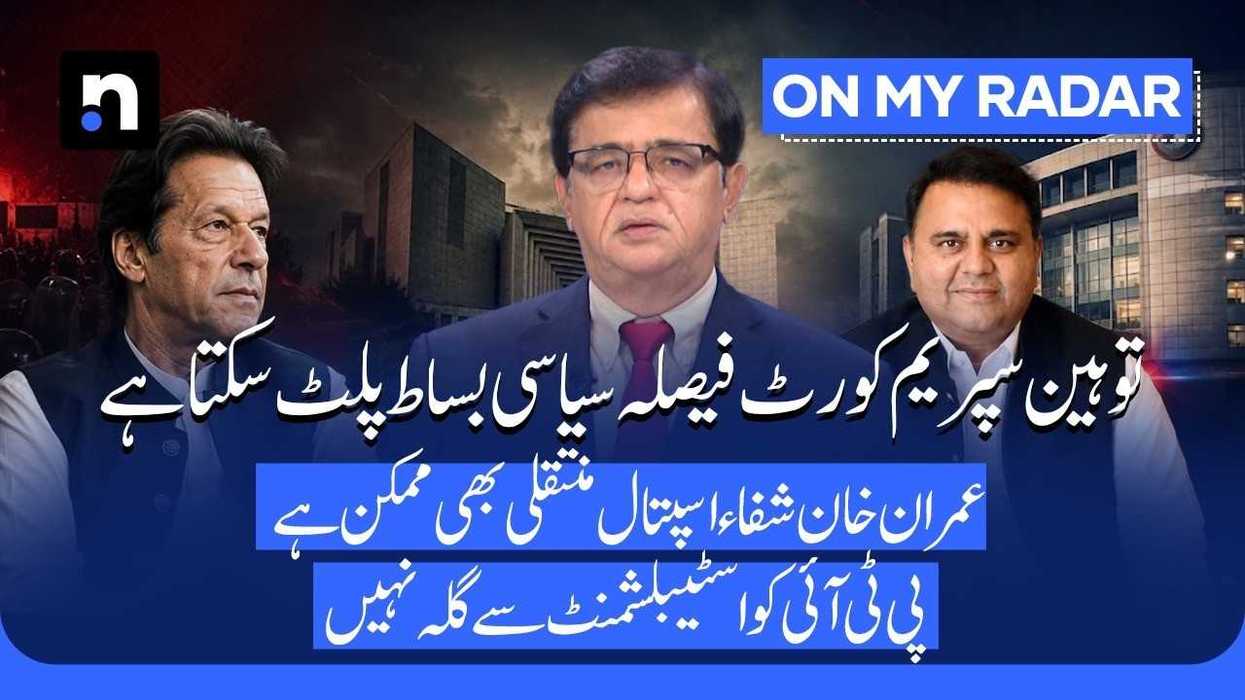
The controversy over former prime minister Imran Khan’s medical treatment has opened a fresh front between the government, the opposition and the judiciary, after authorities transferred him to PIMS Hospital instead of the Shifa International Hospital named in a Supreme Court order, before returning him to Adiala Jail hours later.
The move has triggered a contempt petition by Pakistan Tehreek-e-Insaf (PTI) and raised wider questions over the government’s compliance with the court’s directives.
The episode has also added to the political uncertainty surrounding Khan, whose health and legal status remain deeply contested issues in Pakistan.
Speaking in the latest episode of On My Radar, Kamran Khan said the developments could have wider political implications, particularly as the Supreme Court considers whether its order was violated and what action should follow.
PTI and a number of prominent lawyers have described the government’s decision as an open defiance of the Supreme Court’s August 18 order. The three-member bench had directed that Khan be shifted to Shifa International within 48 hours for medical examination and remain there until September 16. PTI has now asked the Supreme Court to initiate contempt proceedings against those it holds responsible.
In its petition filed on Saturday, PTI named Prime Minister Shehbaz Sharif, Law Minister Azam Nazeer Tarar, Information Minister Attaullah Tarar and seven other individuals, accusing them of failing to comply with the court’s directive. PTI leaders have also linked Punjab Chief Minister Maryam Nawaz to the alleged violation, although she was not named among the respondents in the petition.
The petition seeks action under Article 204 of the Constitution, which deals with contempt of court. The provision has previously been invoked against senior political figures. In 2012, then-prime minister Yousaf Raza Gilani was convicted by the Supreme Court under Article 204(2) for contempt.
The case is notable for another reason. Rather than directly blaming the establishment, PTI has placed responsibility on the PML-N-led government. Political observers have also highlighted the fact that Interior Minister Mohsin Naqvi has not been made a respondent in the contempt petition.
Seeking an early hearing, PTI Chairman Barrister Gohar Khan met the Supreme Court registrar on Monday. Gohar said the registrar assured him that the request would be placed before Chief Justice Yahya Afridi, expressing hope that the case would be fixed for hearing soon.
The dispute stems from the Supreme Court’s August 18 order, issued after a medical report prepared by PIMS specialists said Khan had complained of heaviness in his head and an elevated heart rate. The report also recorded “Anxiety 3+”. The court subsequently ordered his transfer to Shifa International for further medical examination.
Instead, Khan was taken to PIMS shortly after midnight on Thursday and returned to Adiala Jail about five hours later. The government subsequently said he had been found healthy after the examination.
However, reports indicated that PIMS doctors had recommended a cardiac CT angiography (CTA), a test used to examine the coronary arteries and assess possible blockages and the risk of a heart attack. The test was reportedly not conducted because the required facility was unavailable at the hospital.
The episode has also reportedly triggered concern within the ruling PML-N. According to media reports, Nawaz Sharif discussed the matter with Prime Minister Shehbaz Sharif at Jati Umra on Sunday and asked why Khan had been taken to PIMS instead of Shifa International despite the Supreme Court’s order.
Sources quoted in the reports said Shehbaz briefed Nawaz on the circumstances surrounding the decision. Nawaz, in response, warned that Pakistan could not afford another constitutional or political crisis.
The government is also facing pressure beyond Pakistan’s political and judicial circles. Twenty-two international cricketers, including 21 former captains, have written to Prime Minister Shehbaz Sharif calling for Khan to receive necessary medical treatment. According to ESPNcricinfo, the former players urged the government to allow the formation of a medical board in line with the Supreme Court’s order and facilitate a comprehensive assessment of Khan’s health.
The controversy comes against the backdrop of Khan’s continuing importance to Pakistan’s political landscape. Despite being in prison, he remains a major political force, making it difficult to discuss any meaningful political settlement or long-term stability without taking his position and his supporters into account.
That has strengthened calls in political circles for the Supreme Court’s order to be implemented in letter and spirit and for the current dispute to be resolved through dialogue rather than confrontation. September 16, the date until which the court ordered Khan to remain at Shifa International, is still some weeks away, leaving room for the government to comply with the directive.
Prime Minister Shehbaz Sharif has repeatedly offered talks to the opposition and, even after the Supreme Court’s latest order concerning Khan, urged political parties to resolve their differences through dialogue.
PTI, too, may have to demonstrate flexibility if such a political opening emerges. Khan has frequently been reluctant to negotiate with rival political parties, a stance that has previously carried a political cost, including PTI’s resignations from the National Assembly and the dissolution of the Punjab Assembly.
For now, the focus remains on the Supreme Court and whether it will take up PTI’s contempt petition. Its response could determine not only the next phase of the dispute over Khan’s medical treatment but also have wider consequences for Pakistan’s already fragile political landscape.



Comments
See what people are discussing