

India budget supports gradual fiscal consolidation, ratings firm says
Deficit targets seen achievable despite lower GST rates

Business Desk
The Business Desk tracks economic trends, market movements, and business developments, offering analysis of both local and global financial news.
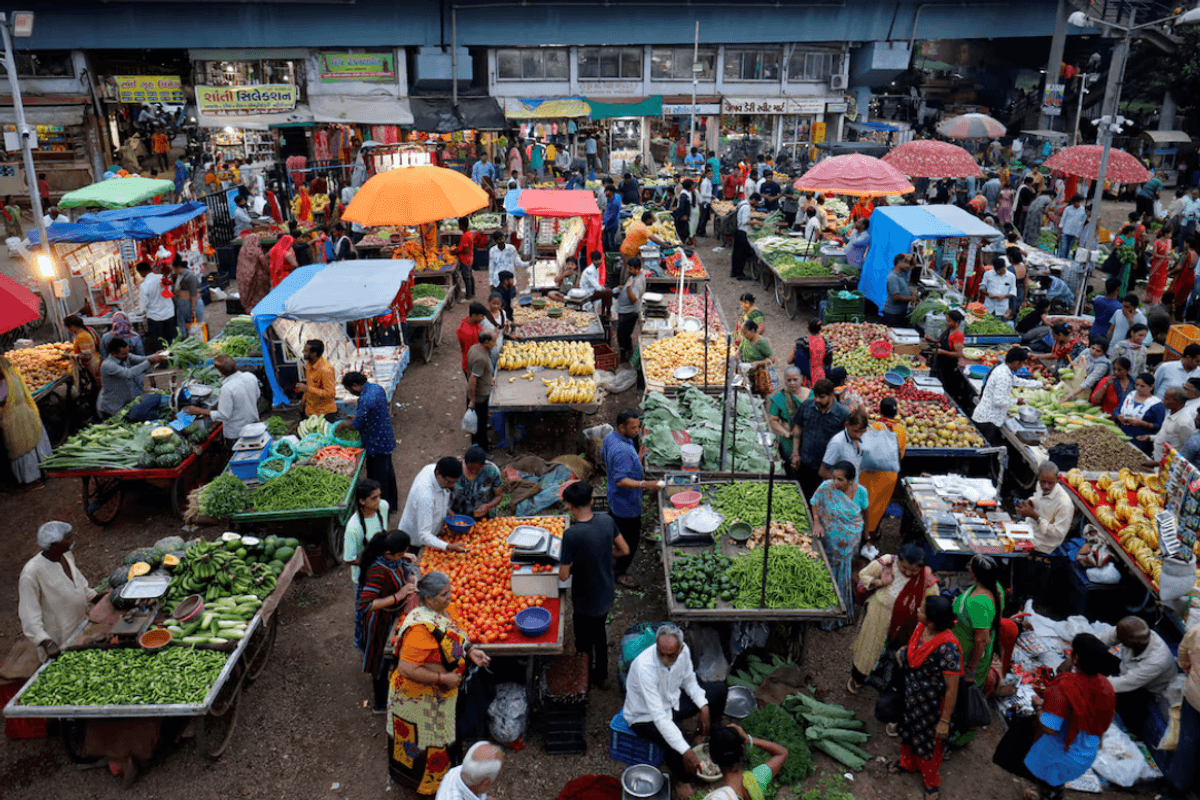
Customers buy fruits and vegetables at an open air evening market in Ahmedabad, India, August 21, 2023
Reuters
India’s latest federal budget reinforces expectations of gradual fiscal consolidation, with the government on track to meet its deficit targets despite lower projected tax receipts, according to an assessment by S&P Global Ratings.
The central government is expected to meet its fiscal deficit target of 4.4% of gross domestic product for fiscal year 2026, which ends on March 31, 2026. The budget also targets a deficit of 4.3% of GDP for fiscal 2027, levels that S&P said are broadly consistent with its own projections.
The ratings agency said India, which it rates BBB with a stable outlook, is likely to achieve its fiscal 2027 deficit target even after budgeting for lower Goods and Services Tax receipts following a streamlining of GST rates in September 2025. It said GST revenues could surprise on the upside due to stronger consumer demand and improved tax collection efficiency.
Additional support for meeting deficit targets could come from continued large dividend transfers from the central bank and the possibility of underspending on capital expenditure, S&P said.
India differs from many regional and global peers because its state governments also run persistently high deficits, the agency noted. It estimates aggregate state deficits at around 2.7% to 2.8% of GDP over the next three fiscal years. Combined with a gradual reduction in the central government deficit to about 3.9% of GDP by fiscal 2029, the general government deficit is projected to narrow to about 6.6% of GDP, from an estimated 7.3% in fiscal 2026.
S&P said it expects India’s economy to continue outperforming peers at similar income levels, with real GDP growth forecast at 6.7% in fiscal 2027 and 7% in fiscal 2028. Growth is expected to be supported by consumer spending and public investment, which should also underpin fiscal revenue gains.
Lower GST rates are likely to support middle-class consumption and complement recent income tax cuts, the agency said. As a result, consumption is expected to play a larger role in driving growth than investment in the current fiscal year and the next.
However, S&P cautioned that higher effective U.S. tariffs are weighing on the expansion of India’s export-oriented manufacturing sector. In response, the fiscal 2027 budget includes measures aimed at boosting manufacturing and exports. The agency said a potential trade agreement with the United States could reduce uncertainty and strengthen confidence, particularly in labour-intensive industries.
The government has maintained its focus on investment-led growth. Budgeted capital expenditure remains at 3.1% of GDP in fiscal 2027, unchanged from the previous year. When related spending such as grants to state governments and public enterprises is included, total capital outlays are expected to rise to 5.6% of GDP, from 5.1% a year earlier.
S&P said execution bottlenecks in infrastructure projects are likely to ease as global supply chain pressures moderate.
Fiscal 2027 will also mark a shift in India’s fiscal framework, with the government moving its primary performance anchor from deficit targets to the central government debt-to-GDP ratio. Authorities aim to reduce the ratio to between 49% and 51% by fiscal 2031, from 56% in fiscal 2026. The budget, however, did not specify a detailed deficit path under the new framework.




Comments
See what people are discussing