


News Desk
The News Desk provides timely and factual coverage of national and international events, with an emphasis on accuracy and clarity.
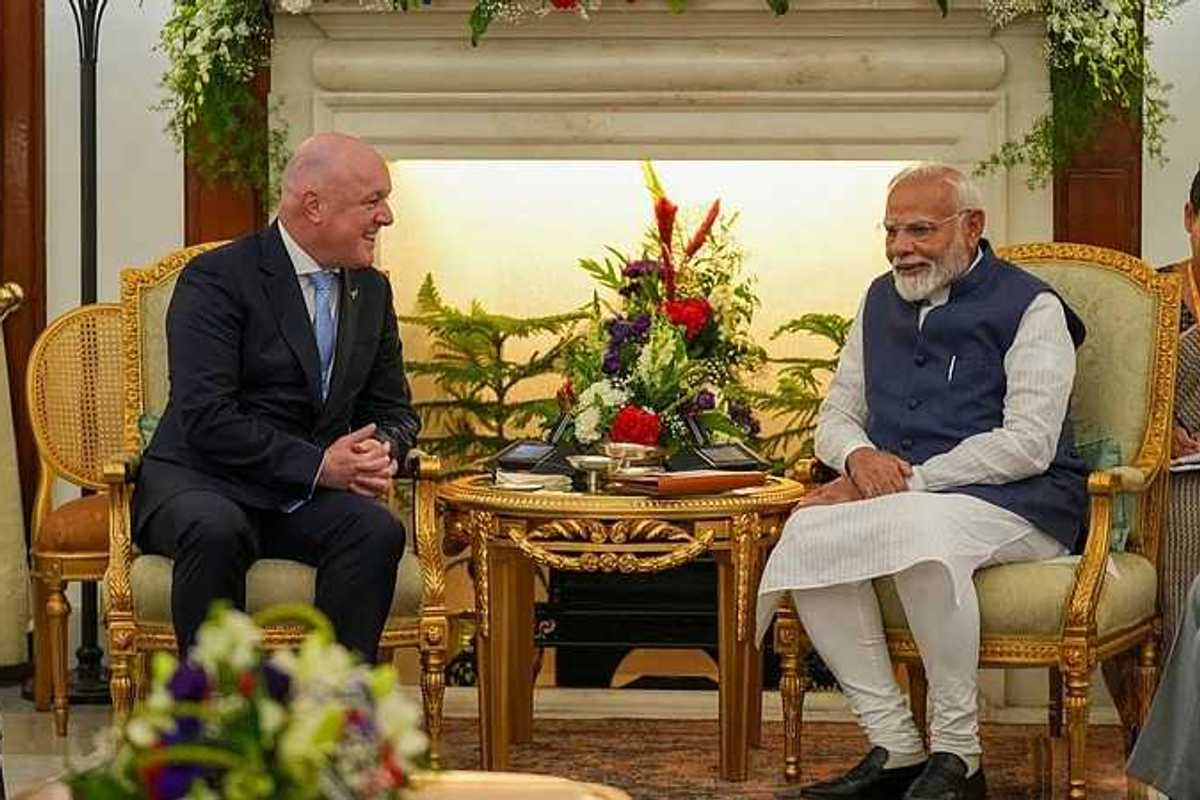
New Zealand Prime Minister Christopher Luxon in a meeting with Indian Prime Minister Narendra Modi during the latter's visit to New Zealand.
Courtesy: X/@chrisluxonmp
India and New Zealand announced a strategic partnership on Saturday covering defence, security, trade, and diplomacy, during a landmark visit by Prime Minister Narendra Modi to Auckland. The partnership was formalised at Government House alongside 18 bilateral agreements, with both countries setting a roadmap to double two-way trade by 2030.
What does the India-New Zealand strategic partnership include?
The strategic partnership covers tighter defence cooperation including naval exercises, stronger trade and diplomatic ties, and collaboration in culture, sport, and science. Both governments agreed to a long-term vision aimed at taking bilateral relations to a new level and set a target of significantly increasing annual trade. The two sides also reaffirmed their shared interest in a free, open, peaceful, and prosperous Indo-Pacific.
New Zealand Prime Minister Christopher Luxon welcomed Modi with an indigenous Maori ceremony and guard of honour at Government House in Auckland. Luxon said the partnership would provide "framework and breadth" for the relationship, while Modi described it as a milestone that would inspire "greater energy and confidence." Modi told the New Zealand leader that their shared democratic values made the two countries natural partners.
Why is Modi's visit to New Zealand significant?
It is the first visit by an Indian prime minister to New Zealand in 40 years, reflecting India's deeper diplomatic engagement in the Pacific at a time of growing Chinese influence in the region. Modi's New Zealand stop was the final leg of a July 6 to 11 tour that also took him to Indonesia and Australia. The visit comes days after China test-fired a ballistic missile into the Pacific Ocean, adding a layer of regional strategic significance to the trip.
New Zealand has a diaspora of around 300,000 people of Indian origin, and Modi is expected to address up to 10,000 supporters at a community event at Auckland's Spark Arena. A similar event in Melbourne drew nearly 30,000 attendees two days earlier. Luxon, who faces a general election in November, has framed the visit and the broader free-trade agreement with India as delivering jobs and economic benefits for New Zealand.
What controversy surrounded Modi's New Zealand visit?
The India-New Zealand free trade agreement, signed in April and awaiting parliamentary approval, has attracted pushback in New Zealand over provisions for easier immigration and visa access for Indian students and workers. New Zealand First minister Shane Jones drew widespread criticism when he told a local radio show he would never agree to what he called a "butter chicken tsunami" coming to New Zealand. An Indian community leader accused Jones of outright racism.
Prominent evangelical preacher Brian Tamaki drew even sharper condemnation. Ahead of Modi's arrival, Tamaki called on social media for New Zealand to "purge" Hindus, Sikhs, and Muslims and suggested burning places of worship. New Zealand's race relations commissioner described the comments as utterly appalling. Luxon responded by promoting a welcoming message for the visit, calling it a "winning partnership" that delivers prosperity and security for both countries.


Comments
See what people are discussing