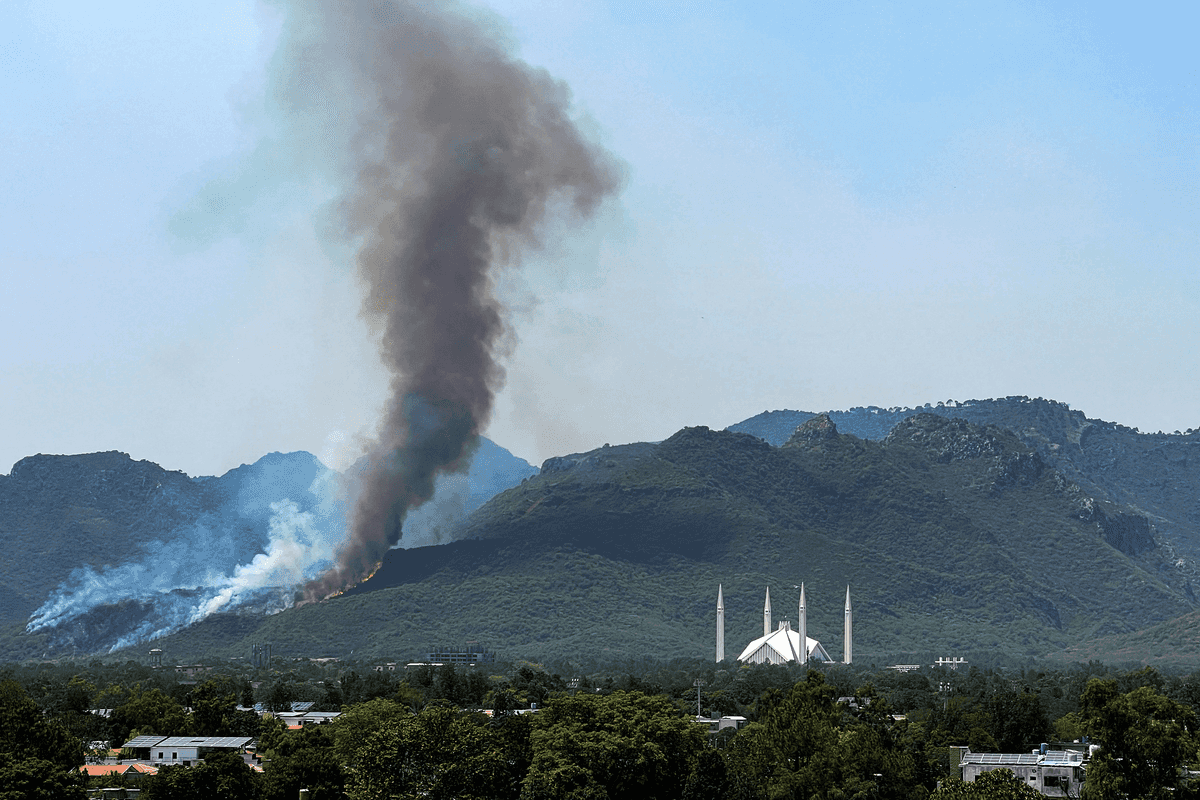
A fast-growing invasive plant is quietly fueling forest fires in one of Pakistan’s most iconic natural landscapes, experts warn, highlighting a growing environmental challenge in the region.
Lantana camara, an exotic shrub introduced to the country during the 19th century, now occupies large swathes of Margalla Hills National Park in Islamabad, contributing to a surge in wildfire incidents over the past two years.
According to a report presented by Pakistan’s Ministry of Climate Change to Parliament, the shrub’s dry branches and leaves are highly flammable, igniting easily and spreading rapidly under strong winds. Experts say its proliferation is altering the park’s ecology and amplifying fire risks in degraded areas.
Speaking to Nukta, Dr. Muhammad Saeed, Assistant Director of Research & Planning at the Islamabad Wildlife Management Board, explained: “Lantana camara is native to Central and South America. Its toxic chemicals deter native animals from feeding on it and suppress the growth of local plants. In Margalla Hills, roughly 20% of the park is infested, particularly in areas impacted by human activity. Lantana not only triggers frequent wildfires but also outcompetes native species after fires, causing further ecological damage.”
Dr. Saeed noted that the plant is also found in Punjab, Khyber Pakhtunkhwa, and across Islamabad. While it does provide food for certain birds and insects and absorbs carbon dioxide, its allelopathic properties—releasing chemicals that inhibit other plants—create serious ecological imbalance. Experts stress that controlling it requires sustained, carefully planned efforts.
The issue has become a central focus of the Margalla Healing Project, launched in 2024 to manage Lantana and restore native biodiversity. Over 20 acres have already been cleared, including areas like Trail 4, where volunteers and park authorities have removed the shrub and replanted indigenous species. The cleared Lantana is being converted into eco-friendly biofuel pellets for local communities.
Introduced by British gardeners for ornamental purposes in the mid-19th century, Lantana - locally called “Panj Phali,” “Pat Siapa,” or “Pardesi Booti” - grows rapidly after monsoons, is toxic to grazing animals, can trigger allergies in humans, and becomes highly flammable in summer.
Government data indicates that more than 70 fire incidents in Margalla Hills during 2023 and 2024 were exacerbated by the shrub.
Legislation such as the Islamabad Nature Conservation and Wildlife Management Act 2024 empowers the Islamabad Wildlife Management Board to protect the park, control fires, and regulate illegal activities. Officials say the Margalla Healing Project could expand to other forested regions, including Murree, Kahuta, and Azad Kashmir.
Experts caution that without immediate, coordinated action, Lantana camara could irreversibly disrupt Margalla’s delicate ecosystem, producing millions of seeds each year dispersed by birds and rainwater.
Authorities emphasize that public participation, scientific monitoring, and sustained restoration efforts are crucial to safeguarding one of Pakistan’s most treasured natural landscapes.
The Margalla Healing Project is being hailed as a model initiative, combining conservation, technology, and community engagement to tackle invasive threats and restore ecological balance.








Comments
See what people are discussing