

Iran to declare 'prohibited zone' near Strait of Hormuz, threatening sanctions on vessels
Iran's Supreme National Security Council announced plans to establish a "prohibited zone" in the Persian Gulf extending from the US Navy blockade line, warning that any ship entering the area will face Iranian sanctions

News Desk
The News Desk provides timely and factual coverage of national and international events, with an emphasis on accuracy and clarity.
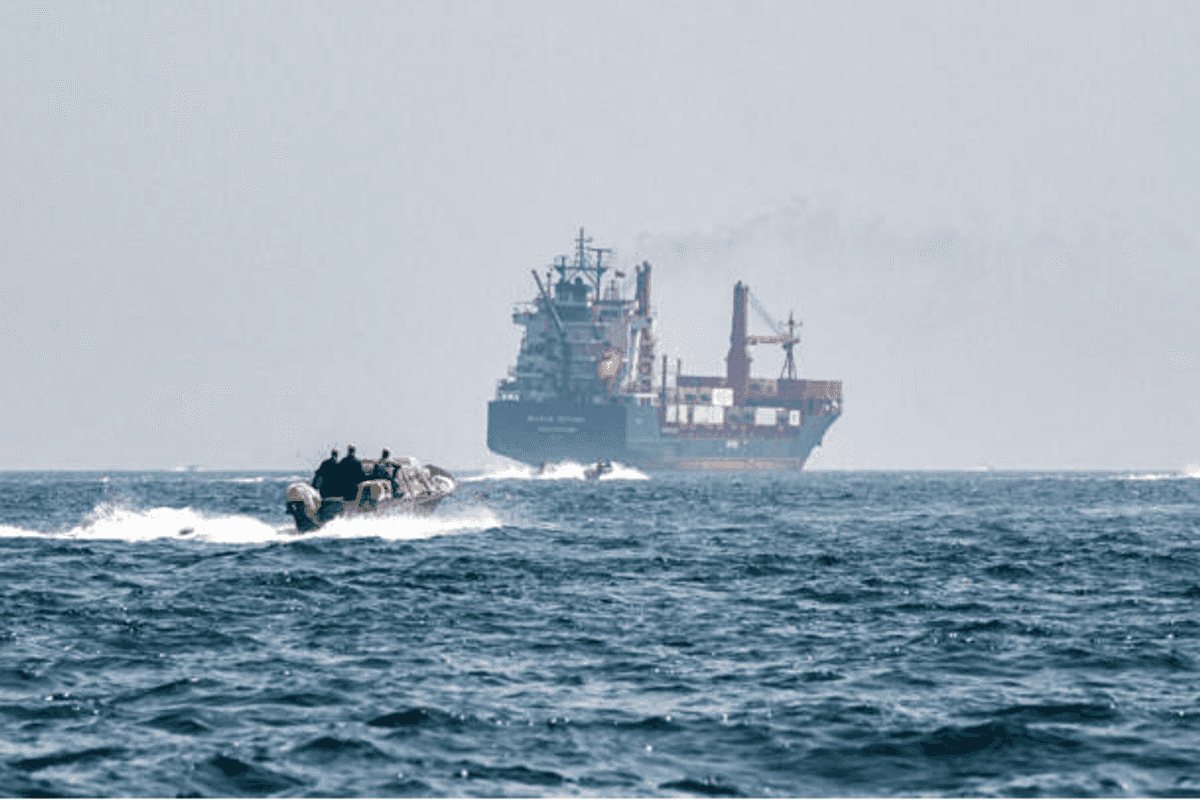
Iran will establish a maritime "prohibited zone" near the strategic Strait of Hormuz in the coming days, top national security official Mohsen Rezaei announced on Sunday, marking a significant escalation in Tehran's maritime strategy against the United States.
How will Iran enforce the new 'prohibited zone' in the Persian Gulf?
Speaking on Iranian state television, Rezaei explained that the restricted area will begin at the US Navy's blockade line and extend into broader sections of the Persian Gulf. "Any vessel entering this new zone will be placed on the sanctions list" of Iran, Rezaei warned, adding that Tehran is finalizing an agreement with Omani authorities to establish an updated international shipping corridor through the strait under Iranian operational oversight.
Rezaei declared the Strait of Hormuz "under the control of the armed forces", rejecting claims by Washington that commercial transit remains unimpeded. The security chief noted that while regular commercial flow has dropped from over 100 daily transits to single digits, Iran has purposefully avoided sinking target vessels to prevent catastrophic environmental damage in regional waters.
What warnings did Iranian leadership issue regarding further US military actions?
The announcement of the prohibited zone coincided with explicit warnings from Iranian Parliament Speaker and chief negotiator Mohammad Bagher Ghalibaf, who declared that "the era of proportionate responses has come to an end." Speaking in a broadcast carried by state media, Ghalibaf asserted that any future military action or aggression against Iranian interests would trigger an immediate, asymmetric, and "more painful response."
The heightened rhetoric follows weekend military engagements where the Islamic Revolutionary Guard Corps (IRGC) fired ballistic missiles targeting a US Navy aircraft carrier and guided-missile destroyer, though US Central Command (CENTCOM) reported both ships avoided damage.
What military exchanges preceded the prohibited zone announcement?
In direct retaliation for the missile launch, US forces conducted precision strikes destroying three Iranian oil tankers—identified by CENTCOM as the M/T Downy, M/T Stark 1, and M/T Kylo—which American officials labeled part of a "multibillion-dollar shadow network" funding the IRGC.
CENTCOM Commander Admiral Brad Cooper delivered a stern warning: "If you shoot at two of our ships, we will impose an even higher economic cost—taking out three of yours."
Following the loss of its tankers, the IRGC claimed to have struck three commercial vessels navigating unauthorized routes through the strait alongside three US-affiliated ships elsewhere in the Gulf.
As maritime traffic through the chokepoint dips to historic lows, US Energy Secretary Chris Wright stated on Sunday that Iran's naval capabilities are near exhaustion and that Tehran is "clinging on to power," even as President Donald Trump and Vice President JD Vance continue to downplay the severity of the six-month conflict as "small potatoes" ahead of domestic midterm elections.





Comments
See what people are discussing