

Israel faces political deadlock as Netanyahu and Eisenkot fall short of Knesset majority
Partial general election results in Israel have left both Prime Minister Benjamin Netanyahu’s right-wing bloc and Gadi Eisenkot’s opposition alliance well short of a 61-seat majority

News Desk
The News Desk provides timely and factual coverage of national and international events, with an emphasis on accuracy and clarity.
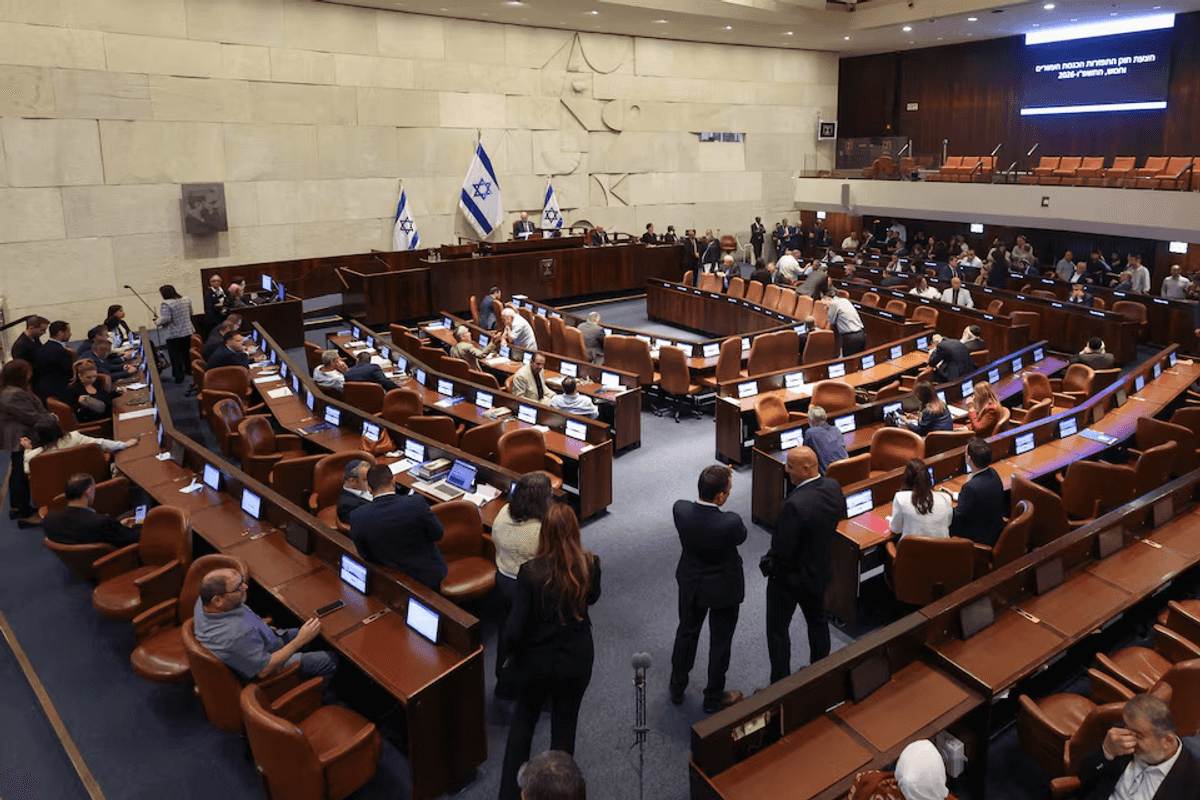
FILE: Israeli politicians react following a vote to dissolve the Knesset, Israel's parliament, before the end of its term, at the Knesset, in Jerusalem, May 20, 2026.
Israel was plunged into political uncertainty on Thursday, October 29, after partial general election tallies left Prime Minister Benjamin Netanyahu and his chief challenger, former military chief of staff Gadi Eisenkot, far short of a governing majority in the 120-seat Knesset.
How did the partial vote count leave both Netanyahu and Eisenkot short of a majority?
According to the BBC, with roughly 85 percent of regular ballots tallied by the Central Elections Committee, Netanyahu’s Likud party alongside its ultra-Orthodox and religious-nationalist allies was projected to secure 53 seats—eight short of the 61-seat threshold required to form a government.
On the opposing flank, Eisenkot’s centrist Yashar party and three aligned Zionist opposition factions were on track for 48 seats. The projection reversed early television exit polls that had briefly pointed to an opposition-led lead when voting booths closed on Tuesday night.
Why do Arab party gains create a kingmaker paradox amid allegations of fraud?
The parliamentary arithmetic is complicated by a historic performance by Arab-led factions, which are projected to secure an unprecedented 19 seats—nearly doubling their previous representation following high turnout among Arab citizens.
While the Arab lists mathematically possess the numbers to act as kingmakers and break the impasse, political red lines have largely prevented formal coalition building. Nearly every Jewish faction across the political spectrum—with the sole exception of Yair Golan’s Democrats party—has ruled out entering a formal coalition with or relying on external parliamentary backing from Ra'am or the Joint List.
The shift in parliamentary balance immediately triggered acute political friction. Netanyahu’s Likud party accused the Arab factions of having "stolen" the vote through alleged irregularities at polling stations, calling on the Israel Police and the Shin Bet internal security agency to open criminal inquiries. Those allegations were swiftly condemned by election integrity watchdogs and opposition lawmakers, who characterized the claims as a deliberate attempt to delegitimize the election outcome and undermine public trust in the democratic process.
How could absentee 'double envelopes' impact the outcome?
The final composition of the Knesset now hinges on between 430,000 and 480,000 uncounted absentee ballots, known as "double envelopes". These ballots—cast by military personnel, diplomatic staff stationed abroad, prison inmates, and hospitalized voters—traditionally tilt toward right-wing and security-aligned factions.
The Central Elections Committee confirmed that verifying and tabulating the double-envelope ballots will take up to two days before official, certified tallies are finalized and published.
Once the final figures are certified, President Isaac Herzog will host formal consultations with representatives of all elected parliamentary factions to determine which lawmaker has the clearest path to assemble a 61-seat majority before issuing an official mandate.
According to reporting by The Times of Israel and Haaretz, party negotiators have launched preliminary backchannel contacts behind closed doors as counting centers finalize the absentee vote tallies.





Comments
See what people are discussing