

JI Islamabad march will go ahead in mid-November, says Hafiz Naeem
JI chief Naeemur Rehman says the Islamabad march will go ahead in mid-November unless the govt abolishes the petroleum levy, even as both sides agree to form a joint committee to discuss economic relief

News Desk
The News Desk provides timely and factual coverage of national and international events, with an emphasis on accuracy and clarity.
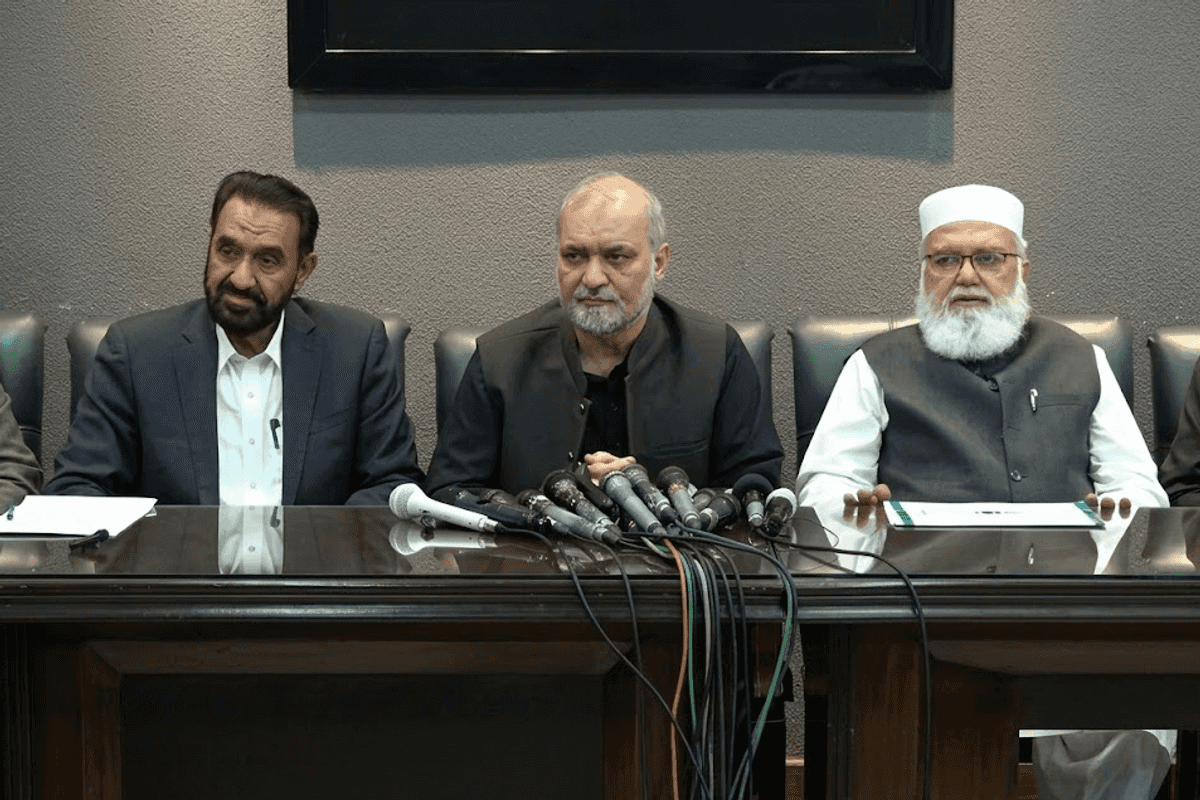
Jamaat-e-Islami chief Hafiz Naeemur Rehman said Tuesday that his party will not postpone its Islamabad march again, despite Prime Minister Shehbaz Sharif's request for more time.
The party demands the immediate abolition of the petroleum levy as fuel prices surge.
Will the Jamaat-e-Islami Islamabad march go ahead?
Yes, according to Rehman, who said the march will take place in mid-November. He told reporters after meeting Sharif that the party will not delay it further. The protest will proceed if the government fails to accept the party's demands.
"We will hold our march in mid-November, and we will not postpone it now," Rehman said.
However, the government and JI have now agreed to establish a joint committee to address public grievances and develop longer-term economic relief measures. Federal Minister Ahsan Iqbal said the six-member panel would comprise three government representatives, including Deputy Prime Minister Ishaq Dar, Rana Sanaullah and Iqbal himself, alongside three JI nominees.
What is Jamaat-e-Islami demanding on the petroleum levy?
Rehman said the government was proposing to phase out the petroleum levy, but his party wanted it abolished immediately. He claimed the levy generates 150 billion rupees ($540 million) in monthly revenue for the government. He described it as "extortion."
"Our position is clear and unequivocal: the levy must be abolished," he said, adding that Jamaat-e-Islami would do whatever it could if the levy was not removed.
اسلام آباد: امیر جماعت اسلامی پاکستان حافظ نعیم الرحمان وزیر اعظم سے پیٹرولیم لیوی کے حوالے سے ملاقات کے بعد اہم پریس کانفرنس میں ملاقات کی تفصیلات سے آگاہ کر رہے ہیں#لیوی_بھتہ_نامنظور https://t.co/aQ3yTUINKa
— Jamaat e Islami Pakistan (@JIPOfficial) October 27, 2026
Rehman said Sharif had asked the party for another seven to 10 days. He argued that people were already struggling with inflation. He said the party had held lengthy sit-ins and presented its demands to the prime minister during Tuesday's meeting.
Iqbal said the new committee would examine ways to extend existing government relief programmes to more deserving households and develop proposals for gradually phasing out the petroleum levy in the next federal budget. The government has therefore proposed a process for considering the party's demand, rather than the immediate abolition sought by JI.
Sanaullah said the government was already providing targeted assistance of 100 rupees per liter to eligible consumers, including users of motorcycles, rickshaws and cars with engines smaller than 800cc, to offset the impact of the 80-rupee levy. He said the relief program was expected to expand to cover 20 million people and welcomed JI's cooperation in improving assistance for low-income households.
Why are the government and JI urging political restraint?
Iqbal urged JI to reconsider its planned protest, saying political confrontation could undermine economic stability and weaken efforts to provide relief to the public. He described Pakistan as an "island of stability" amid conflicts in the Middle East and neighbouring regions, arguing that domestic political turmoil would work against the country's economic interests.
Sanaullah also called for political unity, saying internal stability would support the diplomatic efforts of the government and military leadership. He credited Prime Minister Shehbaz Sharif and the military leadership with helping ease tensions between the United States and Iran, encouraging better relations between Saudi Arabia and Iran, and countering efforts he said were aimed at dividing the Islamic world.
How did the Jamaat-e-Islami petroleum levy protest begin?
The party has demanded the levy's abolition for more than two months as fuel prices have surged amid conflicts in the Middle East. On Aug. 16, Jamaat-e-Islami announced sit-ins in provincial capitals and later called a nationwide strike for Sept. 3.
In early September, the government and the party agreed to form committees to recommend measures to reduce the levy. On Sept. 20, the party launched a march toward Islamabad, warning that its protest could turn into a campaign to oust the government if the levy was not abolished.
Why was the earlier Islamabad march suspended?
Two days later, Rehman suspended the march when the convoy had reached Multan, following a request from Sharif. The prime minister had assured the party that a meeting would be held to discuss its demands.
The party alleged last week that the government had made no further contact about the planned meeting. Rehman warned Monday that Jamaat-e-Islami would march toward the capital in mid-November if the prime minister did not abolish the levy.
The newly announced joint committee provides a channel for further negotiations, but the party has not withdrawn its demand for immediate abolition of the levy. Rehman's stated plan remains to proceed with the march unless the government meets JI's demands.



Comments
See what people are discussing