

Karachi crisis fuels debate over new administrative units
Kamran Khan says 18 years of PPP rule have left Karachi struggling with basic services

News Desk
The News Desk provides timely and factual coverage of national and international events, with an emphasis on accuracy and clarity.
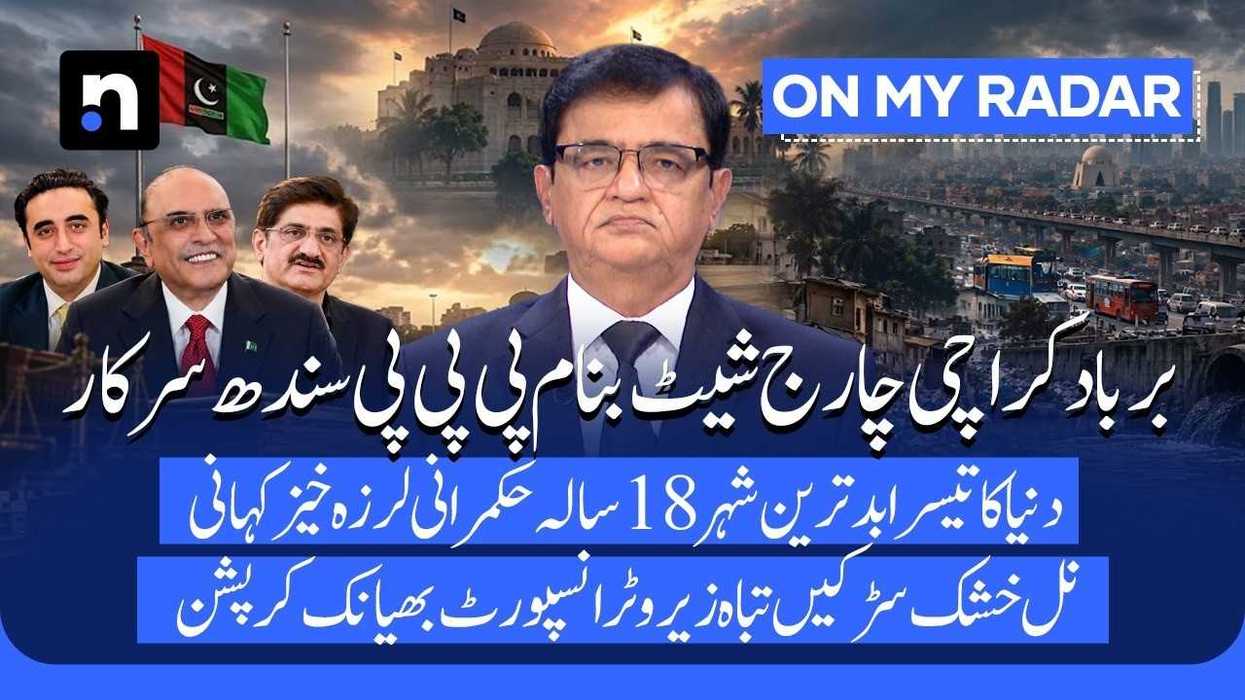
Kamran Khan has questioned the performance of Pakistan Peoples Party governments in Sindh after 18 years of continuous rule, arguing that Karachi’s worsening water, transport, security, health and infrastructure problems have strengthened the case for a new administrative structure.
In the latest episode of his “On My Radar” show, Khan said Karachi’s roughly 30 million residents, who he said contribute 95% of the Sindh government’s revenue, had a simple question for President Asif Ali Zardari, PPP Chairman Bilawal Bhutto Zardari and Sindh Chief Minister Murad Ali Shah: What should a city look like after a government has controlled its provincial finances and major institutions for 18 years?
“If any government gets not one year, not five years, not 10 years, but 18 continuous years to develop a city, has the provincial treasury in its hands, the police dancing to its tune, and water agencies, building control, transport, vehicle registration, government land, hospitals, municipal laws and development budgets all within its jurisdiction — in other words, a kind of continuous 18-year monarchy — what should the condition of that city be?” Khan said.
He said Karachi’s condition itself provided the answer, accusing the PPP-led Sindh government of failing to provide basic services despite its long tenure.
Khan began his “charge sheet” with Karachi’s water crisis. He said the K-IV water project, launched 24 years ago at an estimated cost of Rs25 billion, had grown to Rs172 billion without delivering the promised relief to residents.
Instead, he said, millions of Karachi residents remain dependent on private water tankers, turning water supply into a major business and what he described as a “whole economy.”
He next criticized the city’s vehicle registration and traffic systems, saying millions of cars and motorcycles have operated for decades with substandard, old or self-made license plates. He said delays in issuing new plates, problems with records and slow ownership transfers had undermined the system.
“A city where a vehicle cannot be correctly identified — how will crime and traffic be controlled?” Khan asked, describing Karachi as a “jungle of chaotic traffic” where many areas lack signals and traffic rules are openly violated.
Khan also criticized the failure to complete Karachi’s Safe City project, saying it had remained stalled for 17 years. While cameras have been installed in some areas, he said 80% to 90% of the city still lacks adequate surveillance, unlike Lahore and Islamabad, where Safe City systems have been operational for years.
Public transport was another major target. Khan said a city that once had a tram system and a circular railway now has only a limited number of buses for a population of about 30 million.
He said the Peoples Bus Service cannot meet even 1% of the city’s public transport needs and that Karachi still lacks a mass-transit network capable of effectively connecting the city.
Khan also criticized delays to the Red Line and Yellow Line mass-transit projects, saying the Red Line, launched in March 2022, had become a source of hardship for residents, businesses and traffic on University Road and surrounding areas. He blamed what he described as corruption, incompetence and mismanagement for the stalled projects.
On roads, Khan cited a briefing by Karachi Mayor Murtaza Wahab to the Sindh chief minister that identified about 315 internal roads as needing reconstruction, along with 60 major roads. He said billions of rupees had subsequently been announced for development but residents had yet to receive the promised improvements.
He also accused the provincial government of failing to maintain Karachi’s drainage system, saying encroachments had blocked storm-water drains and that the Supreme Court had assigned the cleanup of major drains to the National Disaster Management Authority.
“Eighteen years later, if the provincial government cannot manage the city’s drains, then what will it manage?” Khan asked.
Crime was another central concern. Khan said more than 64,000 street-crime incidents were officially reported in Karachi last year and that hundreds of people had been killed while resisting robberies.
“Bilawal Bhutto Zardari, Murad Ali Shah! Tell us, what is your police doing?” Khan said. “After your 18-year government, is a Karachi citizen still responsible for his own safety?”
He questioned why ordinary residents become concerned when they see police checkpoints while robbers continue to operate freely.
Khan described the alleged reuse of syringes at Kulsum Bai Valika Hospital in Orangi Town as the most disturbing item on his list. He said hundreds of children contracted HIV and accused the health system of failing to respond adequately.
“Do the citizens of Karachi have no right to live, that if they survive stray bullets on the streets, they should be killed by poisonous syringes in hospitals?” he asked.
He also accused the provincial government of failing to curb corruption, pointing to alleged land grabbing, manipulation of revenue records, bribery at registrar offices and illegal construction.
Khan said thousands of unauthorized structures, additional floors, subdivided properties and what is locally known as “China cutting” had turned Karachi into a dangerous concrete jungle. He also cited the identification by the Sindh Building Control Authority of 588 dangerous and dilapidated buildings, questioning why stronger action had not followed.
Fire safety was his 12th allegation. Khan said Karachi had failed to develop an effective firefighting system despite repeated disasters, including the Baldia factory fire and Gul Plaza incidents.
For a city of about 30 million people, he said, there are only 28 fire stations, 36 fire tenders and about 700 firefighters.
Khan said the overall picture was reflected in a ranking by The Economist, which he cited as placing Karachi fourth among the world’s worst cities and 170th among 173 cities assessed as difficult or undesirable places to live.
“This is not just a global ranking but a post-mortem of 18 years of Pakistan Peoples Party rule,” Khan said.
He argued that 18 years was enough time for a government to transform a major city, noting that an 18-year-old born when the PPP first took power in Sindh in 2008 would now be an adult.
“And Karachi?” he asked.
“Karachi is still buying water. Still looking for buses. Stuck in traffic jams. Protecting its mobile phone. And now Karachi is afraid to entrust even the lives of its children to the government system.”
Khan concluded: “Karachi is no longer asking for promises. Karachi is now asking for accountability.”
The discussion then broadened from Karachi’s governance failures to Pakistan’s debate over creating new administrative units.
Khan noted that the PPP-controlled Sindh Assembly had passed a resolution the previous week opposing any division of Sindh. But he said a contrasting position had emerged from the federal government.
Interior Minister Mohsin Naqvi, speaking Saturday at a National Policy Dialogue at the University of Management and Technology, said new administrative units would have to be created “at all costs,” according to Khan’s account.
Naqvi also said decisions on new provinces or administrative units should not depend on the wishes of a particular government, individual or political party, but on the people’s will. He said new administrative units would not threaten anyone’s cultural or political identity and that he would not retreat from that position regardless of who came to power or what happened to his own office.
Khan said the government’s position on a new administrative map appeared to be taking shape first in the federal capital. According to reports cited in the program, preparations had been completed to give Islamabad a form of provincial status or establish a new administrative framework.
A high-level special committee has submitted a draft to Prime Minister Shehbaz Sharif, Khan said. The proposal recommends a 27-member assembly for Islamabad and suggests that its chief executive could be called a chief minister or mayor, with the officeholder accountable to the elected assembly.




Comments
See what people are discussing