

KP plans sweeping reforms to restore security after governor’s rule
KP government drafts 100-day and 180-day action plans with 206 measures after governor’s rule They target security, services, economy and public trust

Kamran Ali
Correspondent Nukta
Kamran Ali, a seasoned journalist from Khyber Pakhtunkhwa, Pakistan, has a decade of experience covering terrorism, human rights, politics, economy, climate change, culture, and sports. With an MS in Media Studies, he has worked across print, radio, TV, and digital media, producing investigative reports and co-hosting shows that highlight critical issues.
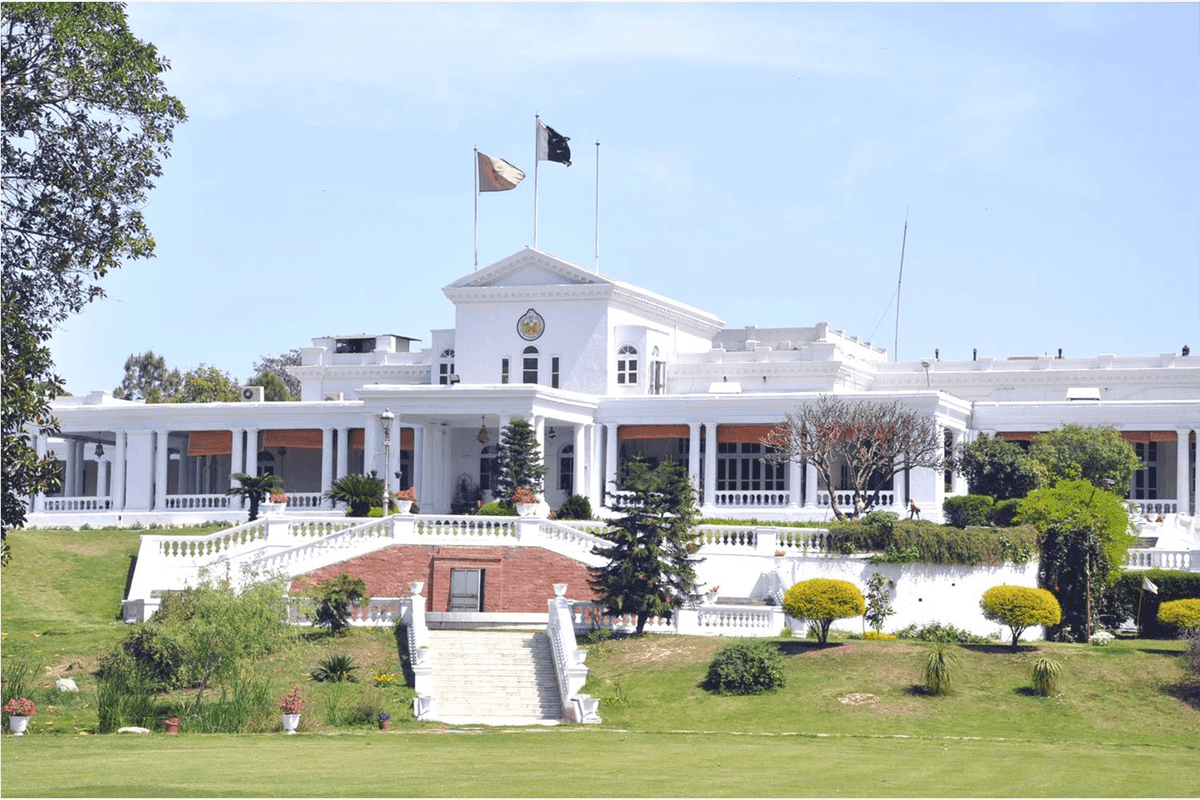
Khyber Pakhtunkhwa Governor House.
Courtesy: KP Govt
The government of Pakistan’s Khyber Pakhtunkhwa province has drawn up 100-day and 180-day action plans proposing 206 measures across 27 departments and all 37 districts, following the imposition of governor’s rule and a state of emergency on October 11.
The proposed plans aim to improve security, strengthen governance, upgrade public services and revive economic activity, with a particular focus on restoring public trust and accelerating socioeconomic development in the newly merged tribal districts.
According to a document prepared for the provincial chief secretary and obtained by Nukta, the measures are grouped into three categories: governance, socioeconomic development, and public trust and perception. Of the 206 proposed measures, 97 relate to governance, 55 to socioeconomic development and 54 to public trust and perception.
The document lists several possible names for the initiative, including Mustahkam Khyber Pakhtunkhwa, meaning Stable Khyber Pakhtunkhwa, and the Khyber Pakhtunkhwa 180-Day Strategic Action Plan.
Focus on basic services
A substantial part of the proposed program targets deficiencies in municipal services and public infrastructure. Measures include repairing around 150 major roads, covering 8,000 open manholes, improving sanitation at 4,000 locations, clearing about 150 blocked drainage channels and rehabilitating 80 parks across the province.
Healthcare reforms would include round-the-clock maternity services at 250 facilities, ensuring essential medicines are available at least 80% of the time, introducing digital attendance monitoring for staff and establishing independent oversight of 829 additional health facilities in the merged districts. The document also proposes transferring hospital management to private operators, although it cites different figures of 18 and 38 facilities.
In education, the plans propose upgrading 1,500 schools and addressing furniture shortages affecting about 700,000 students. They also envisage transferring 500 underperforming schools to private management and reopening damaged or non-functional schools in the merged districts. Rescue 1122 emergency services would be expanded in southern parts of the province.
Agriculture, energy and economic activity
The proposed measures also target rural livelihoods and economic development through climate-resilient orchards, expanded water storage, solar-powered agricultural tube wells, upgraded veterinary facilities and improved livestock and fisheries services.
The plans call for subsidised solar systems for 65,000 households and measures to improve miners’ safety and training. They also propose better tourism facilities and safety inspections at tourist attractions.
Digitalisation is another component of the programme. The government plans to bring 376 public services online, launch an Asaan Karobar business portal, introduce direct digital payments and use QR codes to collect public feedback.
Public engagement and monitoring
To improve communication between the government and residents, the proposals include district-level public liaison centres, weekly Pashto-language FM radio programmes, media monitoring and a dedicated unit to counter rumours. Monthly campaigns would highlight government performance, while other measures would address polio vaccination, food safety, flood warnings and public complaints.
Implementation would be tracked through digital monitoring systems at departmental and district levels, supported by a central dashboard using colour-coded indicators to measure progress against targets. The plans also envisage community committees, engagement with tribal elders and stronger mechanisms for addressing public grievances.
Separately, Khyber Pakhtunkhwa Governor Faisal Karim Kundi said the selection of local representatives and development council members was nearing completion. He said names chosen through jirgas, or traditional councils, following consultations had been forwarded to Prime Minister Shehbaz Sharif.
Kundi stressed that decision-making in the merged districts should reflect local voices, traditions and public trust.
According to official sources, the action plan is due to be presented to the provincial chief secretary on October 19. If approved, it will be forwarded to the governor for final approval before implementation begins.





Comments
See what people are discussing