


News Desk
The News Desk provides timely and factual coverage of national and international events, with an emphasis on accuracy and clarity.
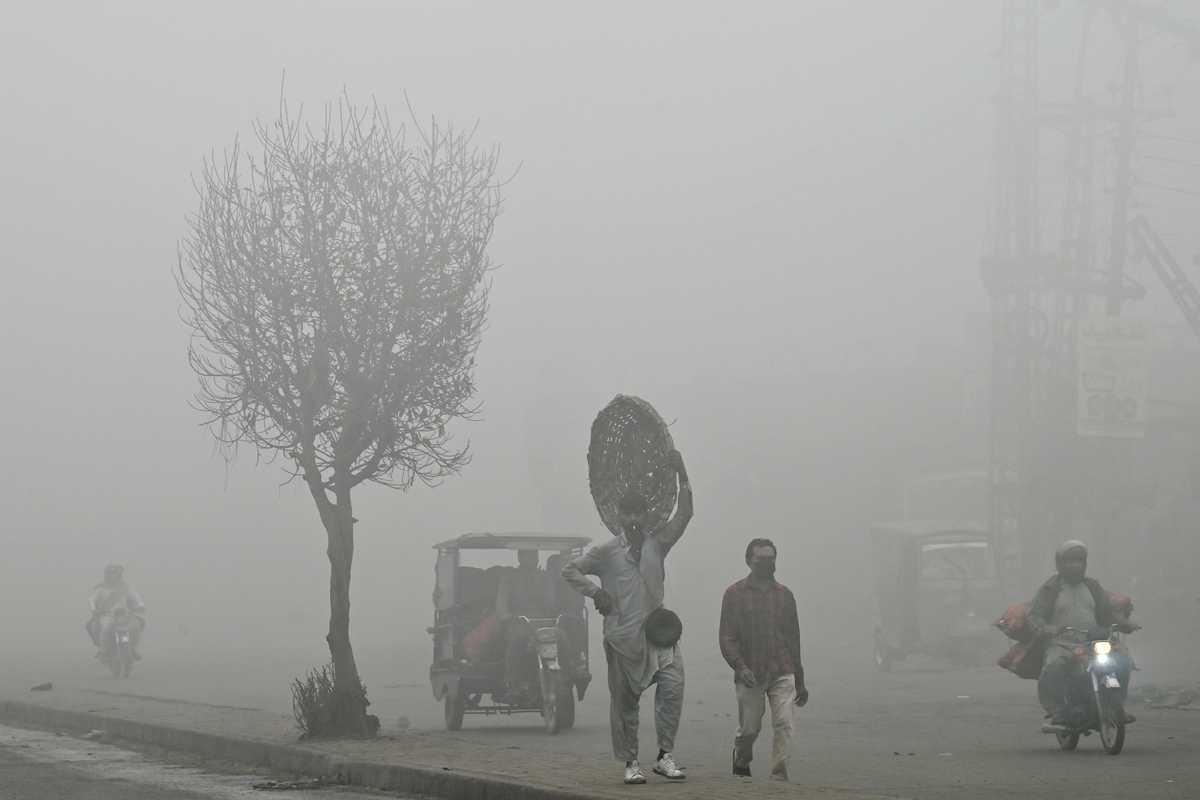
Pedestrians walk along a road engulfed in thick smog in Lahore, Pakistan.
AFP/File
Lahore recorded the highest air pollution levels among the world's major cities on Saturday morning, according to Swiss air quality monitoring company IQAir.
Its air quality index (AQI) touched 400 as smog continued to blanket parts of Pakistan's Punjab province.
Which city in Pakistan is the most polluted?
Lahore. IQAir placed the city first in its global ranking for major cities during the 9am to 10am period on November 28. Afghanistan's Kabul followed with an AQI of 304, while India's capital New Delhi ranked third at 238. Karachi recorded an AQI of 160.
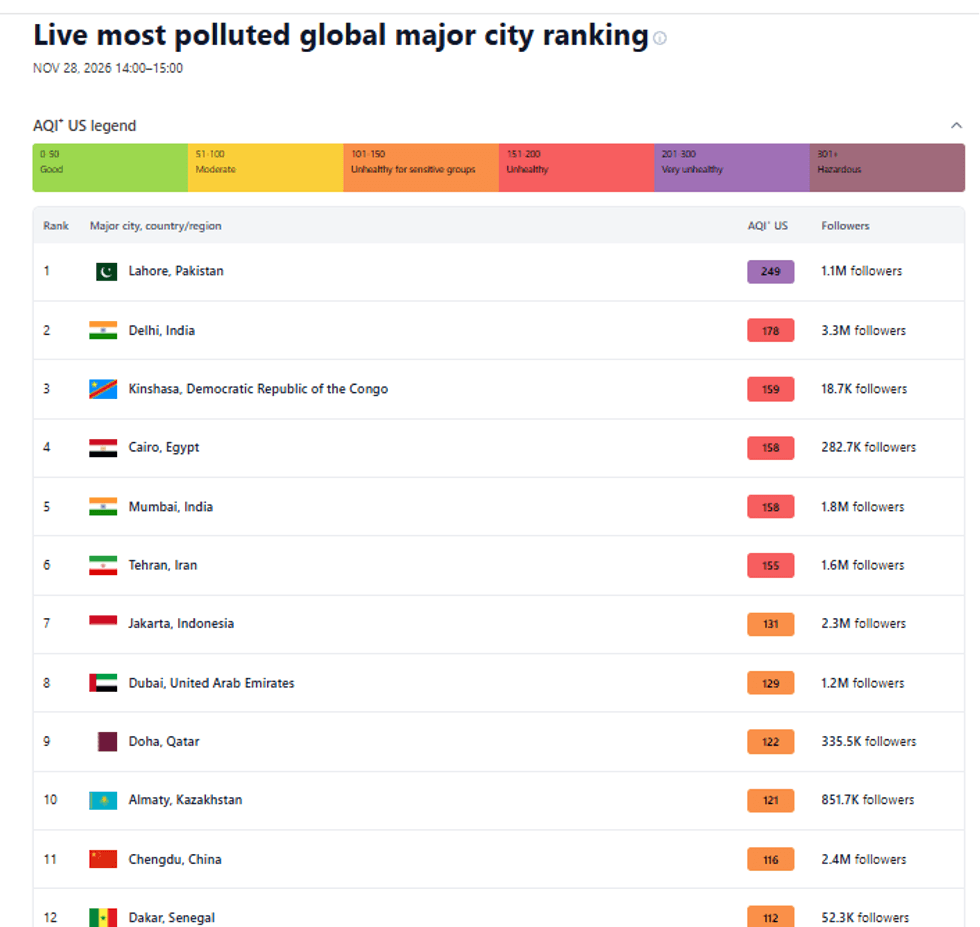
Other cities across the region also reported elevated pollution levels. Dubai recorded an AQI of 168, Kathmandu 166 and Kolkata 161. Cairo, Chengdu and Kampala were also among the 10 most polluted major cities in the ranking.
Pollution levels also differed sharply across Lahore. Individual monitoring stations in several neighborhoods registered readings considerably higher than the city's overall AQI.
What does an AQI of 400 mean for health?
An AQI reading of 400 falls within the hazardous range under IQAir's classification, which categorizes readings above 300 as hazardous. At these levels, exposure to polluted air can pose serious health risks to the general population. Children, older people and those with existing respiratory or heart conditions are particularly vulnerable.
The recurring pollution has raised concerns over the health impact of prolonged exposure to poor air quality. These concerns are strongest in densely populated urban centers across Punjab.
What causes smog in Lahore and Punjab?
Vehicle exhaust, industrial emissions and the burning of agricultural residue are among the major contributors to the region's air pollution. During winter, cooler temperatures and unfavorable atmospheric conditions can further aggravate the problem. These conditions limit the movement and dispersion of pollutants, allowing smog to accumulate closer to the ground.
Persistent smog continues to affect Lahore and other parts of Punjab. Deteriorating air quality has become a recurring problem there during the winter months.



Comments
See what people are discussing