

Makkah pact sparks debate in India over Pakistan’s growing regional role
Kamran Khan says the pact prompts India to reassess its regional strategy as Pakistan deepens ties with key Middle Eastern powers

News Desk
The News Desk provides timely and factual coverage of national and international events, with an emphasis on accuracy and clarity.
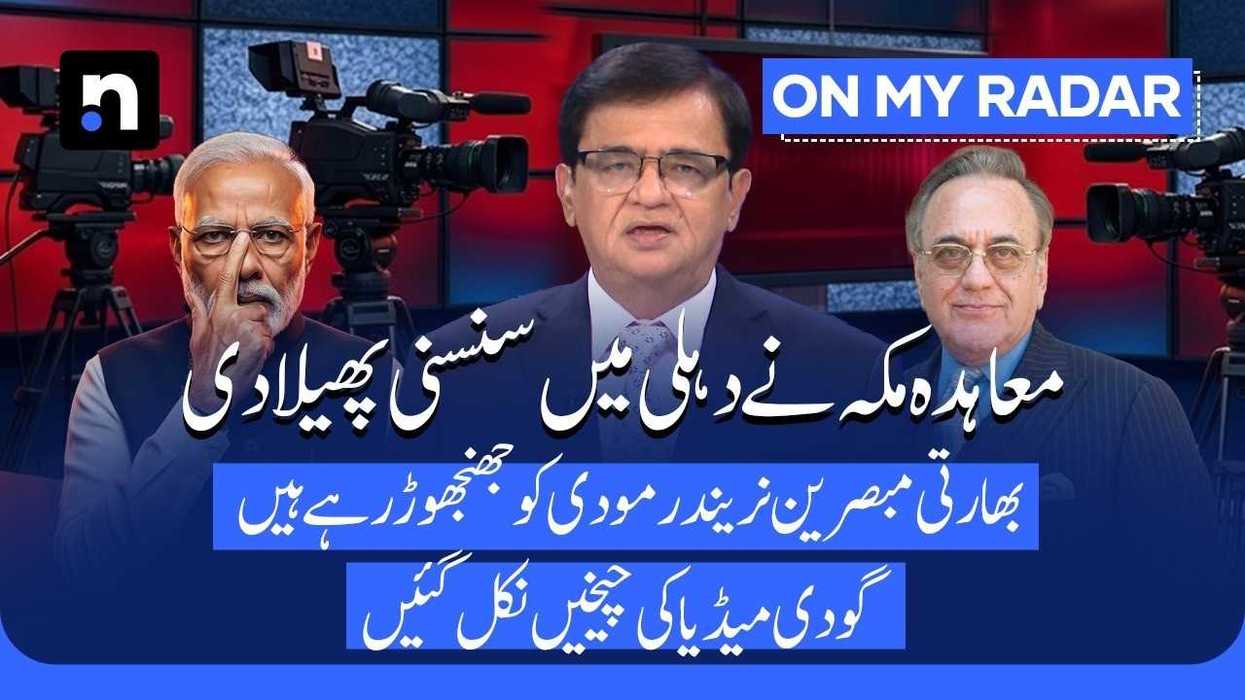
The Makkah Joint Defense Agreement between Pakistan, Saudi Arabia and Türkiye has triggered a debate in India over its potential implications for the regional balance of power, with Indian commentators divided over whether the pact represents a significant strategic setback for New Delhi or a development whose impact remains limited.
In the latest episode of On My Radar, Kamran Khan said the agreement could mark a new phase in defense cooperation between Pakistan, Saudi Arabia and Türkiye, with its significance extending beyond the immediate commitments outlined in the pact.
The agreement has received considerable attention in Indian media, with outlets including The Times of India, The Indian Express and ThePrint examining what the three-way security arrangement could mean for India’s strategic and diplomatic position in South Asia and the Middle East.
Some Indian commentators have argued that Pakistan’s expanded defense ties with Riyadh and Ankara could alter existing regional calculations. The agreement’s most significant provision treats an armed attack on any one of the three countries as an attack on all, although the publicly available details do not specify what military response the other members would be required to provide.
The development has also prompted questions about India’s broader regional strategy, including its proposed India-Middle East-Europe Economic Corridor (IMEC), with some analysts arguing that New Delhi needs to reassess its approach as Pakistan deepens its ties with key Middle Eastern powers.
Indian defense analyst Maj Gen Yash Mor said India would need to exercise caution following the agreement, arguing that the pact could create a new security and balance-of-power challenge for New Delhi.
Shishir Gupta, executive editor of Hindustan Times, has also described the agreement as a source of concern for India, arguing that Pakistan could emerge as its principal beneficiary.
Not all Indian commentators, however, share that assessment. Journalist Shekhar Gupta has sought to play down concerns over the pact, arguing that perceptions of an immediate threat to India are exaggerated and that much of the anxiety surrounding Pakistan’s growing influence in the Middle East remains concentrated on social media.
The agreement brings together three countries with distinct strategic strengths. Saudi Arabia has significant economic and energy resources and influence in the Arab world, Türkiye has a developed defense industry, while Pakistan has a large military and is the only nuclear-armed state among the three.
Its longer-term significance will depend on how the agreement is implemented and whether the three countries translate the framework into practical military coordination. For now, the pact has added a new dimension to Pakistan’s defense relationships with two influential regional powers and prompted a fresh debate over the evolving balance of power.



Comments
See what people are discussing