


News Desk
The News Desk provides timely and factual coverage of national and international events, with an emphasis on accuracy and clarity.

In this file photo, Balochistan Chief Minister Sarfraz Bugti addresses a press conference.
The Chief Minister of Pakistan’s Balochistan province, Sarfraz Bugti, said on Tuesday that the long-running issue of missing persons in the province has been “permanently resolved”.
The term 'missing persons' in Balochistan refers to allegations of enforced disappearances spanning decades, often involving ethnic Baloch and nationalist activists. Rights groups say many of those who vanished were allegedly abducted by security or intelligence agencies during counter-insurgency operations and never returned.
Official figures from the government-led Commission of Inquiry on Enforced Disappearances show the body received 10,636 complaints nationwide between March 2011 and September 2025. Of these, 8,986 cases have been disposed of, while 1,650 remain under investigation, the commission said in September 2025.
 X
X
Rights organizations, however, argue that the real number of missing persons is significantly higher and includes cases dating back to the early 2000s.
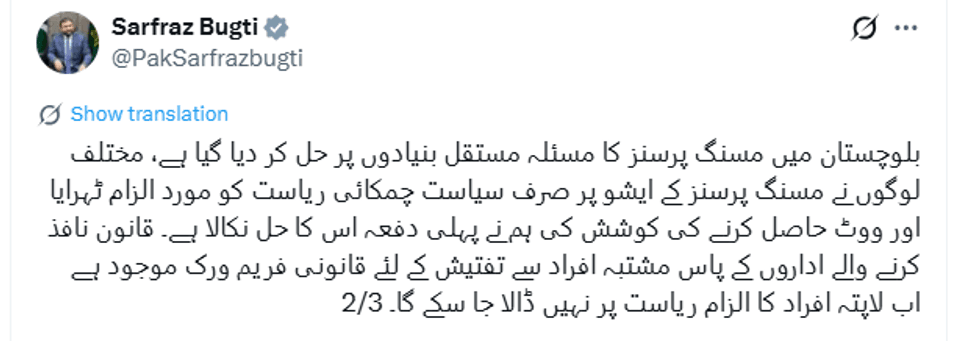
In a post on X after the provincial cabinet meeting, Bugti said those who previously raised the issue for political gain had blamed the state to win votes. “For the first time, we have introduced a concrete solution,” he wrote.
“Law enforcement agencies now have a legal framework to interrogate suspects, and allegations of enforced disappearances can no longer be directed at the state.”
Alongside his statement, Bugti announced that the provincial cabinet had approved the creation of two new administrative divisions - Pishin and Koh-e-Suleman - to improve governance in Balochistan, Pakistan’s largest and poorest province.
He said further divisions and districts were also being considered, adding that “only through good governance and merit-based policies can we address the grievances of the people of Balochistan and strengthen their connection with the state.”
The missing persons issue has long been a source of political tension and human rights concern in Balochistan, where nationalist groups have intermittently rebelled against the state, citing marginalization and economic neglect. Human rights organizations have documented alleged abductions and extrajudicial killings, criticizing authorities for a lack of transparency and accountability.





Comments
See what people are discussing