

Nepal and Tibet face massive rescue effort as flood death toll tops 1,000
With more than 4,400 people still missing, international rescue teams are using heavy drilling and blasting equipment to reach over 600 workers trapped in flooded hydroelectric tunnels along the Trishuli River

News Desk
The News Desk provides timely and factual coverage of national and international events, with an emphasis on accuracy and clarity.
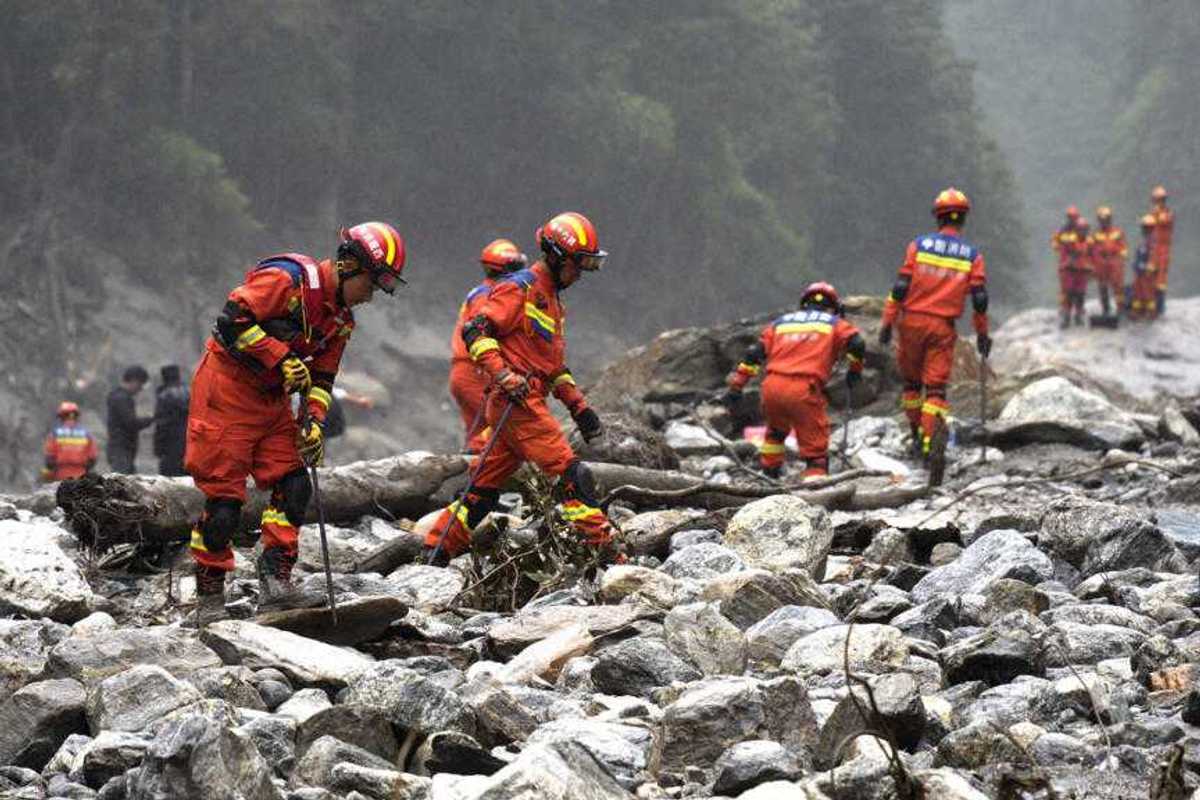
The death toll from last week's catastrophic glacial flash flood along the Nepal-China border has officially surpassed 1,000, with UN and disaster management officials warning on Wednesday that contact has still not been established with several remote mountain communities.
According to the BBC, across both Nepal and neighboring Tibet, more than 4,400 people remain unaccounted for following the August 26 disaster.
What caused the Himalayan glacial collapse?
According to scientific analysis released by the United States Geological Survey (USGS), the disaster was triggered at 08:37 local time (03:52 GMT) on Wednesday, August 26, when a massive high-altitude glacial collapse generated a magnitude 5.2 seismic event. The resulting avalanche of ice, rock, and mud surged down the Bhote Koshi and Trishuli river valleys in Rasuwa district, just north of Kathmandu.
A fresh scientific report highlighted by CNN revealed that the glacier showed visible signs of physical instability days prior to the collapse, including brown meltwater streams and expanding fissures in the surrounding bedrock. Geological monitoring units warn that glaciers surrounding the impact crater remain highly unstable and pose significant potential risk for secondary collapses and debris flows.
With emergency authorities confirming that over 4,400 people remain unaccounted for across Nepal and China's Tibet region, families who have exhausted search efforts at local mortuaries and shelters are turning to traditional rituals to mourn their lost loved ones.
Why are families turning to symbolic funerals, and what are the updated casualty figures?
Seven days after the August 26 disaster, disaster management agencies updated the combined cross-border death toll to 1,066. Officials in Nepal have recovered 1,050 bodies, while Chinese state authorities report 16 confirmed deaths in Tibet. Additionally, at least 17 bodies have been recovered along riverbanks downstream in neighboring India.
The total number of missing persons across the border region stands at 4,462, including 3,916 in Nepal and 546 in Tibet.
Facing overflowing mortuary capacity and rapid decay, Nepalese health officials have been forced to conduct mass burials of unidentified victims after taking DNA samples to facilitate future identification for grieving relatives. The emotional toll has led many families to execute symbolic cremation and religious rites without physical bodies to seek spiritual peace.
How are international rescue teams attempting to reach trapped hydropower workers?
Search and rescue operations are being spearheaded by an international coalition comprising Chinese and Nepalese military personnel alongside specialized tunnel rescue experts from India, South Korea, and Australia. The focus remains heavily concentrated on over 600 workers believed to be trapped inside mud-filled subterranean tunnels at 11 damaged hydroelectric power sites along the Trishuli River basin.
Nepali Prime Minister Balendra Shah confirmed that rescue crews have successfully extracted 279 individuals from the hydroelectric sites so far using air resources, heavy machinery, and controlled crown blasts to breach blocked access points. In total, the Nepalese Army and Nepalese Tourist Board report that 119 individuals were recently evacuated by air, including 118 Nepali citizens, and 330 foreign nationals have been rescued across affected zones.
What is the status of missing foreign nationals and international aid?
Consular officials continue tracking missing international tourists, trekkers, and pilgrims. The UK Foreign, Commonwealth & Development Office (FCDO) confirmed through Minister Lord Wood of Anfield that 36 British nationals remain unaccounted for in the region.
A UK rapid development team arrived in Nepal on Saturday to coordinate with the British Embassy and local authorities. The UK government offered a £5 million emergency assistance package to support Nepal's relief and reconstruction efforts.
Meanwhile, clarification was issued regarding initial military reports that British national Alastair Chambers was among those rescued by air; Chambers confirmed to media outlets that he was uninjured and had independently traveled to the affected district to assist local humanitarian relief operations.
With emergency supplies running low and weather conditions remaining volatile, international aid agencies are prioritizing airlifts, communication restoration, and DNA sampling for victim identification.
How is the Nepalese government framing international climate responsibility?
According to The Guardian, Nepali Prime Minister Balendra Shah renewed his critique of global climate policy in a statement published on social media, describing the disaster as a stark warning of accelerated cryosphere degradation across the Himalayas.
Shah asserted that because climate change is driven by global carbon emissions, disaster response, adaptation financing, and long-term reconstruction estimated to cost billions of dollars must be treated as a global responsibility shared by industrialized nations.




Comments
See what people are discussing