

One year in, Trump shattering global order
Trump’s aggressive second-term actions are reshaping global politics and sidelining decades of US-led institutions.

Razi Wani
Producer - News Desk
Razi Ud Din Ahmed Wani is a multimedia journalist and digital storyteller with a strong background in fact-checking, South Asian politics, documentary filmmaking, scriptwriting, and digital content production. With an MA in Mass Communication from the University of Karachi, he has experience directing and scripting web series and socio-political satires. And has worked across various media and digital platforms, focusing on emerging trends and storytelling formats.
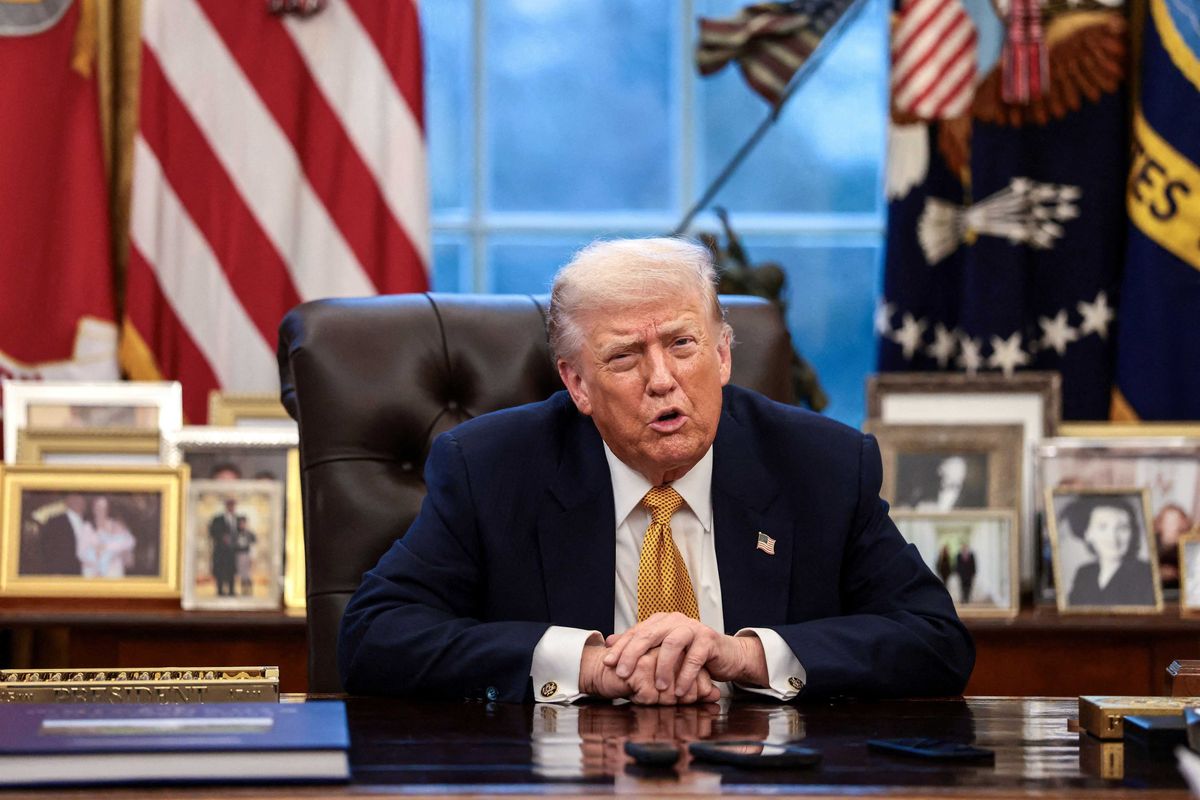
FILE: U.S. President Donald Trump is interviewed by Reuters White House correspondent Steve Holland (not pictured) during an exclusive interview in the Oval Office in the White House in Washington, D.C., U.S., January 14, 2026.
Reuters
One year into his second term, President Donald Trump is reshaping the global order built after World War II in ways that allies and adversaries alike say may prove irreversible.
Far from slowing down, Trump, who turns 80 in June, has opened the new year with a series of aggressive moves that openly challenge decades of U.S.-led international norms.
On Jan. 3, Trump ordered an attack on oil-rich Venezuela that left more than 100 people dead, according to U.S. officials, and resulted in commandos seizing leftist President Nicolás Maduro, a longtime U.S. adversary.
Since then, Trump has repeatedly threatened the use of force against both allies and rivals.
Escalating threats
The Republican president has intensified calls to seize Greenland from NATO ally Denmark and has warned of military strikes against Iran as the government there violently suppresses mass protests.
He has also floated military action in Colombia and Mexico, though he appeared to retreat after speaking with their presidents. Supporters say the pattern reflects Trump’s belief in coercive diplomacy, using threats to extract concessions without firing shots.
Trump has simultaneously discarded traditional diplomatic frameworks as he presses ahead with his “America First” agenda, including withdrawing the United States from dozens more United Nations bodies and international organizations.
“Many international organizations now serve a globalist project rooted in the discredited fantasy of the ‘End of History,’” Secretary of State Marco Rubio said, invoking the post-Cold War belief in a stable, democratic world order.
Force at home and abroad
Trump’s unapologetic embrace of force has extended to domestic affairs.
Led by Vice President JD Vance, the administration declined to express sympathy after a masked federal anti-immigration agent fatally shot a motorist in Minneapolis, instead deploying additional security forces.
Stephen Miller, the architect of Trump’s hard-line immigration agenda and now a key voice on foreign policy as deputy White House chief of staff, said the era of restraint was over.
“We live in a world, in the real world, that is governed by strength, that is governed by force, that is governed by power,” Miller said in a CNN interview.
No higher purpose
The United States was instrumental in creating postwar institutions such as the United Nations and NATO, alliances Trump has repeatedly criticized as unfair to American interests.
U.S. leaders have long faced accusations of hypocrisy, including during the 2003 invasion of Iraq under President George W. Bush, which bypassed the United Nations.
Analysts say the difference now is Trump’s open rejection of even rhetorical appeals to universal values such as democracy or human rights.
In Venezuela, where U.S. officials once branded Maduro illegitimate after disputed elections, Trump has dismissed the opposition and said he is prepared to work with Maduro’s vice president, now serving as interim leader.
Trump has said controlling Venezuela’s oil reserves is a priority and that the threat of force would be used to keep the country in line.
French President Emmanuel Macron warned that Washington’s approach risks ushering in an era of “new colonialism and new imperialism,” four years after Russia’s invasion of Ukraine.
“The United States is an established power, but one that is gradually turning away from some of its allies and breaking free from international rules that it was still promoting recently,” Macron said.
Lasting consequences
Melanie Sisson, a fellow at the Brookings Institution, said the United States historically achieved its goals without relying on conquest or invasion.
“We were generally able to get our way, more often than not, using other tools of influence, exercised through international organizations and alliances,” she said.
Even if European leaders hope for a revival of the liberal order, Sisson said Trump’s approach is likely to embolden other powers to pursue raw self-interest.
“I don’t think there’s going to be a reconstruction of the post-World War II international order as we might recognize it,” she said.
“That doesn’t mean some core principles couldn’t return, but Trump is reshaping international politics in a way that will be durable.”
One diplomat from a U.S. ally, speaking on condition of anonymity to speak candidly, said the moment was ripe for change, even if Trump’s methods are jarring.
Russia and Israel have both waged military campaigns with limited international pushback, the diplomat noted.
“It was clear that the global order wasn’t working, even if we pretended it was.”


Comments
See what people are discussing