

Is Pakistan's administrative map due for a rethink?
Kamran Khan says Pakistan's biggest governance challenge is its outdated administrative model, not a lack of resources

News Desk
The News Desk provides timely and factual coverage of national and international events, with an emphasis on accuracy and clarity.
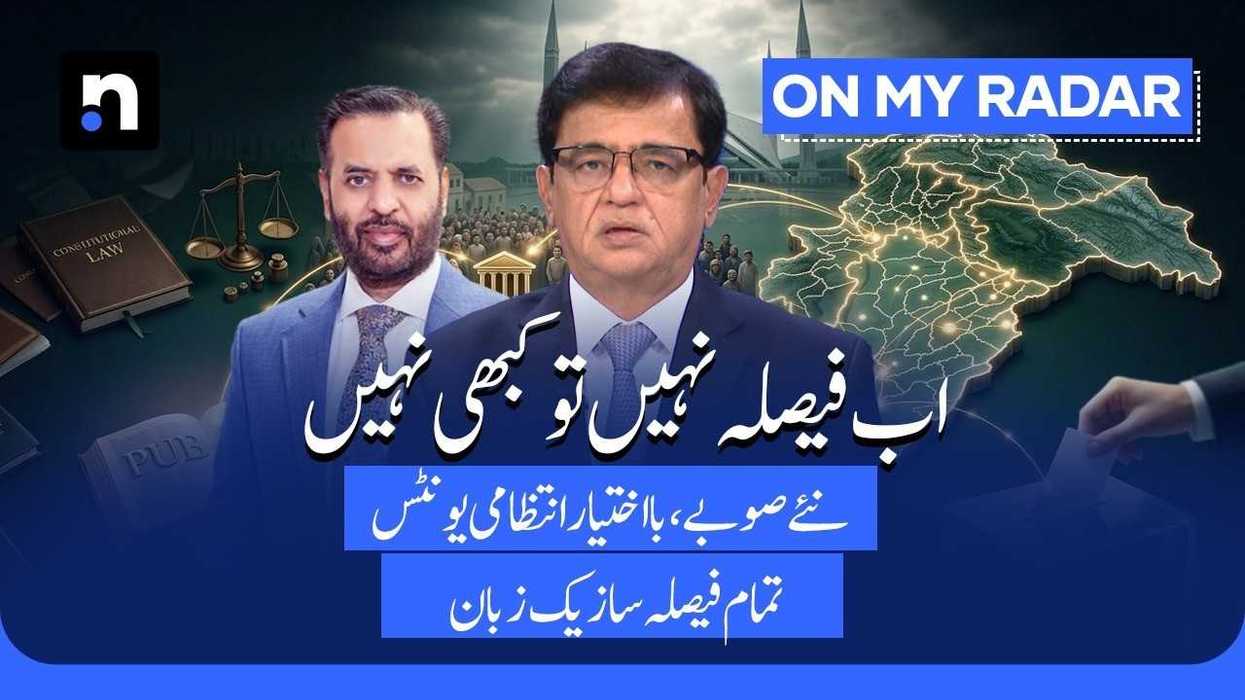
For decades, calls for creating new provinces in Pakistan have surfaced only to fade amid political disagreements. But that conversation appears to be entering a new phase.
With senior government and military officials publicly acknowledging the need to rethink the country's administrative structure, the debate has shifted from political rhetoric to a broader question: can Pakistan continue to govern a nation of more than 250 million people under a system designed decades ago?
In the latest episode of On My Radar, Kamran Khan argued that Pakistan's biggest governance challenge is not simply a lack of resources, but an outdated administrative model that no longer reflects the country's size, population, or growing urbanization. He noted that while the world has changed, Pakistan continues to operate under almost the same administrative map it inherited decades ago. Last week, that debate gained fresh momentum after Interior Minister Mohsin Naqvi and Director General ISPR Lieutenant General Ahmed Sharif Chaudhry publicly spoke about the need for new provinces or autonomous administrative units.
With a population exceeding 250 million, Pakistan remains divided into the same broad administrative structure despite decades of demographic growth and rapid urban expansion. Cities have grown, new economic centers have emerged, and public service demands have multiplied, yet the machinery of government has remained largely unchanged. As a result, the discussion on creating new provinces and autonomous administrative units is increasingly being viewed as a serious governance reform rather than merely a political slogan.
Pakistan is not the first country to face such a challenge. Around the world, several countries have restructured their administrative boundaries to improve governance and bring government closer to citizens. India offers one of the clearest examples. In 1956, it had 14 states. Today, it has 28 states and eight Union Territories.
Those changes were not made simply to redraw the map. Their purpose was to improve governance by decentralizing decision-making. Research on public administration consistently suggests that when authority is concentrated in a single capital, governments often struggle to respond efficiently to the needs of distant regions.
Pakistan provides several examples of this problem. Residents of Hyderabad, Mirpurkhas, Sukkur, Larkana and Tharparkar often have to travel to Karachi to resolve even routine administrative matters. People in South Punjab have long argued that major decisions affecting their region are made in Lahore. Similar complaints are regularly heard in southern Khyber Pakhtunkhwa and the remote districts of Balochistan, where many believe government remains too distant from the people it serves.
Pakistan's Constitution also supports greater decentralisation. Article 140A requires provincial governments to establish local governments with political, administrative and financial authority. Yet, despite being a constitutional obligation, the provision has never been fully implemented, leaving local governments without the powers originally envisioned.
The demand for new provinces or autonomous administrative units has existed for decades, but successive governments have failed to build lasting political consensus around the issue. This time, however, both political leaders and the establishment appear more willing to engage with the debate. While obstacles remain, including opposition from the Pakistan Peoples Party, public support continues to grow. An ARY News poll conducted across several social media platforms found that between 70% and 97% of respondents favoured the creation of new provinces.
The larger issue, however, goes beyond redrawing provincial boundaries. The real challenge is building a governance system in which decisions are made closer to the people, allowing citizens to access public services without travelling hundreds of kilometres to a single administrative centre. Whether through new provinces, autonomous administrative units, or meaningful devolution of power, the central question remains the same: how can Pakistan build a state that is more responsive to the needs of its people?





Comments
See what people are discussing