

Pakistan’s documented businesses struggle to survive amid cash economy surge
Kamran Khan says that without tax reform and regulation of the undocumented economy, Pakistan’s future will be shuttered shops and silent factories

News Desk
The News Desk provides timely and factual coverage of national and international events, with an emphasis on accuracy and clarity.
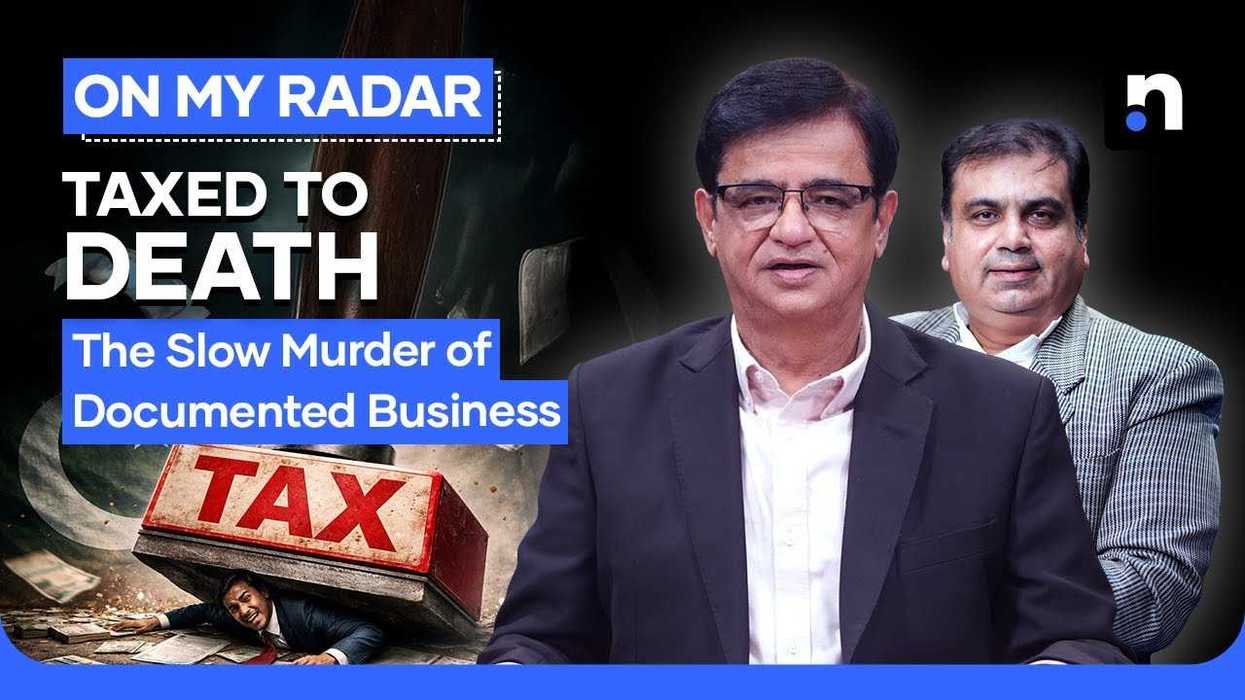
Pakistan’s business landscape is facing an unprecedented crisis. Documented businesses - those that operate within the formal legal and tax framework - are finding it increasingly difficult to survive, while a parallel cash economy continues to thrive unchecked.
From retail stores to real estate, a significant portion of commercial activity happens outside the tax net, creating an uneven playing field that favors undocumented operations.
As Kamran Khan highlighted in the latest episode of On My Radar, the reality today is that honesty in business has become a liability in Pakistan. Those who follow the law are facing mounting financial pressure, while the cash-driven shadow economy grows stronger every day.
This, he explained, is evident in recent high-profile incidents, such as a massive property deal in Karachi completed entirely in cash, with truckloads of money brought by the buyer - a major retail grocery chain owner. Such transactions, he noted, are no longer rare anomalies but daily occurrences in today’s Pakistan.
The formal economy is under severe strain. Businesses that comply with the law face rising tax rates, high operational costs, and regulatory burdens. Following a Federal Constitutional Court decision, the corporate tax rate has effectively risen from 29% to 39% after including the supertax, and with advance taxes, withholding taxes, and provincial levies, total tax obligations can reach up to 58%.
On top of this, companies must bear additional costs such as minimum wages, social security contributions, EOBI, and expensive utilities. In contrast, undocumented businesses operate freely, paying no taxes and issuing no receipts, giving them a clear cost advantage.
This imbalance is particularly damaging in the retail sector, where profit margins are already thin. Price-sensitive consumers, especially amid high inflation, are naturally drawn to the lower-cost offerings of undocumented operators. The recent closure of Carrefour’s largest store in Dolmen Mall, Karachi, illustrates this crisis: it was not merely a branch closure but a clear signal that the documented retail model can no longer operate profitably in Pakistan.
Statistics underscore the scale of the challenge. According to the Bureau of Statistics, only 700,000 out of 3.7 million retail outlets are part of the tax net. Consequently, while government expenditures continue to rise, the number of compliant taxpayers remains limited, placing a disproportionate burden on law-abiding businesses.
An Ipsos survey suggests that if even a few key sectors began paying taxes, up to one trillion rupees could be added annually to the national treasury. The real estate sector alone loses nearly 500 billion rupees per year in untapped taxes. Meanwhile, the salaried class contributed 606 billion rupees in taxes last fiscal year—265% more than the 166 billion rupees paid by traders.
The burden of taxes and rising costs has forced many international companies to scale down or exit Pakistan. Shell and Total Energies have reduced operations, Honda and Suzuki have shut assembly plants, and Procter & Gamble and Unilever have downsized their operations. While companies officially cite currency crises, import restrictions, and uncertain tax policies as reasons, the underlying problem remains that documented businesses are no longer competitive against the thriving shadow economy.
Economic data reinforces the severity of the situation. Net foreign direct investment fell 43% to $808 million between July and December of the current fiscal year, while investors withdrew $613.8 million in portfolio investments during the same period. Experts estimate that roughly $400 billion of Pakistan’s economy operates undocumented—nearly equal to the country’s GDP.
Supertaxes, advance taxes, delayed refunds, and high corporate levies have crippled cash flow for documented businesses. As Kamran Khan emphasized, “In today’s Pakistan, the more transparent and honest a business is, the greater its financial vulnerability. Honesty has become a burden rather than an advantage.”
If decisive steps are not taken to expand the tax net, regulate the undocumented economy, and ensure a level playing field, Pakistan’s future may belong not to thriving businesses but to shuttered shops, empty malls, and silent factories. The pressing question is no longer why businesses are closing but whether the state still wants to see honest businesses survive.



Comments
See what people are discussing