

Why Pakistan’s economic gap with India is widening
Kamran Khan says Pakistan must face the hard truth that, despite its strong defense capabilities, it falls far behind India economically

News Desk
The News Desk provides timely and factual coverage of national and international events, with an emphasis on accuracy and clarity.
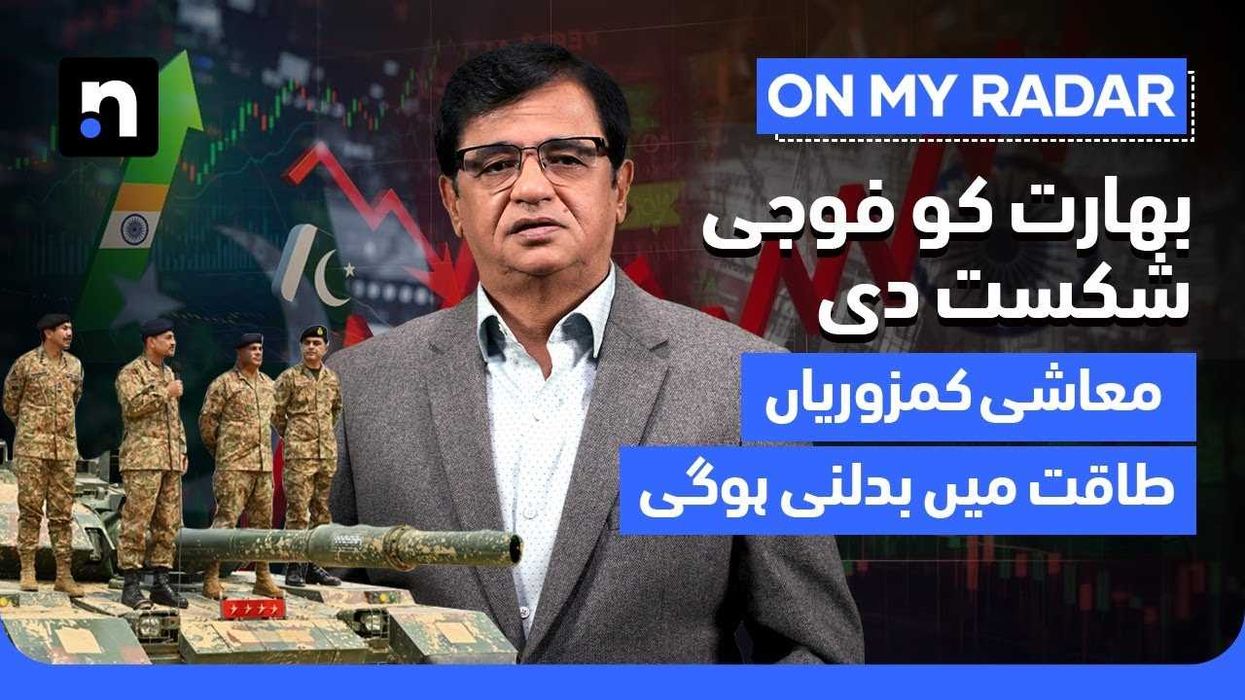
Pakistan’s military strength and strategic deterrence remain a source of national confidence, but the country’s growing economic weakness poses a far greater long-term challenge, senior journalist and analyst Kamran Khan said, warning that national security can no longer be viewed in isolation from economic stability.
In the latest episode of On My Radar, Kamran Khan said Pakistanis must confront a difficult reality: while the country has proven itself a credible hard power and a responsible nuclear state, it has fallen dangerously behind its regional rival India on the economic front. He stressed that military success alone cannot sustain national power without a strong and resilient economy.
Khan noted that Pakistan’s armed forces, which gained global recognition after defeating India’s much larger military on the battlefield in May 2025, have ensured that the country’s defense remains secure. However, he cautioned that this strength masks deep structural weaknesses in the economy that threaten long-term stability.
Drawing a comparison with India, Khan said the economic gap between the two neighbors has widened dramatically over the past 25 years. Once comparable, the two economies now differ sharply in size, scale, growth and global influence. India’s economy currently stands at around $4.2 trillion, compared with Pakistan’s $400 billion, making it more than ten times larger.
He pointed out that India is now the world’s fifth-largest economy, while Pakistan ranks around 40th. Even more striking, Khan said, is the fact that the combined market capitalization of just one Indian business group—Tata—exceeds Pakistan’s entire GDP.
Khan highlighted growth trends as another area of concern. India’s GDP growth is expected to remain between 6.5 and 7 percent, while Pakistan’s is projected at around 2.8 percent. Over the past four years, Pakistan’s average growth rate has remained close to 1.6 percent, reflecting persistent economic stagnation.
Per capita income figures further underline the gap. According to Khan, an average Indian earns about $2,820 annually, compared with $1,707 in Pakistan, a difference that directly affects purchasing power and living standards. India also maintains a healthier debt-to-GDP ratio of 57 percent, compared with Pakistan’s 70.2 percent, placing a heavier debt burden on Pakistani citizens.
Foreign exchange reserves, he said, reveal one of the starkest contrasts. India holds reserves of over $560 billion, while Pakistan’s stand at under $20 billion, leaving Islamabad far more vulnerable to external shocks and currency pressure. The disparity is reflected in exchange rates, with the dollar trading near 280 rupees in Pakistan compared with about 90 Indian rupees.
Khan also drew attention to exports and foreign investment. India’s total exports of goods and services reached $824 billion last year, nearly twenty times Pakistan’s $40.4 billion. India attracted $81 billion in foreign direct investment, while Pakistan received just $2.5 billion, much of which was offset by capital outflows. He noted that recent multi-billion-dollar investment commitments by major US technology companies further demonstrate global confidence in India’s economy.
The consequences of this divergence are visible in employment and social indicators. India’s unemployment rate stands at 3.2 percent, compared with 7.1 percent in Pakistan. In education, India consistently outspends Pakistan, invests more heavily in research and higher education, and ranks significantly higher on global university and research indices.
These trends show that India has prioritized long-term investment in education, technology, research and human development, while Pakistan has remained trapped in cycles of political instability, weak governance and economic volatility.
He argued that Pakistan’s competition with India cannot be limited to the battlefield and must extend to science, technology and global markets. While Pakistan’s defense strategy has relied on smart deterrence and efficient use of limited resources, Khan said only a strong and self-sustaining economy can secure the country’s future defense and development needs.
Khan said Pakistan’s real victory over India will come not through military dominance alone, but through economic self-reliance and stability. How the current leadership responds to this challenge will ultimately shape how this period is judged by history.





Comments
See what people are discussing