

Pakistan’s economy at a critical crossroads as investment plummets
Kamran Khan says declining local and foreign investment could permanently weaken Pakistan’s industrial base without urgent reforms

News Desk
The News Desk provides timely and factual coverage of national and international events, with an emphasis on accuracy and clarity.
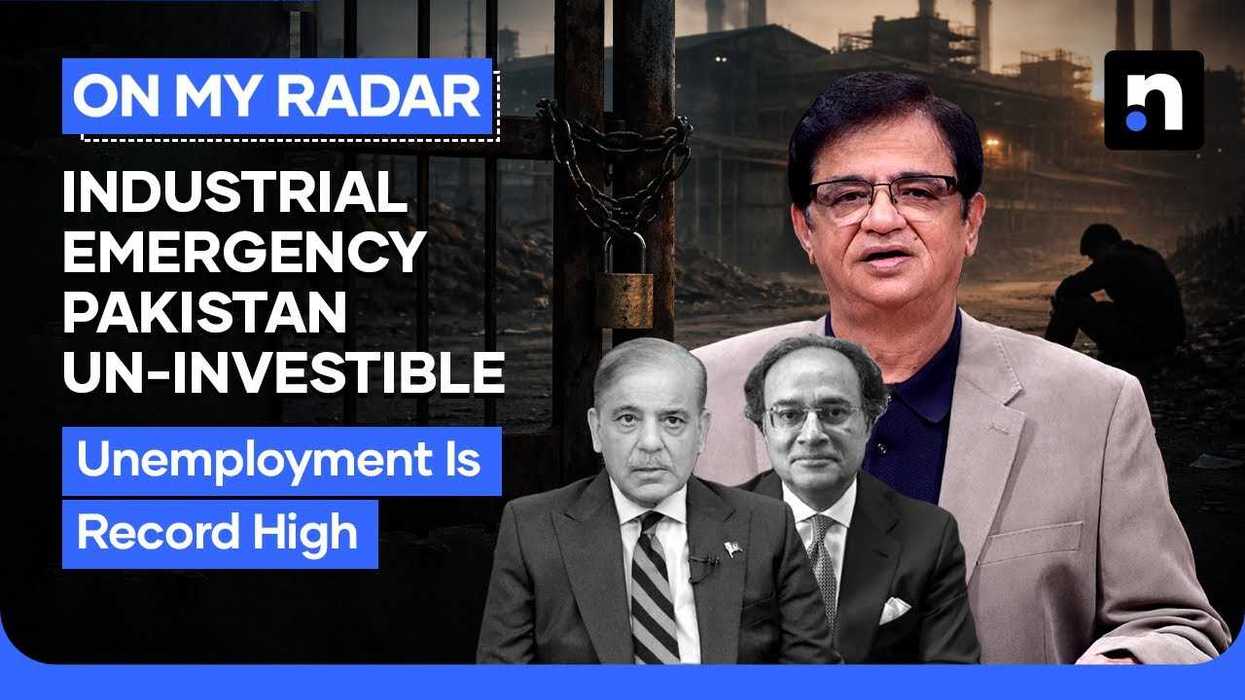
Pakistan’s economy is facing a deepening crisis, with a growing perception that the country has become un-investible. While the government continues to promote a narrative of macroeconomic stabilization, the ground reality shows a shrinking manufacturing base, falling foreign investment, and rising unemployment.
This disconnect has prompted Pakistan’s largest business body, the Federation of Pakistan Chambers of Commerce and Industry (FPCCI), to demand an industrial emergency, warning that the country’s manufacturing sector is on the verge of a structural collapse that may prove irreversible.
In the latest episode of On My Radar, Kamran Khan talked about the severity of the situation. He said that Pakistan’s economic indicators show a sharp decline in both local and foreign investment, and he warned that unless urgent reforms are implemented, the country risks losing its industrial capacity permanently.
The demand for an industrial emergency is not without reason. In recent months, the country has witnessed the closure of 150 textile units, more than 100 spinning mills, and over 400 ginning factories. Multinational companies are exiting rapidly, and deindustrialization is accelerating. This trend has contributed to an increasingly bleak investment environment, with both local and foreign investors losing confidence.
The numbers paint a stark picture. During the first half of the current fiscal year (July–December 2025), Pakistan received only $808 million in foreign direct investment (FDI) - a decline of 43% compared to the previous year.
Over the past six years, private investment in the manufacturing sector has also nearly halved, dropping from PKR 706 billion in 2019 to PKR 377 billion in 2025. At the same time, the unemployment rate has risen to 7.1%, the highest level in 21 years, indicating that joblessness is becoming increasingly unmanageable.
The International Finance Corporation (IFC) estimates that Pakistan needs to raise its investment-to-GDP ratio to 25–30% to achieve sustainable growth. However, the ratio has remained below 15% for the past five years, and in 2025 it fell to just 13%, the lowest level since 1973—a 52-year low. In comparison, Bangladesh’s investment-to-GDP ratio has averaged 32%, and Vietnam’s 38% over the same period.
A key factor behind the decline is Pakistan’s high energy costs. Electricity and gas prices are among the highest in the region, with industrial electricity bills reaching approximately PKR 34 per unit and gas tariffs at PKR 3,900 per MMBTU. Under such conditions, it is understandable that foreign investors are leaving and local investors are avoiding new investment. The demand for an industrial emergency appears increasingly justified.
During a recent seminar titled “Dialogue on Economy”, Lieutenant General Sarfaraz Ahmed, National Coordinator of the Strategic Investment Facilitation Council (SIFC), pointed to the high tax burden as a major barrier to investment. He argued that until income tax rates are reduced and the “super tax” on the corporate sector is abolished, new investment in manufacturing will remain unlikely.
The “un-investible” label is particularly troubling because Pakistan is not a small or weak economy. It has a population of 250 million, with 65% under the age of 35, and a strategic geographic location that gives it global importance. Over the past two years, inflation has fallen significantly and interest rates have been reduced by more than 100 percentage points. Pakistan’s stock market has been one of the best-performing markets globally, delivering 52% returns in rupee terms and 49% in dollar terms last year. Despite these positives, investment has failed to rebound.
The core issue, analysts argue, is structural economic problems rather than political instability. High energy tariffs, a heavy tax burden, rising cost of production, regulatory uncertainty, and an inefficient business environment have all undermined competitiveness. Investors face lengthy processes, including NOCs from multiple government departments, and frequent policy changes that increase risk. Karachi’s industrial infrastructure, once a symbol of economic activity, has deteriorated into a warning sign of decline.
The demand for an industrial emergency reflects deep-rooted economic challenges. If these structural issues are not addressed urgently, Pakistan risks further deindustrialization, escalating unemployment, and continued capital flight - solidifying its image as an “un-investible” country.



Comments
See what people are discussing