

Pakistan military says armed forces 'prepared' as it marks anniversary of 2025 conflict with India
Military detailed cyber, air and multi-domain operations against India on the first anniversary of the 2025 conflict, claiming power disruptions and aircraft kills

News Desk
The News Desk provides timely and factual coverage of national and international events, with an emphasis on accuracy and clarity.
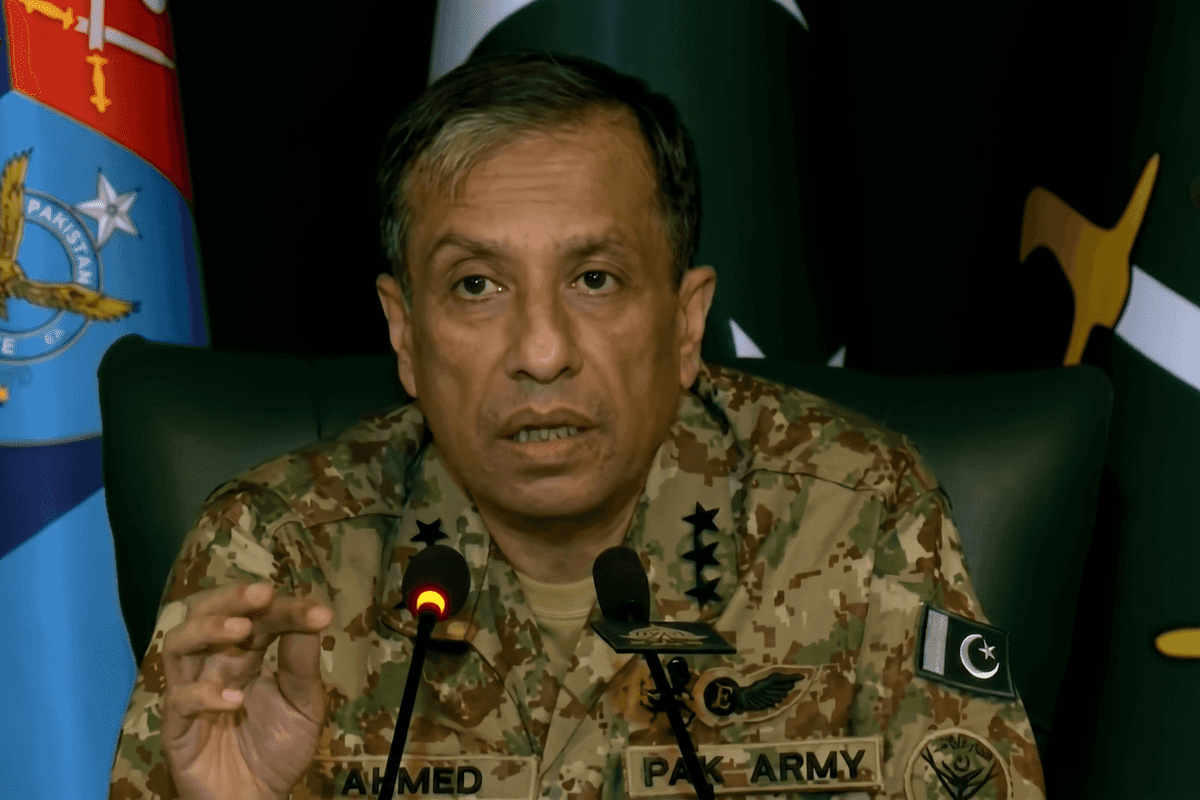
Lt. Gen. Ahmed Sharif Chaudhry, director general of Inter-Services Public Relations, addresses a press briefing in Islamabad on May 7, 2026.
Screenshot
Pakistan's military spokesperson said Thursday that the country's armed forces were "prepared" for future conflict, as officials marked the first anniversary of last year's four-day confrontation with India.
The press conference in Islamabad detailed what Pakistan described as cyber, air and multi-domain operations conducted during the fighting, which involved missiles, drones, artillery exchanges and air engagements.
What did Pakistan's military said about the 2025 conflict with India?
Pakistan's military said it conducted cyberattacks on Indian power grids, communication hubs and transport infrastructure, causing widespread disruption.
Air Force aircraft, including J-10 and F-16 jets, intercepted Indian strike formations while electronic warfare disrupted Indian coordination.
Officials claimed multiple Indian aircraft were shut down within minutes, calling the engagement the largest beyond-visual-range air battle in history.
What triggered the 2025 India-Pakistan conflict?
The confrontation erupted after India blamed Pakistan-based militants for an April 22, 2025 attack in Pahalgam, in Indian-administered Kashmir, that killed 26 civilians, most of them tourists.
Pakistan denied any involvement and called for an independent investigation. India launched cross-border strikes on May 7 under "Operation Sindoor," saying it had targeted militant infrastructure inside Pakistan and Pakistan-administered Kashmir.
- YouTube www.youtube.com
Pakistan said civilian areas were struck and responded with "Operation Bunyan-un-Marsoos," targeting Indian military installations.
The fighting became the most serious confrontation between the two nuclear-armed neighbors in decades before a US-backed ceasefire was announced on May 10, 2025. Pakistan refers to the episode as "Marka-e-Haq," meaning "Battle of Truth."
What did Pakistan's military spokesperson say at the anniversary briefing?
Lt. Gen. Ahmed Sharif Chaudhry, director general of Inter-Services Public Relations, said the conflict demonstrated Pakistan's capacity for multi-domain warfare across land, air, sea, cyber and information domains.
He highlighted what he called "homegrown" military capabilities, including missiles, drones, anti-drone systems, artillery and electro-optical satellites. "We are prepared; if anyone wishes to test us, they are more than welcome," he said.
Chaudhry also outlined what he described as the "strategic consequences" of the conflict, accusing India of escalating tensions based on false allegations and criticizing Indian political and military leadership.
He accused India of supporting militant activity against Pakistan from Afghan territory, an allegation India has denied.
What cyber and air operations did Pakistan's air chief describe?
Air Chief Marshal Zaheer Ahmed Babar Sidhu said the Pakistan Air Force's cyber force launched offensive operations targeting Indian communication hubs, power grids and transport infrastructure, causing power disruptions across multiple Indian states and at key military installations.
He said the confrontation demonstrated the integration of cyber, electronic warfare and drone capabilities developed through four to five years of military modernization. "What the world witnessed in May 2025 was not achieved overnight," Sidhu said.
Sidhu described the air engagement as a "full-spectrum, multi-domain operation" and said Pakistan used drones, hypersonic missiles and long-range weapons to strike 16 Indian air bases and military facilities.
He claimed BrahMos missile sites, command and control centers and two S-400 air defense batteries were neutralized. Air Vice Marshal Tariq Ghazi separately said Pakistan achieved confirmed kills of multiple Indian aircraft, including four Rafale jets.
What role did the Pakistan Navy play during the conflict?
Rear Admiral Shifaat Ali said the Pakistan Navy maintained uninterrupted maritime operations throughout the conflict and remained prepared to respond to any escalation in the Arabian Sea.
"We want peace, but that is not our weakness," he said.
Chaudhry echoed that message, saying: "Anyone who thinks there is space for war between two nuclear neighbors is crazy."



Comments
See what people are discussing