

Pakistan’s political crisis demands consensus, not another round of confrontation
Kamran Khan says Pakistan’s political crisis is part of a broader challenge as the state enters a phase of institutional and administrative overhaul

News Desk
The News Desk provides timely and factual coverage of national and international events, with an emphasis on accuracy and clarity.
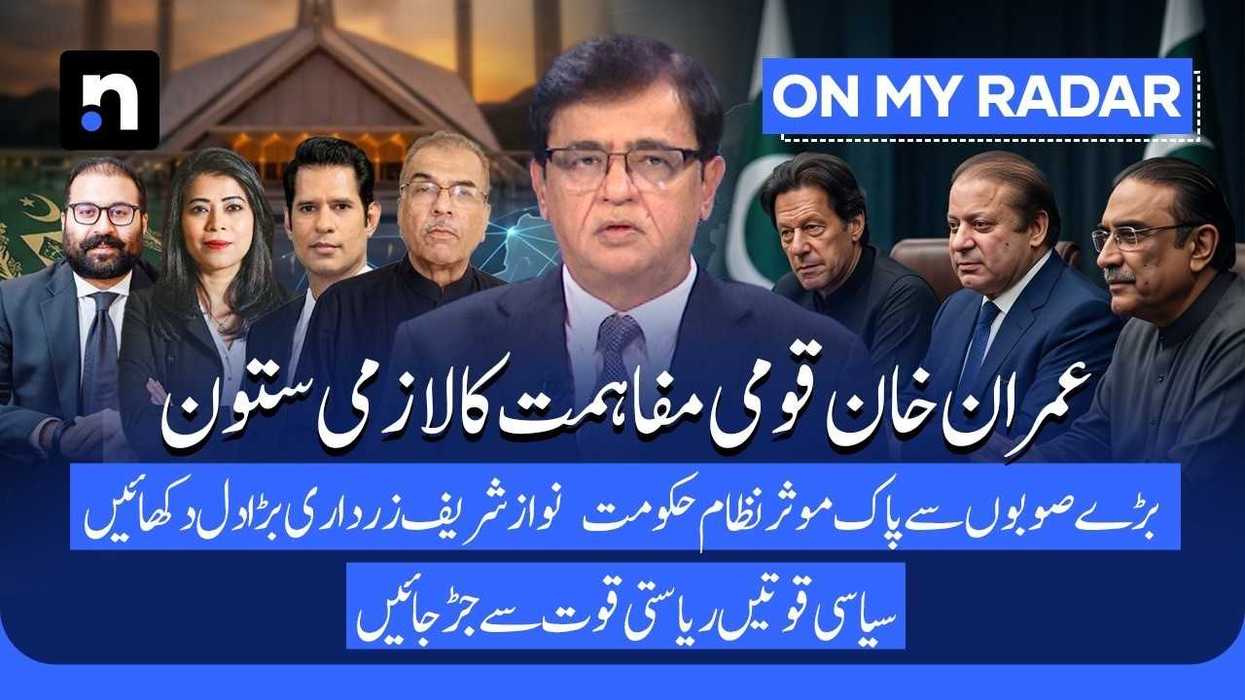
Pakistan’s political deadlock is increasingly colliding with a broader question about the future of its governance system, as pressure grows for administrative and constitutional reforms that would require support well beyond the ruling coalition.
With the government facing differences with its key ally, the Pakistan Peoples Party (PPP), and the opposition Pakistan Tehreek-e-Insaf (PTI) remaining a major political force, any meaningful restructuring will likely depend on broader political consensus.
Kamran Khan said in the latest episode of On My Radar that Pakistan’s political crisis was only one part of a much larger challenge facing the country. He said the state had entered a phase of institutional and administrative overhaul in which major decisions could no longer be deferred. A dysfunctional governance system, oversized provinces and weak local governments, he argued, were creating a need to rethink how the country was administered.
Such changes, however, cannot be driven by a single political party. They would require legislation, constitutional amendments and, most importantly, agreement among major political stakeholders. National reconciliation, therefore, is becoming less a political aspiration and more a prerequisite for any significant restructuring of the system.
The growing distance between the PPP and the ruling coalition has added another layer of uncertainty, particularly as questions emerge over parliamentary support for potentially major constitutional changes. At the same time, PTI and its founder, former prime minister Imran Khan, remain central to the country’s political equation.
Khan has consistently supported the creation of new provinces and greater devolution of powers. As prime minister, he had advocated creating a province in every administrative division, arguing that smaller units would be easier to govern and could improve the delivery of public services.
This makes the inclusion of Imran Khan and PTI in any broader reconciliation process a central political question. With PTI retaining significant representation in parliament and a substantial political following outside it, attempts to pursue major reforms while excluding the party could face both political and parliamentary hurdles.
The possibility of political reconciliation has also gained renewed attention following the Supreme Court’s recent order concerning Khan’s medical treatment. The court ordered that the PTI founder be shifted to Shifa International Hospital in Islamabad for a detailed medical examination and directed the formation of an independent medical board. It also sought details of cases pending against Khan, including those in which he has been convicted.
The ruling has triggered fresh debate over whether the development could create space for renewed political engagement. Within the PML-N, however, responses to the decision have exposed differing positions.
Law Minister Azam Nazeer Tarar announced that the government would seek a review of the Supreme Court order, and the federal government subsequently filed a review petition challenging Khan’s transfer from prison. In contrast, Prime Minister’s Adviser on Political Affairs Rana Sanaullah and Parliamentary Affairs Minister Tariq Fazal Chaudhry described the ruling as being based on merit and said it should be implemented.
PML-N senior leader Khawaja Saad Rafique also welcomed the ruling, saying it would have been preferable for the government to arrange Khan’s transfer for treatment itself rather than leave the matter to the court.
PPP Chairman Bilawal Bhutto Zardari echoed that view, saying the government should have arranged treatment for the PTI founder itself.
These developments have reinforced a broader question: can Pakistan move towards political stability without bringing all major political forces into the process?
Senior political figures have previously argued that dialogue between the country’s major political players could help break the cycle of confrontation. PML-N leader Rana Sanaullah has said that if Nawaz Sharif, Imran Khan and Asif Ali Zardari were to sit together, a crisis that had persisted for decades could potentially be resolved far more quickly.
Both Nawaz Sharif and President Asif Ali Zardari have extensive political experience and have themselves moved between confrontation and reconciliation during their careers. Their political history includes the Charter of Democracy, which demonstrated that political rivals could reach agreements on issues of national importance.
A renewed effort to bring PTI into a political dialogue could therefore help lower tensions and create space for discussions on electoral, constitutional and administrative reforms. It could also provide greater political certainty at a time when Pakistan is seeking economic stability and attempting to attract investment.
Pakistan is now at a point where political rivalry, confrontation and institutional deadlock risk becoming obstacles to wider reform. Any sustainable restructuring of governance will require more than legislation or constitutional amendments; it will require political ownership across the spectrum.
For Pakistan to move beyond its recurring crises, the challenge is not simply to design a new governance structure but to build the political consensus needed to make it work.



Comments
See what people are discussing