

Pakistan poverty rate rises to 28.9%, reversing earlier gains
Planning Minister Ahsan Iqbal blames political uncertainty, economic crises and climate shocks, calling for greater development spending and stronger local governments

Business Desk
The Business Desk tracks economic trends, market movements, and business developments, offering analysis of both local and global financial news.
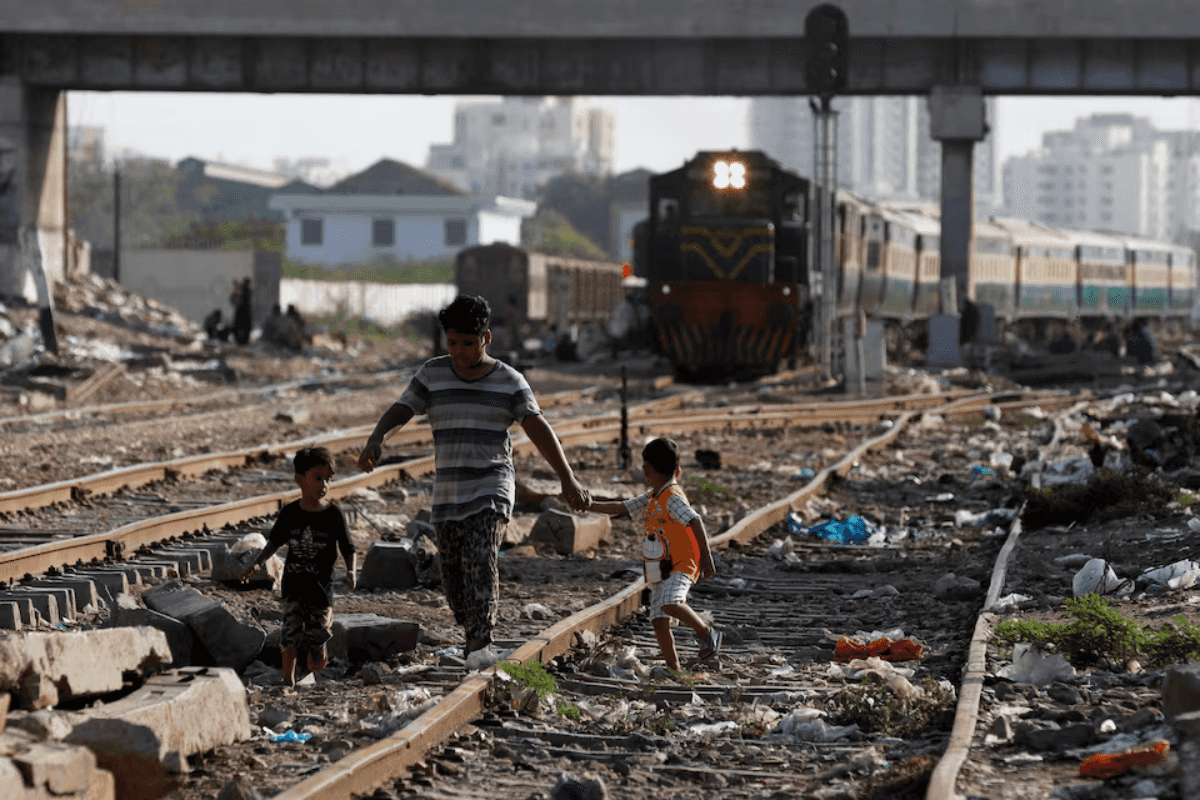
Pakistan's poverty rate rose to 28.9% in fiscal year 2024-25 from 21.9% in 2018-19.
Pakistan's poverty rate rose to 28.9% in fiscal year 2024-25 from 21.9% in 2018-19, reversing earlier progress in poverty reduction, Planning Minister Ahsan Iqbal said Wednesday.
Speaking at an event on multidimensional poverty measurement in Islamabad, Iqbal attributed the reversal to political uncertainty, disruptions in development policies, economic crises and climate-related disasters.
Pakistan's monetary poverty rate had previously declined from 29.5% in 2013-14 to 24.3% in 2015-16 before reaching 21.9% in 2018-19. The latest figure represents an increase of seven percentage points.
Iqbal said the country had lost momentum in poverty reduction after 2018 as political uncertainty, the COVID-19 pandemic, devastating floods and mounting economic pressures restricted investment in human development. Pakistan also faced the threat of financial default in 2022, he added.
He called for renewed investment in education, health care, infrastructure and skills development, saying sustained economic growth, political stability and continuity in development policies were essential to reducing poverty.
Why has Pakistan's development spending stagnated?
Iqbal said Pakistan's federal development budget had remained almost unchanged in nominal terms since 2017-18, despite rising prices, population growth and greater development needs. He warned that constrained public investment was affecting essential services and economic opportunities.
The federal Public Sector Development Programme (PSDP) allocation stood at PKR 1.001 trillion in 2017-18, accounting for approximately 19.6% of the federal budget and 2.5% of gross domestic product (GDP).
For FY27, the allocation is approximately PKR 1 trillion, almost unchanged in nominal terms.
Had development spending maintained its 2017-18 share of the federal budget, the allocation would now exceed PKR 3 trillion, Iqbal said.
He warned that limited development spending was affecting education, health care, water security, infrastructure and employment opportunities, particularly in disadvantaged regions.
The minister also called for stronger provincial accountability and empowered local governments to improve public services.
Under the 7th National Finance Commission Award, provinces receive 57.5% of the federal divisible pool and have primary responsibility for major social sectors, including education, health care and social welfare.
However, Iqbal said the transfer of responsibilities and resources had not consistently produced the improvements in human development needed to address poverty.
He urged provinces to strengthen local governments by transferring political, administrative and financial authority in line with Article 140A of the Constitution.
He also called for functioning Provincial Finance Commissions and transparent, needs-based allocation of resources.
Iqbal said the effectiveness of devolution should be measured by improvements in schools, health facilities, water supply, sanitation and other essential services.
How will Pakistan measure poverty in 2027?
The government plans to update Pakistan's National Multidimensional Poverty Index (MPI) in 2027, working with the Oxford Poverty and Human Development Initiative (OPHI), the Pakistan Bureau of Statistics (PBS) and development partners.
The index examines disadvantages in education, health and living standards, rather than relying solely on monetary poverty estimates.
Pakistan introduced its first National MPI in 2016 with support from OPHI and the United Nations Development Programme (UNDP).
The earlier index helped identify the country's 20 poorest districts, including 11 in Balochistan, five in Sindh, three in Khyber Pakhtunkhwa and one in Punjab, providing a basis for targeted federal development investment, Iqbal said.
The proposed 2027 index will draw on the Pakistan Social and Living Standards Measurement Survey for 2026-27 and examine whether additional challenges should be incorporated into poverty measurement.
These include climate vulnerability, gender inequality, digital exclusion, insecurity, malnutrition, child stunting, early childhood development, youth deprivation and migration.
The government also plans to explore poverty analysis at the National and Provincial Assembly constituency levels using data from the 2023 population census.
Iqbal said more detailed local data could help elected representatives identify development gaps, direct resources toward underserved communities and improve accountability.
He also called for updated poverty data to guide federal and provincial development planning, social protection programs and the allocation of public resources.
He stressed that progress should ultimately be assessed through improvements in people's living conditions, rather than public expenditure or the completion of projects alone.





Comments
See what people are discussing