

Pakistan seeks duty-free access to Chinese market to narrow $19.6bn trade deficit under CPEC Phase-II
Planning Minister Ahsan Iqbal proposed a non-reciprocal, zero-tariff arrangement for Pakistani exports during high-level talks in Beijing with China’s National Development and Reform Commission
Haris Zamir
Business Editor
Experience of almost 33 years where started the journey of financial journalism from Business Recorder in 1992. From 2006 onwards attached with Television Media worked at Sun Tv, Dawn Tv, Geo Tv and Dunya Tv. During the period also worked as a stringer for Bloomberg for seven years and Dow Jones for five years. Also wrote articles for several highly acclaimed periodicals like the Newsline, Pakistan Gulf Economist and Money Matters (The News publications)
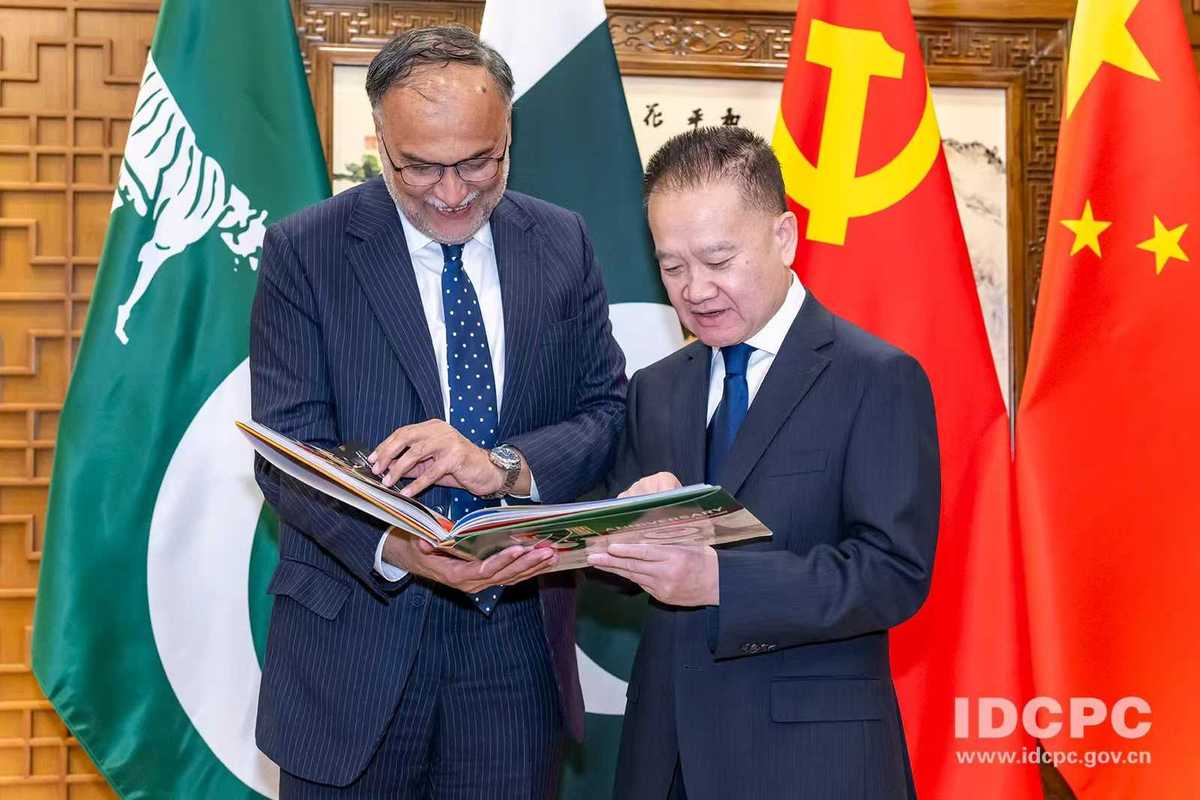
Pakistan’s Planning Minister Ahsan Iqbal meets China’s NDRC Vice Chairman Zhou Haibing in Beijing to discuss expanded trade access, infrastructure financing and new investment opportunities under CPEC Phase-II, aiming to strengthen economic ties and boost Pakistan’s exports.
Picture Courtesy: IDCPC
Pakistan has sought duty-free access to China for all Pakistani goods to narrow a $19.6 billion trade deficit and boost exports, as Islamabad pushes for greater market access under the second phase of the China-Pakistan Economic Corridor (CPEC).
Federal Minister for Planning, Development and Special Initiatives Ahsan Iqbal proposed a non-reciprocal tariff arrangement, separate from the existing bilateral free trade agreement, during a meeting in Beijing with Zhou Haibing, vice chairman of China’s National Development and Reform Commission (NDRC), according to a statement issued by Pakistan’s Ministry of Planning.
Modelled on China’s zero-tariff access arrangement for African countries, the proposal aims to enhance the competitiveness of Pakistani products in China's nearly $3 trillion annual import market. Iqbal called for technical discussions between the two sides to determine product coverage, rules of origin, and an implementation timetable.
According to ministry figures, Pakistan imported $22.34 billion worth of goods from China in fiscal year 2025–26, while its exports to the neighboring country amounted to just $2.71 billion, underscoring the steep imbalance in bilateral trade.
What infrastructure financing and Gwadar shipping proposals were discussed?
During the talks, the planning minister called for early completion of a financing agreement for the 102-kilometer Thor Nullah–Raikot section of the Karakoram Highway, which constitutes the first priority under the broader Rs576 billion Thakot–Raikot realignment project. The realignment is designed to keep the strategic corridor operational in sections affected by hydropower reservoirs along the Indus River.
Pakistan also discussed Chinese participation in upgrading the Main Line-1 (ML-1) railway beyond the Karachi–Rohri section, with Islamabad exploring Asian Development Bank (ADB) financing for the segment. In addition, the two sides reviewed four joint road feasibility studies, including the proposed Babusar Tunnel.
On Gwadar Port, Iqbal sought Beijing’s support in restoring regular commercial shipping services through engagement with Chinese state-owned shipping giant COSCO. He also proposed a joint feasibility study on establishing strategic petroleum storage facilities at the port, while reviewing progress on the Gwadar Free Zone, the second phase of the Eastbay Expressway, and a proposed mineral transport corridor connecting resource-rich Chagai with Gwadar for processing and exports.
What energy, mineral, and industrial initiatives were pitched for CPEC Phase-II?
Under CPEC’s second phase, Pakistan urged faster progress on the Kohala and Azad Pattan hydropower projects and proposed a joint technical assessment for converting selected power plants from imported coal to locally mined Thar coal to curb fuel import dependence.
Iqbal also sought Chinese approval for the Siah Diq copper project and proposed jointly developing two or three model special economic zones (SEZs). Pakistan further proposed adding three private-sector industrial ventures to CPEC’s cooperation agenda:
- An aluminium complex at Port Qasim
- A fertilizer manufacturing plant in Thar
- An oil refinery and fuel storage complex at Dhabeji
How are two sides expanding cooperation in technology, education, and agriculture?
Beyond physical infrastructure and energy, the two delegations reviewed the implementation of two existing bilateral agreements on artificial intelligence alongside a proposed 1,500-kilometer fiber-optic link connecting Rawalpindi and Karachi.
In human resource development, Iqbal proposed a jointly financed scholarship program to award 10,000 doctoral fellowships over 10 years.
He also sought Chinese partnerships to modernize Pakistan’s agriculture sector, including establishing dedicated food processing zones to reduce post-harvest losses and expand value-added agricultural exports.
NDRC Vice Chairman Zhou Haibing described CPEC as a foundational pillar of China–Pakistan economic cooperation, pointing to its tangible developmental gains, and affirmed that the commission is ready to work closely with Pakistan’s planning ministry on the corridor’s next phase. Calling for closer alignment of CPEC initiatives with Pakistan’s national development priorities, Zhou welcomed the proposals presented by the Pakistani delegation.



Comments
See what people are discussing