

Pakistan stock market notches third straight year of double-digit gains
KSE-100 rally fueled by earnings growth, liquidity and improving macro outlook

Haris Zamir
Business Editor
Experience of almost 33 years where started the journey of financial journalism from Business Recorder in 1992. From 2006 onwards attached with Television Media worked at Sun Tv, Dawn Tv, Geo Tv and Dunya Tv. During the period also worked as a stringer for Bloomberg for seven years and Dow Jones for five years. Also wrote articles for several highly acclaimed periodicals like the Newsline, Pakistan Gulf Economist and Money Matters (The News publications)
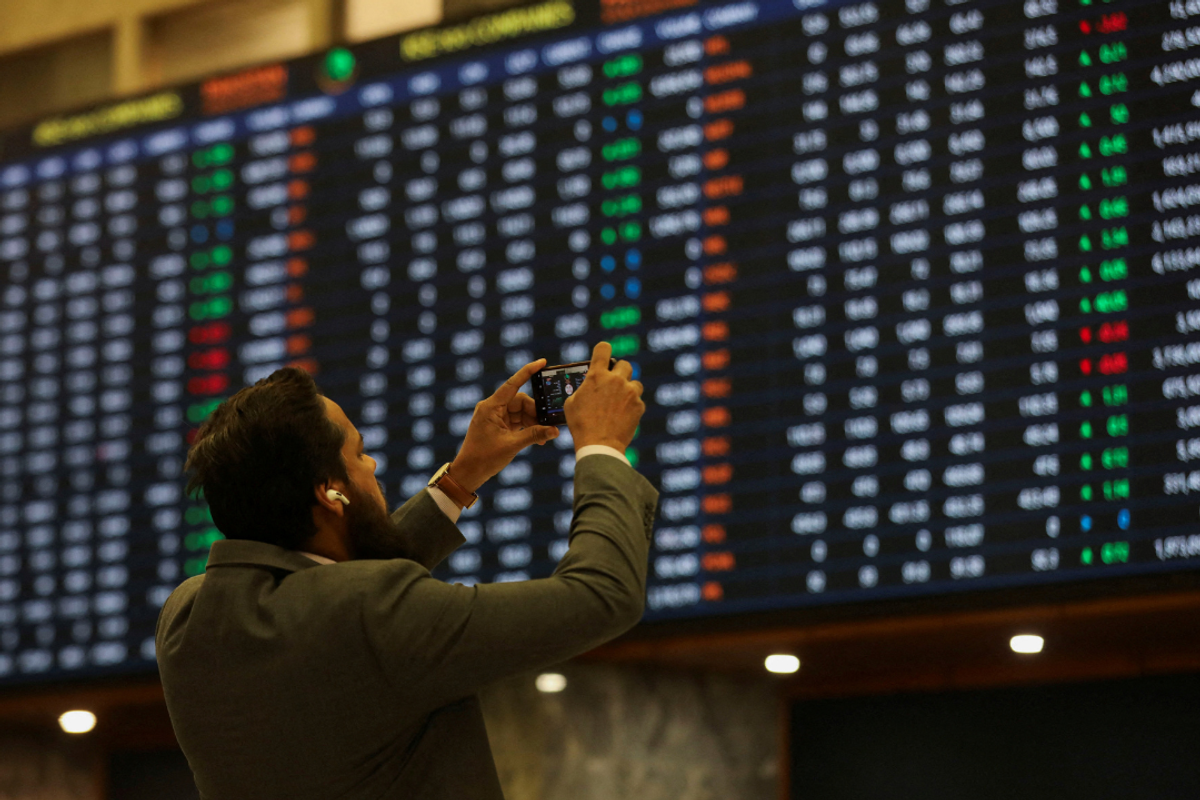
Pakistan’s benchmark KSE-100 index delivered its third consecutive year of double-digit returns in 2025, extending a powerful equity rally driven by strong corporate earnings, ample domestic liquidity and an improving macroeconomic backdrop, according to a market outlook released this week.
The KSE-100 rose 48.6% year to date in 2025, following gains of 84.3% in 2024 and 54.5% in 2023. Analysts said the performance was supported by robust earnings growth, a central bank maintaining a pro-growth policy stance, and a revival in mergers and acquisitions as well as initial public offerings.
While returns are expected to moderate in 2026, the broader equity uptrend remains intact. The index has a December 2026 target of 208,000 points, implying a 21.6% upside from its closing level on Dec. 23 this year based on target price mapping and justified price-to-earnings multiples.
Supportive macro environment
Analysts cited a favorable macroeconomic setting marked by declining inflation, stable interest rates, improving foreign exchange reserves, a manageable current account position and a relatively steady currency. These factors are collectively strengthening investor confidence and supporting equity valuations.
Domestic liquidity remains strong, fueled by fresh fund inflows and conversions from fixed-income investments, and is expected to continue underpinning market activity. With interest rates relatively low, real estate demand subdued and measures discouraging dollarization, equities are increasingly viewed as the preferred asset class over low-yielding fixed-income instruments.
The KSE-100 is currently trading at a forward P/E of 8.0 times, in line with its long-term historical average, and a forward price-to-book ratio of 1.3, about 10% below its historical average of 1.5. The market is also trading at a 31% discount to regional peers, highlighting what analysts describe as attractive entry points.
Earnings growth and sector leaders
Corporate earnings are projected to grow 5.9% in 2026, led by sharp gains in several key sectors. Technology earnings are expected to surge 214.3%, followed by textiles at 50.9%, oil marketing companies at 33.4%, cement at 20.7%, automobiles at 20.2% and fertilizer at 9.3%. Analysts said this earnings outlook provides continued support for equities.
Merger, acquisition and IPO activity is also gaining momentum. Arif Habib Ltd. plans 10 to 12 offerings in 2026 across sectors including fast-moving consumer goods, pharmaceuticals, oil and gas, automotive, information technology, real estate and financial services. These offerings are projected to raise between PKR 20 billion and 25 billion, signaling a robust capital-market pipeline.
Valuation gap and mean reversion
Despite the rally, Pakistan’s equity market continues to trade at a discount relative to the size of the economy. The market capitalization-to-GDP ratio stands at 16.0%, below the 20-year average of 18.8%. A return to the historical average would imply roughly 23% upside for the KSE-100 and expand total market capitalization to about PKR 24 trillion.
Looking ahead, analysts said a strong IPO pipeline in 2026, combined with improving macro stability and supportive valuations, strengthens the case for market deepening and a gradual move toward long-term historical market cap-to-GDP averages over the next decade.
Frontier market outperformance
Since Pakistan’s inclusion in the MSCI Frontier Markets Index in November 2021, the KSE-100 has delivered a cumulative return of 138%, sharply outperforming the frontier markets index, which gained 14.5% over the same period. The divergence underscores the strength of leading Pakistani companies relative to peers in other frontier markets, analysts said.
Despite ongoing policy and macroeconomic challenges, Pakistan’s equity market has demonstrated an ability to generate alpha on a risk-adjusted basis within the broader frontier universe.
Toward a potential expansion cycle
Pakistan’s macroeconomic revival is gaining traction, with improvements in inflation, external balances and growth signaling a shift toward stability. Historically, the KSE-100 has experienced valuation multiple expansion during periods of macroeconomic stabilization, notably in fiscal years 2014, 2015 and 2017, when P/E ratios rose to around 11.6-11.7 amid policy normalization, controlled inflation and strengthening external accounts.
Analysts see similarities between those episodes and the evolving outlook for fiscal year 2026. The policy rate is expected to remain steady at 10.5%, inflation is projected to ease further to 6.9%, and the current account deficit is forecast at about 0.3% of GDP. Foreign exchange reserves are expected to build to as much as $16.8 billion, while fiscal consolidation continues and real GDP growth of 3.7% remains near historical averages.
This alignment of policy easing, improving liquidity and stronger external balances is expected to lower the cost of capital and enhance earnings visibility, supporting renewed participation from both domestic and foreign investors. With equity valuations still deeply discounted relative to regional peers, analysts say cyclical sectors such as cement stand to benefit disproportionately from the recovery.
As economic fundamentals converge with proactive policymaking, 2026 is shaping up as a potential inflection point for Pakistan’s financial markets, with the KSE-100 entering what analysts describe as a sustainability phase driven by expanding earnings, falling yields and improving investor sentiment.





Comments
See what people are discussing