

Pakistan stocks drop 9% from January peak in broad selloff
Analysts call slide sentiment-driven, cite history of rebounds after sharp declines

Business Desk
The Business Desk tracks economic trends, market movements, and business developments, offering analysis of both local and global financial news.
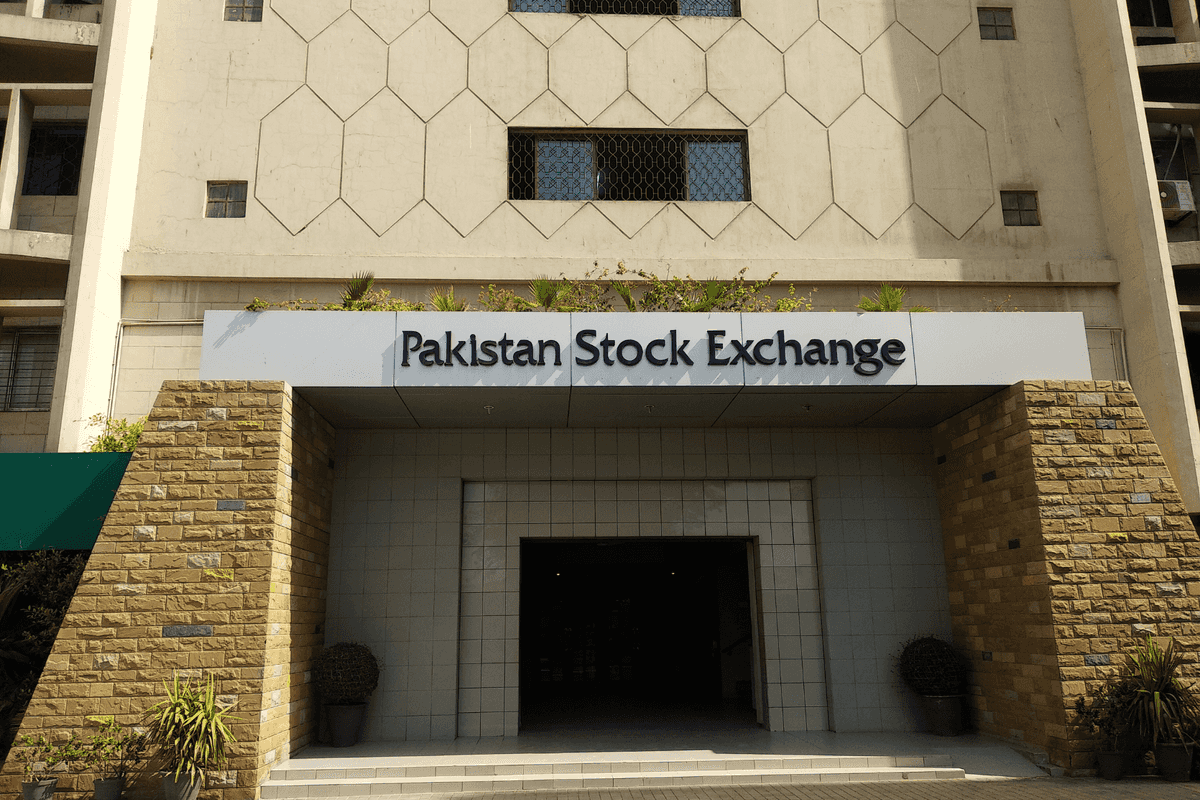
Pakistan’s benchmark stock index has fallen about 9% from its Jan. 23 peak, including an intraday slide of roughly 2,700 points on Tuesday, in a broad-based selloff that has unsettled investors after a strong rally earlier this year.
The index reached a high of 189,166 points, with market capitalization of PKR 21,219 billion. On Tuesday, it dropped to 173,150 points, bringing market capitalization down to PKR 19,666 billion — an erosion of PKR 1,553 billion.
The decline in the KSE-100 index has affected cyclical stocks and index heavyweights, reflecting what analysts describe as a sentiment-driven correction rather than a shift in underlying fundamentals.
Investors had expected a 50-100 basis point rate cut in the latest monetary policy decision, but the central bank held rates steady, dampening market expectations. Security-related concerns surrounding the Reko Diq mining project also weighed on sentiment.
The selloff comes amid a broader global risk-off tone, with geopolitical caution linked to tensions involving Iran contributing to investor nervousness. Market participants also cited profit-taking after a powerful rally into late January as a key factor behind the pullback.
Historical patterns
An analysis of KSE-100 data since 2000 shows 444 instances where the index fell 10% or more within a month, a pattern analysts refer to as a “fast decline” regime.
Historically, such corrections have often been followed by positive returns over longer horizons. One month after a fast decline, the index posted an average return of 1.8%, with gains 63.7% of the time. Over three months, the average return was 5%, positive in 61.9% of cases.
Six-month returns averaged 13.1%, with gains in 70.9% of instances. One-year returns averaged 25.7%, positive 73.2% of the time. Over three years, the average cumulative return was 80.6%, while five-year cumulative returns averaged 189.2%, with gains in 93.5% of cases.
The data indicate that while short-term volatility can persist, both the likelihood and magnitude of gains have historically increased over longer holding periods.
Outlook
Analysts said headline-driven declines tend to be temporary, with corporate earnings capacity and macroeconomic stabilization playing a more decisive role over time.
They cautioned that their constructive stance would be reassessed in the event of a material breakdown in Pakistan’s IMF program execution or signs of sustained macroeconomic instability. For now, they do not expect a significant interest rate hike or sharp currency depreciation in the near term.
While higher taxation could lead to earnings adjustments, analysts said the risk of a major deterioration in profits among index heavyweights remains limited.
Market strategists argue that the current correction resembles a sentiment reset rather than a structural shift in fundamentals. Although markets rarely signal a clear bottom, past episodes of rapid, sentiment-driven drawdowns have historically rewarded investors who remained invested through volatility.





Comments
See what people are discussing