

Pakistan vows to address Kashmir protesters’ demands through regular review meetings
Pakistan’s negotiating team to meet every 15 days, stresses that protests in democracies must remain peaceful

News Desk
The News Desk provides timely and factual coverage of national and international events, with an emphasis on accuracy and clarity.
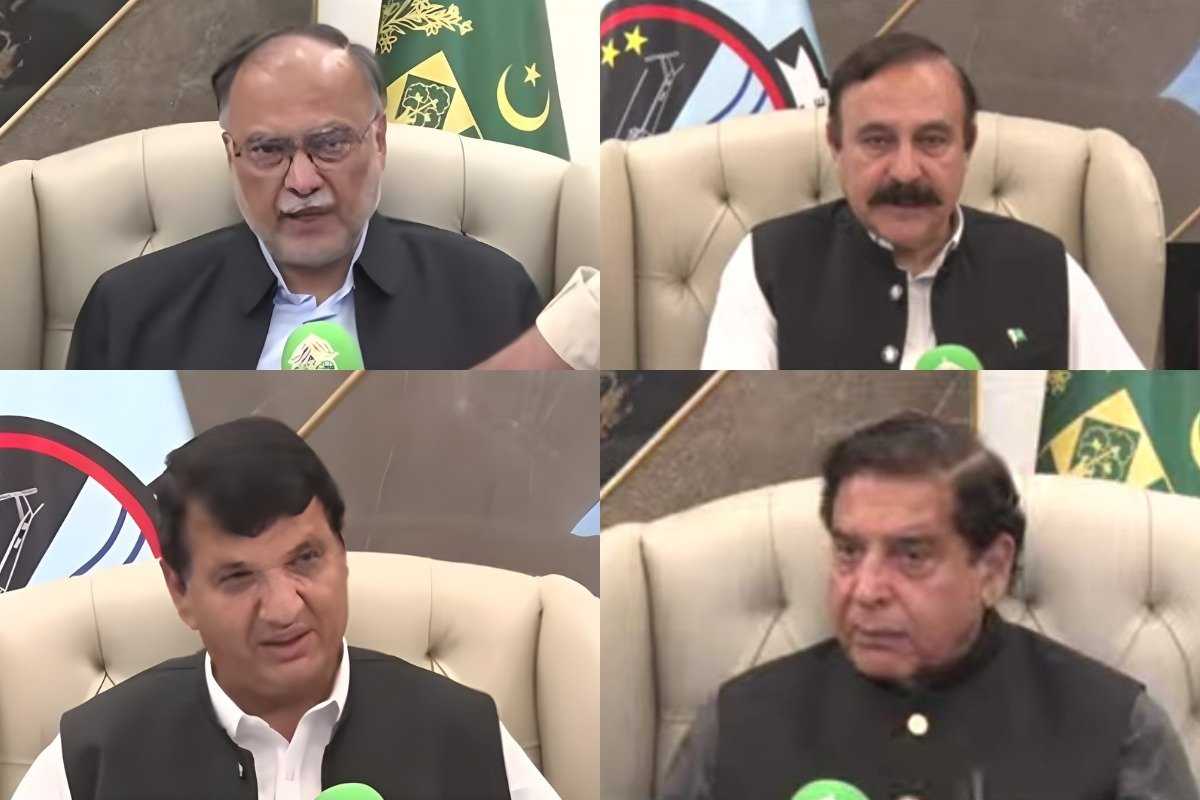
Members of Pakistan’s negotiating committee held a press conference in Islamabad on Saturday to talk about the agreement with Kashmir protesters.
Nukta
Senior Pakistani ministers said on Saturday that the government will hold follow-up meetings every 15 days to ensure implementation of the agreement reached with protesters in Pakistan-administered Kashmir, aiming to address their long-standing grievances and prevent future unrest.
The announcement came at a press conference in Islamabad, hours after a federal delegation returned from Muzaffarabad following successful negotiations with the Joint Awami Action Committee (JAAC), which had led days of demonstrations over economic and governance issues.
The delegation — comprising Ministers Ahsan Iqbal, Rana Sanaullah, Amir Muqam, Sardar Yousaf, ex-aide to PM on Kashmir Affairs Qamar Zaman Kaira, former AJK president Masood Khan and former premier Raja Pervez Ashraf — said the agreement marks a major breakthrough in restoring calm and addressing the protesters’ concerns. From the AJK government’s side, Education Minister Diwan Ali Chugtai and Local Government Minister Faisal Rathore participated in the talks.
Prime Minister Shehbaz Sharif earlier hailed the outcome, saying “all issues have been resolved amicably.”
Agreement details and compensation measures
According to the signed pact shared by Parliamentary Affairs Minister Tariq Fazal Chaudhry, cases related to the recent violence - which left several law enforcement personnel and protesters dead - will be registered under the Anti-Terrorism Act, with judicial commissions appointed where necessary.
Families of those killed during the October 1-2 clashes will receive compensation equivalent to that of law enforcement personnel. Each family will also be provided a government job within 20 days, while those injured by gunfire will receive PKR1 million in compensation.
Ministers call for peace, warn against violence
Planning Minister Ahsan Iqbal said the talks proved that dialogue remains the most effective path to resolving public grievances. “Movements that turn violent lose their direction,” he warned, adding that Pakistan’s enemies often exploit unrest for their own agendas.
Qamar Zaman Kaira said the people of Kashmir could “finally breathe a sigh of relief,” emphasizing that the government was committed to implementing the agreement in both letter and spirit. “A follow-up meeting will be held every 15 days to ensure progress,” he said.
Kaira also outlined plans for a comprehensive development package focusing on health, education, and infrastructure, urging protesters to avoid violence in the future.
Minister Amir Muqam thanked Prime Minister Shehbaz Sharif for overseeing the process despite being abroad, saying, “India wanted more casualties, but that did not happen. The issue has been defused.”
Former Prime Minister Raja Pervez Ashraf said the government acted swiftly to prevent the situation from spiraling out of control. “All protesters are patriotic Pakistanis, but such movements can be hijacked by anti-state elements,” he cautioned. “We must resolve our issues through unity and compassion.”
Parliamentary Affairs Minister Tariq Fazal Chaudhry added that peace had been restored in the region. “Their demands were genuine and focused on public welfare - there was no political agenda,” he said.
The protests had erupted after a deadlock between the AJK government and JAAC over the abolition of elite privileges and seats reserved for refugees from Indian-administered Kashmir. The movement, which brought parts of the region to a standstill, had been fueled by the JAAC’s 38-point charter of demands calling for governance and economic reforms.



Comments
See what people are discussing