

Pakistan’s economy shows stability in data but stagnation on ground
Despite better inflation and reserves, Kamran Khan says country's economy remains stuck in low growth amid rising taxes and debt

News Desk
The News Desk provides timely and factual coverage of national and international events, with an emphasis on accuracy and clarity.
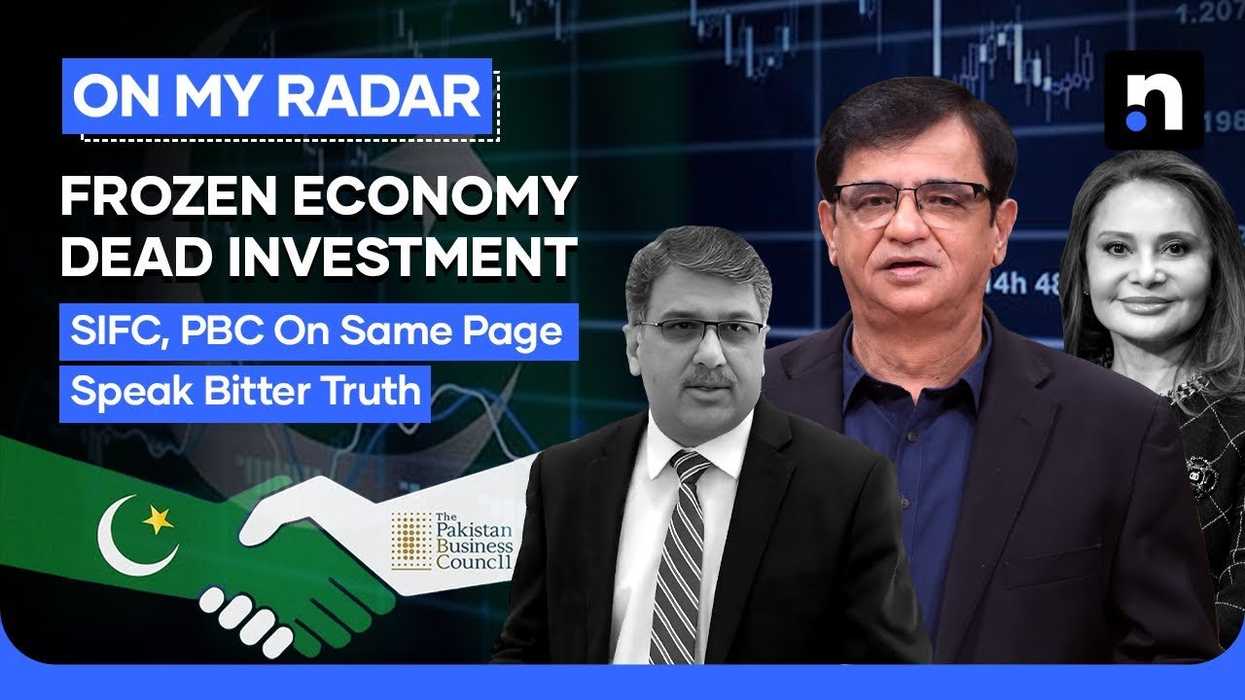
Pakistan’s economy is showing signs of stabilization on paper, but deep structural flaws continue to choke growth, Kamran Khan said during a recent episode of “On My Radar”.
Despite improvements in key macroeconomic indicators such as inflation, interest rates, foreign exchange reserves, remittances and the exchange rate, Pakistan remains stuck in what he described as a contradictory phase of consolidation without real recovery.
Economic growth has averaged just 1.5% to 2% over the past three years, far below the level needed to absorb the country’s rapidly expanding population or reduce poverty, he noted.
Pakistan’s public debt has climbed to a historic high of 77 trillion rupees (approximately $275 billion). After the distribution of funds to provinces under the National Finance Commission award, debt servicing now consumes at least 82% of the federal government’s net revenue.
That means for every 100 rupees collected by the federal government, 82 rupees go toward repaying loans and interest, leaving little fiscal space for development spending, health, education or social protection.
The export sector, considered the backbone of sustainable growth, is also under pressure. During the first five months of the current fiscal year from July to November, Pakistan’s exports fell 6% compared with the same period last year.
The decline was particularly sharp in November, with exports dropping 15.4% year-on-year. Analysts warned that the slowdown is already fueling rising unemployment across key industrial sectors.
According to World Bank estimates cited on the program, about 45% of Pakistan’s population now lives below the poverty line. Youth unemployment has reached 16.3%, highlighting the growing economic distress among younger Pakistanis.
At the center of the crisis is an overburdened and inefficient tax system that has become the single biggest obstacle to domestic and foreign investment.
Even the Special Investment Facilitation Council, or SIFC — a key government body set up to attract investment — has formally acknowledged that Pakistan’s exceptionally high tax burden is discouraging both local investors and foreign companies.
Addressing a “Dialogue on Economy” seminar organized by the Pakistan Business Council, SIFC National Coordinator Lt. Gen. Sarfraz Ahmed said manufacturing-sector investment would remain unlikely unless income tax rates are reduced and the controversial “super tax” on corporations is withdrawn.
The contradiction in Pakistan’s fiscal policy is stark. While GDP growth averaged just 1.8% over the past three years, tax collection more than doubled during the same period.
Federal tax revenue rose from 6.8 trillion rupees in 2022 to 13.9 trillion rupees last year. The government has now set an ambitious target of 16.9 trillion rupees for the current fiscal year.
Analysts said this shows that instead of expanding the tax base, authorities are squeezing the same documented taxpayers harder each year.
Salaried individuals face income tax rates of up to 35%. Companies pay a 29% corporate tax, a 10% super tax, advance tax, withholding taxes, worker welfare funds and provincial levies — pushing the effective tax burden on businesses to as high as 58%.
By comparison, corporate tax rates in the United States, Britain, Norway, Canada and Saudi Arabia range between 20% and 25%. The United Arab Emirates introduced a corporate tax of only 9%.
“In Pakistan, if you earn 100 rupees, nearly 58 rupees go straight to the government in taxes,” he said.
This tax disparity is driving foreign investors toward countries with easier regulations, single-window operations, fewer regulatory bodies and faster dispute-resolution systems.
As a result, Pakistan’s foreign direct investment has remained stuck between $1.5 billion and $2 billion annually for the past four years — a level considered dangerously low for a country of more than 240 million people.
The International Monetary Fund added to those concerns last month in its Governance and Corruption Diagnostic Assessment on Pakistan. The report described corruption as “institutionalized” and urged sweeping reforms to the tax system.
The IMF warned that sustainable economic stability is impossible without lowering tax rates, broadening the tax base and ensuring transparency in revenue collection.
The deeper dilemma lies in Pakistan’s vast undocumented “shadow economy,” estimated at nearly $400 billion — roughly equal to the country’s recorded GDP.
Meanwhile, the Federal Board of Revenue, Pakistan’s tax authority, continues to struggle with credibility. Analysts said neither the IMF, the SIFC nor ordinary citizens fully trust the institution’s performance.




Comments
See what people are discussing