

Pakistan’s Foreign Office rejects claims of CDF Asim Munir visiting Iran as 'US envoy'
Field Marshal's Iran visit was an independent diplomatic mission, completely free of any mandate from the US or Donald Trump, states FO spokesperson

News Desk
The News Desk provides timely and factual coverage of national and international events, with an emphasis on accuracy and clarity.
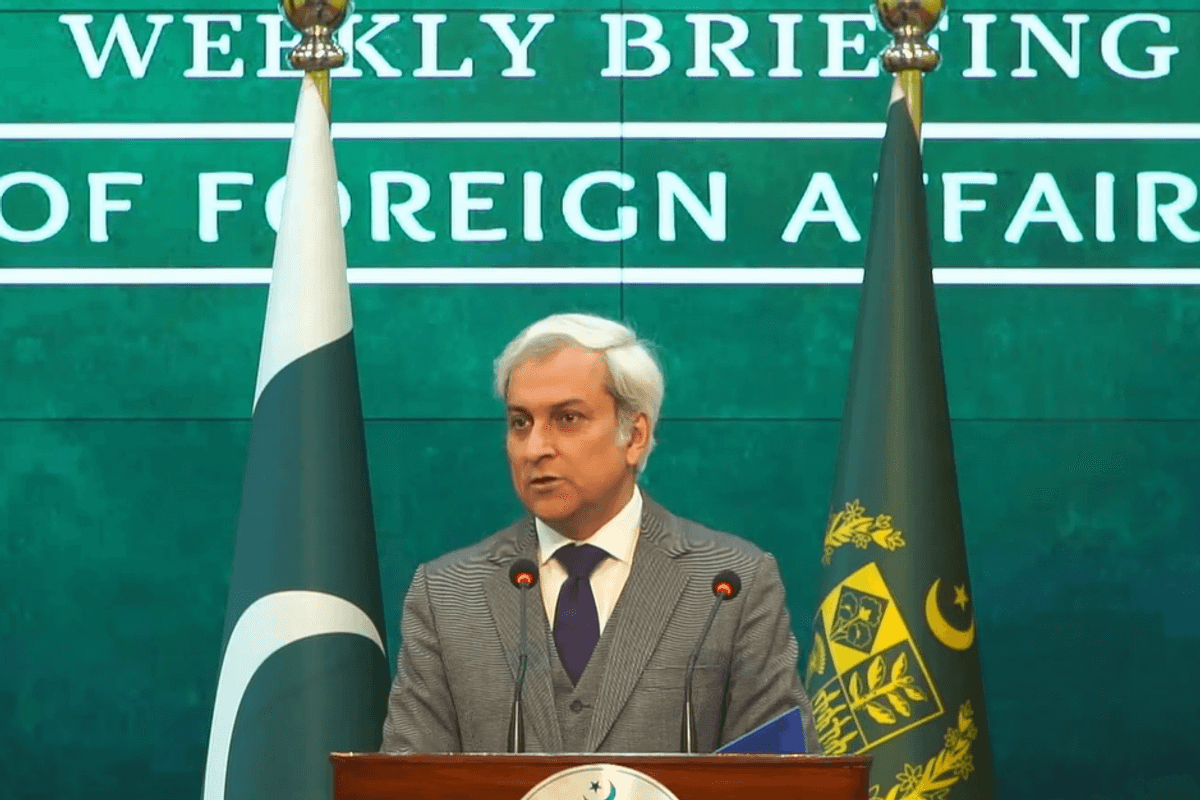
Pakistan’s Foreign Office spokesperson dismissed allegations on Thursday that the Chief of Defense Forces and Chief of Army Staff, Field Marshal Asim Munir, travelled to Iran as an envoy for the United States, labeling the rumors false and inaccurate.
Accompanied by Interior Minister Mohsin Naqvi, the Army Chief held high-level talks with Iranian leadership during a day-long diplomatic mission to Tehran on August 24. This strategic visit was executed as a core component of Pakistan’s independent diplomatic initiatives aimed at breaking the prolonged military deadlock and defusing the ongoing conflict between the United States and Iran.
Why did CDF Asim Munir visit Iran?
CDF Asim Munir traveled to Iran to guide Pakistan's neutral mediation campaign, which seeks to defuse growing regional friction and break the security deadlock between the United States and Iran. The intensive, single-day trip “focused on regional de-escalation, breaking the military stalemate and exploring a negotiated settlement to restore peace and stability”, FO Spokesperson Tahir Andrabi.
During a weekly press conference in Islamabad, FO Spokesperson Tahir Andrabi clarified the real motivations behind the state visit. He declared that widespread media assertions portraying the army chief as a representative for President Trump or Washington are completely baseless. The spokesperson emphasized that the trip was executed entirely under the umbrella of Pakistan’s traditional status as an unbiased regional peacemaker.
Andrabi detailed how the official dialogue highlighted Islamabad's genuine desire to serve as a reliable bridge across the deep diplomatic divide separating the US and Iranian governments. Iranian authorities expressed clear appreciation for Pakistan’s constructive intervention toward securing a non-violent resolution to the ongoing geopolitical standoff. Furthermore, Pakistan continues to work closely with allied regional nations to address the complex diplomatic crises threatening the Middle East.
Pakistan’s diplomatic initiatives to resolve the US-Iran conflict
The state intends to maintain its proactive diplomatic outreach and endorse serious multinational strategies that aim to restart suspended peace negotiations. Alongside the high-level military delegation to Tehran, Deputy Prime Minister and Foreign Minister Ishaq Dar sustained continuous contact with strategic regional partners.
Over a fourteen-day period, Dar conducted three separate consultations with Turkish Foreign Minister Hakan Fidan to coordinate responses to fluid regional shifts, Andrabi mentioned.
A previous memorandum of understanding brokered by Pakistan between the United States and Iran in mid-June had outlined conditions for restoring access to the critical Strait of Hormuz. That preliminary pact permitted Tehran and Muscat to establish future operational guidelines and maritime oversight for the strategic body of water. Unfortunately, the diplomatic breakthrough that was meant to lay the groundwork for permanent security negotiations has since collapsed entirely.
To explore alternative pathways, Omani Foreign Minister Badr Albusaidi arrived in Tehran on Tuesday to review a substitute framework establishing a temporary shipping corridor alongside a joint demining initiative. Significant structural disagreements still separate Iran and the United States, yet this wave of alternative diplomacy successfully returns the technical facets of the maritime crisis to center stage. Nevertheless, Iran's cooperation remains tethered to verifiable policy changes, as Tehran insists Washington must prove its readiness to fulfill its bilateral obligations through measurable deeds.
Expansion of the Makkah Joint Defense Agreement
When asked about Bangladesh’s interest in joining the Makkah Joint Defense Agreement, Andrabi described the alliance as an evolving security architecture. He stated that the defensive framework remains open to countries that share commitments to collective obligations and common security interests aimed at safeguarding regional stability. Any formal request to join will be considered in direct consultation with Riyadh and Ankara, though the operationalization of the pact is still at an early stage, Andrabi stressed.
These remarks follow statements from Dhaka indicating a strong interest in evaluating the strategic defense alliance positively. Bangladesh’s State Minister for Foreign Affairs, Humayun Kabir, noted that joining a security agreement between Islamic countries in West Asia is not unusual. He confirmed that the interim government views the matter constructively, which Pakistan, Saudi Arabia, and Türkiye will jointly review as the alliance matures.


Comments
See what people are discussing