

Pakistan’s new strategic moment hinges on stability at home
Kamran Khan said Pakistan is drawing greater global and Arab attention as the Middle East security landscape shifts

News Desk
The News Desk provides timely and factual coverage of national and international events, with an emphasis on accuracy and clarity.
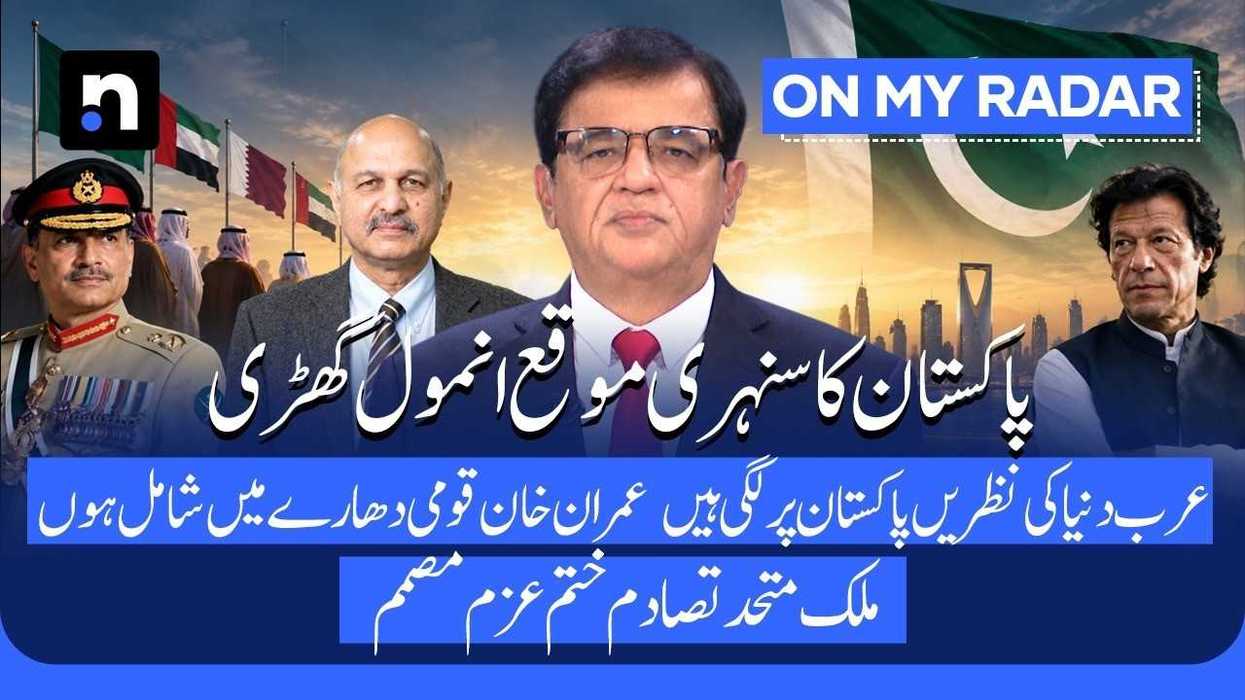
Pakistan is facing what could be one of its most consequential strategic moments in decades, with Arab states reassessing their security arrangements, the Middle East undergoing a major geopolitical shift and early signs of economic stabilization emerging at home. But whether Pakistan can turn this new international attention into lasting gains may depend as much on how it addresses its internal political, security and governance challenges as on its military and diplomatic strength.
Kamran Khan, speaking in the latest episode of On My Radar, said Pakistan was entering a period in which the world, particularly Arab countries, was looking at the country with greater interest as the regional security landscape changes. He argued that the opportunity could prove transformative if Pakistan succeeds in resolving four major internal challenges: terrorism, political polarization, weak governance and the confrontation between the state and Pakistan Tehreek-e-Insaf (PTI) and its leader, Imran Khan.
The Middle East conflict involving the United States, Iran and Israel has fundamentally altered the region's security calculations, according to Khan's analysis. Arab states are reassessing a long-standing model that relied heavily on a single external power for their security, creating space for new regional defense arrangements.
Against this backdrop, the reported defense agreement involving Pakistan, Saudi Arabia and Türkiye has assumed particular significance. But Pakistan's growing strategic relevance will not be determined by military capability alone. A country that is politically stable, peaceful, economically resilient and confident in its institutions is likely to carry considerably greater weight internationally.
That makes Pakistan's domestic situation particularly important at a time when its external relevance may be increasing.
There are some signs of improvement in the economy. Demand for Pakistan's recent $3 billion Eurobond was almost twice the amount on offer, signaling renewed interest from international investors. Foreign exchange reserves have also risen to around $23.7 billion, among the strongest levels seen in recent years.
These developments do not amount to an economic turnaround on their own. They do, however, provide Pakistan with an opportunity to build on greater stability.
If the country can maintain political stability, contain militancy and improve governance, the current economic improvement could create space for greater investment, stronger growth and job creation. But that will require reforms that address some of the structural weaknesses that have repeatedly undermined Pakistan's economic progress.
One of the most important debates in this regard concerns governance and the distribution of political and administrative power.
Pakistan's ongoing national debate provides an opportunity to consider whether greater authority and resources can be transferred from the four provincial capitals to cities, districts and local governments. More effective and empowered local governments could bring decision-making closer to citizens and potentially improve the delivery of public services.
Yet no governance reform can be fully effective without restoring peace in Balochistan and Khyber Pakhtunkhwa.
Balochistan, in particular, has the potential to become central to Pakistan's mineral future, the development of Gwadar and the country's efforts to attract major foreign investment. That makes countering militancy there not simply a security priority but an economic imperative.
Khyber Pakhtunkhwa faces its own security challenges, while the continued threat of militancy in both provinces risks undermining investment, development and public confidence.
The most politically sensitive part of this equation, however, remains the confrontation between the state and Imran Khan's PTI.
For several years, Pakistan has been caught in a political confrontation in which the state and one of the country's largest political forces have remained locked in conflict. The resulting polarization has made it harder to establish a broader political consensus around economic and governance reforms.
A political accommodation that brings Imran Khan and PTI back into the mainstream could, according to this argument, provide a starting point for reducing political tensions. A shift from confrontation towards dialogue could help create conditions in which political forces once again work towards a common national direction.
Such an accommodation could also have implications for governance reform.
PTI and Imran Khan have historically advocated stronger administrative units and greater devolution of authority to lower levels of government. If the political confrontation were to ease, PTI could potentially move from being largely outside the governing system to becoming a participant in broader institutional and governance reforms.
That, however, would require political compromise from all sides.
Pakistan's next major test, therefore, is not simply whether it can take advantage of a changing regional environment. It is whether the country can develop enough political cohesion, institutional stability and economic confidence to make the most of that opportunity.
The international environment may be creating a new space for Pakistan. The challenge now is to build the political unity, effective governance, security and economic foundations needed to occupy that space sustainably.
For the first time in years, Pakistan may have an opportunity for its economy, politics, governance, security and foreign policy to reinforce one another rather than work at cross-purposes. Whether that opportunity becomes a turning point or another missed chance will ultimately depend on what Pakistan does at home.




Comments
See what people are discussing