

Pakistan’s SECP faces leadership vacuum amid critical market reforms
Lack of SECP leadership delays decisions, hitting investor confidence and reforms, says Kamran Khan

News Desk
The News Desk provides timely and factual coverage of national and international events, with an emphasis on accuracy and clarity.
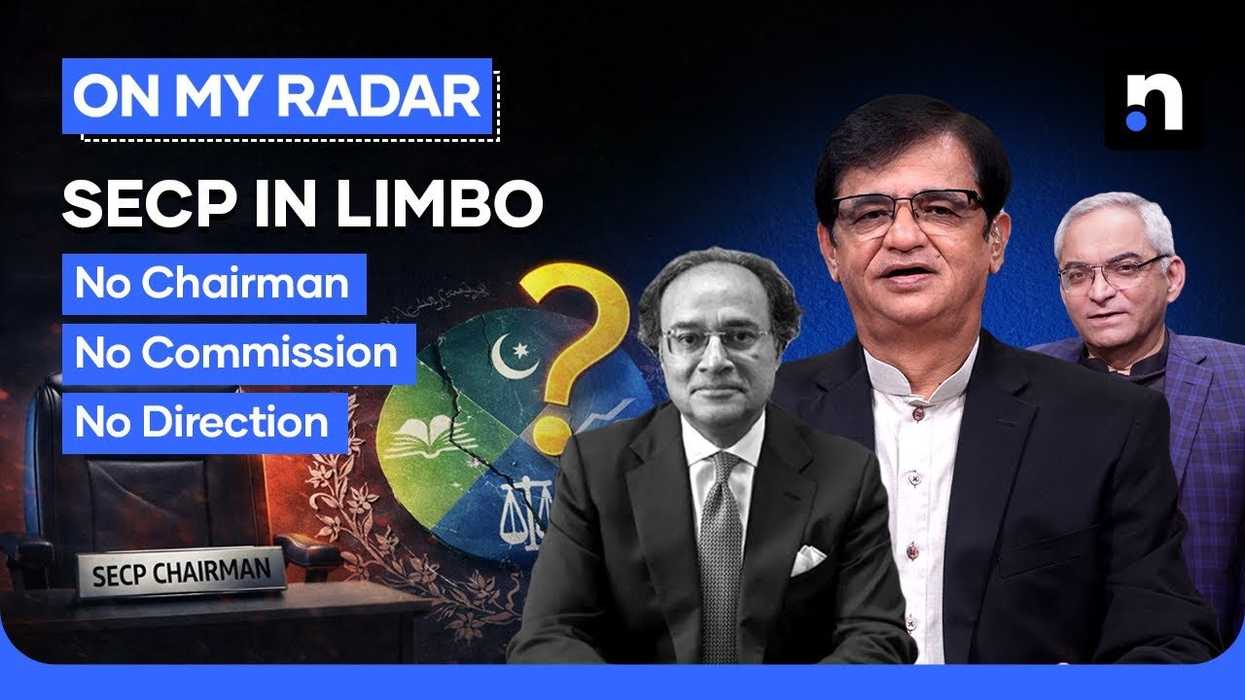
Pakistan’s Securities and Exchange Commission (SECP) has been operating without a chairman and three top commissioners for nearly three weeks, raising concerns about governance and investor confidence, Kamran Khan said on his program “On My Radar.”
The former SECP chairman, Akif Saeed, retired on Dec. 12, 2025, along with two commissioners whose terms had ended. Under the SECP Act 1997, the commission must have five to seven commissioners to function effectively. Currently, only two commissioners, Zeeshan Rahman Khattak and Muzaffar Ahmed Mirza, are overseeing the commission’s daily operations.
“The entire system at SECP is suspended,” Khan said. “Key decisions, including approvals for IPOs and regulatory actions, are effectively on hold.”
The leadership vacuum comes at a critical time for Pakistan, which is promoting reforms, privatization, and foreign investment. The SECP regulates Pakistan’s corporate sector, capital markets, insurance companies, mutual funds, REITs, pension schemes, and non-banking financial companies, serving as the backbone of the country’s business and investment ecosystem.
Despite the ongoing vacancies, government decision-makers have yet to make permanent appointments. Finance Minister Muhammad Aurangzeb’s committee interviewed 27 candidates and shortlisted a few for federal cabinet approval, but confirmations have not occurred.
“This is not just an administrative failure but a governance breakdown,” Khan said. “When regulatory bodies are paralyzed, investor confidence, policy continuity, and reforms are directly affected.”
The absence of SECP leadership has delayed major approvals on IPOs for the Pakistan Stock Exchange and halted sensitive inquiries and penalties against insider trading, black marketing, and cartelization. Even routine regulatory activities continue under legal constraints, as decisions made by only two commissioners may face judicial challenges.
Local and international investors have also been left uninformed. The SECP website does not currently display information about its vacant chairman post, leaving many market participants in uncertainty.
Pakistan’s capital markets and corporate sector have relied on SECP for oversight of stock brokers, credit rating agencies, chartered accountants, and surveyors. With top positions empty, the commission cannot carry out its full mandate.
Khan highlighted the paradox: Pakistan is promoting itself globally as a hub for investment and market stability, yet its key regulator operates in a state of stagnation. “What message does this send to potential investors?” he asked.
Analysts warn that until permanent appointments are made, the administrative void at SECP poses a sustained risk to Pakistan’s economy and financial markets. Investment decisions, policy reforms, and market stability remain in limbo, potentially undermining growth prospects.
The SECP crisis underscores a broader concern about Pakistan’s governance and the effectiveness of its economic managers. Without a fully functioning commission, the country’s corporate and financial systems risk prolonged uncertainty.




Comments
See what people are discussing