

Pakistan’s top court questions plea to refer constitutional amendment case to full court
Justice Jamal Khan Mandokhail says how an eight-member bench could order a full court if it can’t hear the case

Ali Hamza
Correspondent
Ali; a journalist with 3 years of experience, working in Newspaper. Worked in Field, covered Big Legal Constitutional and Political Events in Pakistan since 2022. Graduate of DePaul University, Chicago.
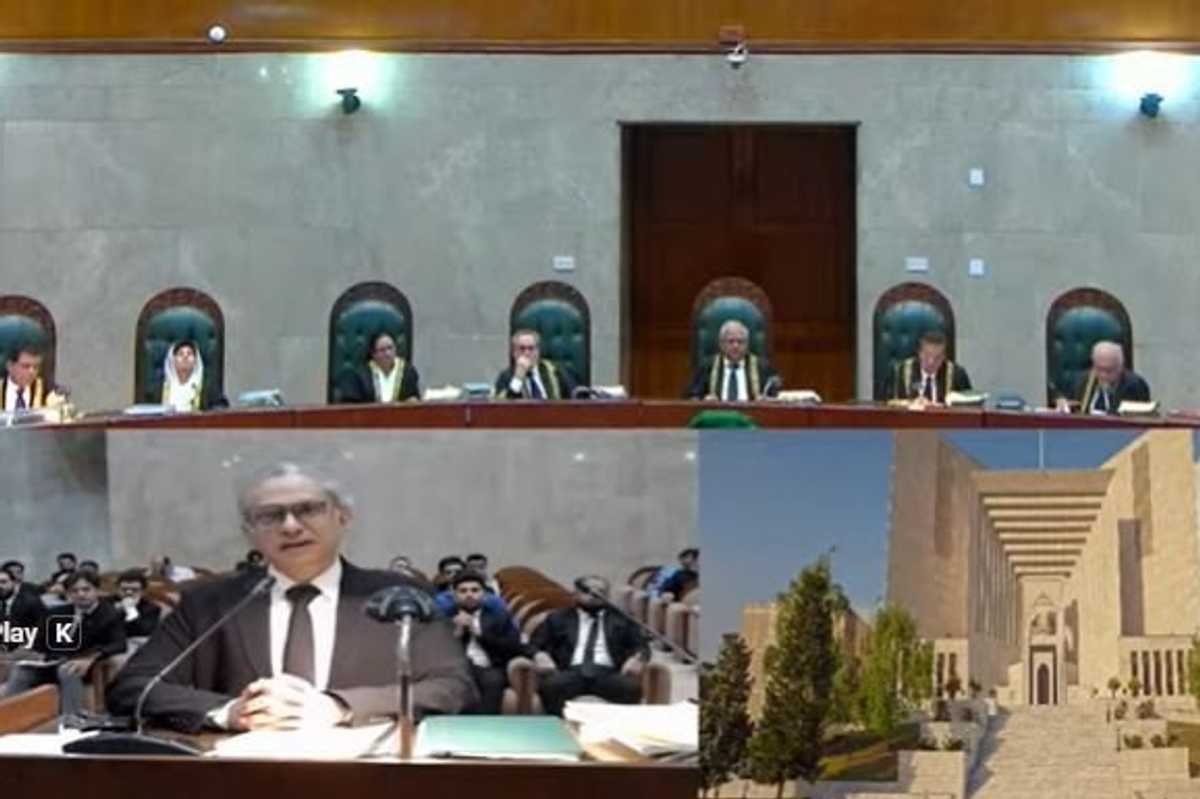
Advocate Khawaja Ahmad Hussain addresses the Supreme Court as an eight-member constitutional bench hears petitions challenging the 26th Amendment during live-streamed proceedings on Oct. 22, 2025.
Screengrab
Pakistan’s Supreme Court debated on Wednesday whether petitions challenging the country’s 26th Constitutional Amendment should be referred to a full court, with Justice Jamal Khan Mandokhail questioning how an eight-member bench could pass such an order if it is not deemed competent to hear the case.
The petitions are being heard by an eight-member constitutional bench led by Justice Aminuddin Khan. The amendment in question relates to the powers and procedures of the judiciary, and several constitutional experts have challenged its validity before the Supreme Court.
Lawyer Khawaja Ahmad Hussain, representing petitioner and former senator Afrasiab Khattak, argued that the case should be heard by the full court — comprising all available judges of the Supreme Court — to ensure neutrality and public confidence.
“The credibility of this institution does not depend on the 26th Amendment,” Hussain said during the hearing. “This case should be heard by another independent bench.”
Justice Mandokhail responded, “Are you saying you don’t trust this bench? If we cannot hear the case, how can we order that it be placed before the full court?”
Hussain cited Article 191-A of Pakistan’s constitution, which, he said, requires such constitutional matters to be heard by a full court. “I am not saying this bench is not independent,” he clarified.
Justice Ayesha Malik noted that the cited provisions were procedural in nature. “Read Article 191-A(1) together with 191-A(3),” she said. “These are procedural articles. They place restrictions on benches but not on the Supreme Court itself. Where is the bar? Can we interpret these articles to mean that the full court can hear the matter?”
- YouTube www.youtube.com
Justice Muhammad Ali Mazhar observed that if all 16 judges of the Supreme Court sat together, it “would become a regular bench, not a constitutional bench,” agreeing with part of Hussain’s interpretation.
Hussain, however, maintained that the Supreme Court retained the authority to refer the case to a full court, insisting that “the path exists” and that the amendment itself was not passed following proper constitutional procedures.
Justice Mandokhail questioned the logic of the request. “So we cannot send the case to a regular bench but can send it to the full court?” he asked.
Hussain replied, “There is no bar on referring the case to the full court. I am not asking for a final judgment, just that the matter be referred. You have the power to issue such an order.”
Justice Shahid Bilal Hassan pointed out that Hussain’s request effectively sought the main relief of his petition through the referral. Hussain countered that his petition did not seek to nullify the amendment but only to have the matter heard by the full court for transparency and legitimacy.
At one point, Justice Mandokhail raised a broader constitutional question. “Suppose a constitutional amendment strips the entire Supreme Court of its powers,” he asked. “Who would hear the challenge? It would still be the Supreme Court.”
The hearing concluded with Hussain completing his arguments. The court adjourned proceedings until Thursday, when the bench is expected to hear responses from the other parties.





Comments
See what people are discussing