

Paris bans protests at key landmarks as Macron slams foreign leaders over riot commentary
French authorities barred public demonstrations across central Paris on Thursday ahead of planned weekend rallies, as President Emmanuel Macron criticized US President Donald Trump for exploiting the country's unrest for midterm campaign

News Desk
The News Desk provides timely and factual coverage of national and international events, with an emphasis on accuracy and clarity.
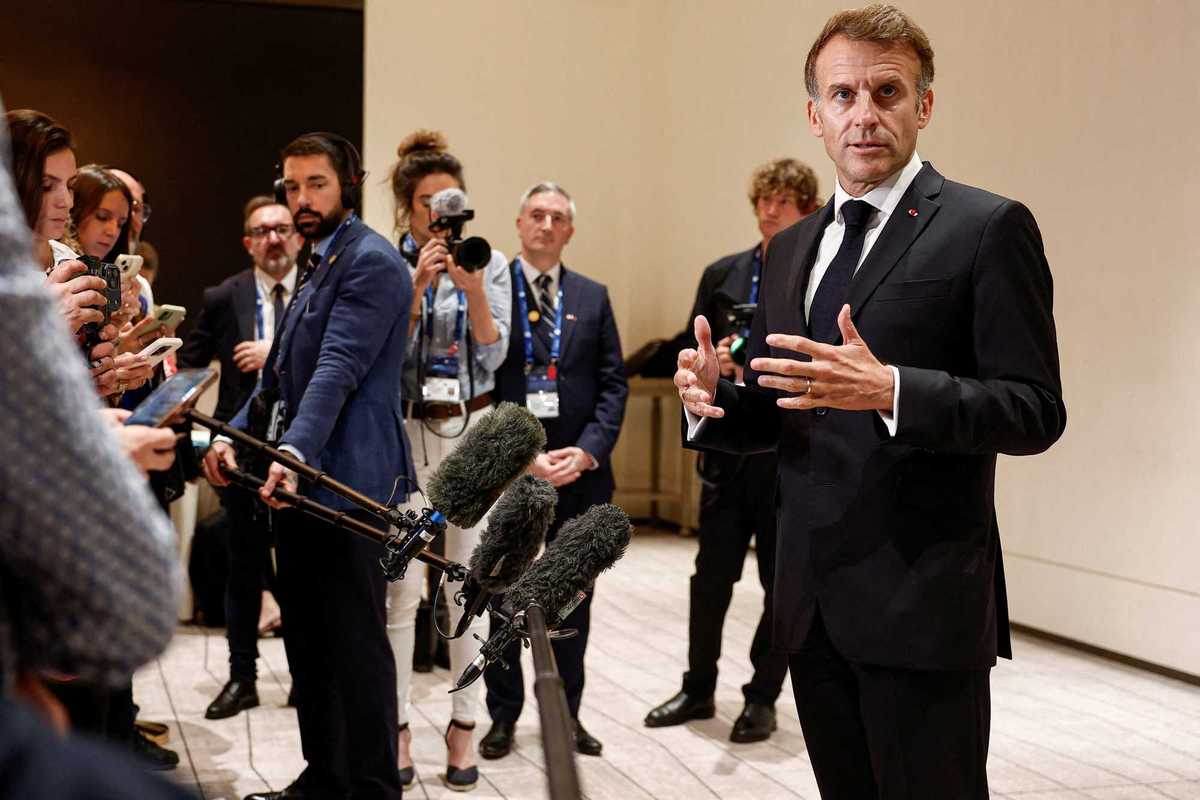
France's President Emmanuel Macron speaks to members of the media on the day of the 9th Annual One Planet Sovereign Wealth Funds (OPSWF) Summit in Lusail on October 21, 2026.
AFP
French police ordered a sweeping ban on public demonstrations across major sectors of Paris on Thursday, October 22, as the government moved to pre-empt renewed street violence following an extraordinary diplomatic rebuke by President Emmanuel Macron against foreign leaders exploiting the crisis.
Where are protests prohibited and how are authorities tightening security?
The decree issued by the Paris Police Prefecture prohibits all public gatherings between 8:00 AM and 8:00 PM (0600 to 1800 GMT) across sensitive political and tourist corridors. The restricted zones encompass the Élysée Presidential Palace, both chambers of parliament, the Louvre Museum, and the Avenue des Champs-Élysées, alongside traditional assembly points including Place de la Bastille, Place de la République, and the Châtelet-Les Halles retail district, which suffered extensive commercial looting over the weekend. Similar prohibitions against high school and university student demonstrations were instituted in both Paris and the southeastern city of Lyon.
The restrictions follow judicial announcements detailing the state's legal response to last weekend’s widespread destruction. Justice Minister Gérald Darmanin confirmed that out of roughly 2,500 individuals taken into police custody nationwide, 174 have been formally jailed and 917 are facing expedited prosecution.
While localized nighttime curfews helped tamp down widespread street clashes in Paris, Lyon, and Lille earlier in the week, transit disruptions have persisted, and neighboring Italy deployed 500 military personnel to Milan to reinforce domestic police units following companion demonstrations.
How did Macron, Trump, and Le Pen clash over political fallout?
Speaking to reporters during an official visit to Doha, Qatar, President Macron took aim at external political figures using footage of French unrest to bolster their own domestic electoral platforms. Without mentioning them solely by name, Macron pointedly referenced US President Donald Trump and Israeli Prime Minister Benjamin Netanyahu, both navigating high-stakes election battles. "There are people who campaign at France's expense — leaders who are in campaign mode, whether here in the region or on the other side of the Atlantic," Macron said, dismissing outside commentary attributing the riots to immigration as baseless and politically motivated.
The rebuke follows Trump’s campaign rally speeches in the United States, where he asserted that France was being "conquered, looted, and burned to the ground by migrants, jihadists, and communists," while praising French far-right candidate Marine Le Pen as the country's pre-eminent "conservative voice".
Le Pen, who currently leads polling ahead of the spring 2027 presidential election, rejected Macron’s criticisms late Wednesday in a statement on X, characterizing his remarks as "conspiratorial". "The images we saw last Saturday are not generated by artificial intelligence: they show the sad reality of what France has become after 10 years of Macronist rule," Le Pen stated.
How are financial markets and labor unions reacting ahead of weekend mobilizations?
The prolonged civic disruption has intensified pressure on the eurozone’s second-largest economy. France's benchmark 10-year government bond yield surpassed five percent on Wednesday, reflecting investor anxieties regarding the country's widening fiscal deficit and national debt trajectory. Credit rating agency Moody’s is scheduled to review France's sovereign debt evaluation on Friday, with market analysts widely forecasting a potential rating downgrade.
Despite government warnings that further street vandalism will not be tolerated, labor unions and grassroots factions are preparing a broader push. Following a consultation with Prime Minister Sébastien Lecornu on Wednesday, Sophie Binet, secretary-general of the hardline CGT union, declared that the labor movement is entering a "new phase" of coordinated strikes set to begin early next month.
Concurrently, organizers representing the "Yellow Vest" movement announced plans to defy restrictions with a march starting from Bastille Square on Saturday, October 24, alongside calls for another round of nationwide mobilizations on November 5.
According to Le Monde, French interior and intelligence authorities are finalizing containment plans involving armored vehicles and rapid-deployment units to shield vital infrastructure ahead of Saturday's scheduled assemblies.




Comments
See what people are discussing