

Political remarks spark debate over respect for Pakistan's fallen security personnel
Kamran Khan says Maulana Fazlur Rehman's remarks raise questions about how political leaders should speak about the country's fallen security personnel

News Desk
The News Desk provides timely and factual coverage of national and international events, with an emphasis on accuracy and clarity.
A nation's character is often judged by how it remembers those who gave their lives in its defense. Throughout history, societies have honored their fallen not because they were paid to serve, but because they made the ultimate sacrifice in service of something greater than themselves.
Peace, security and national sovereignty have always come at a price - one that is measured not in salaries, but in lives.
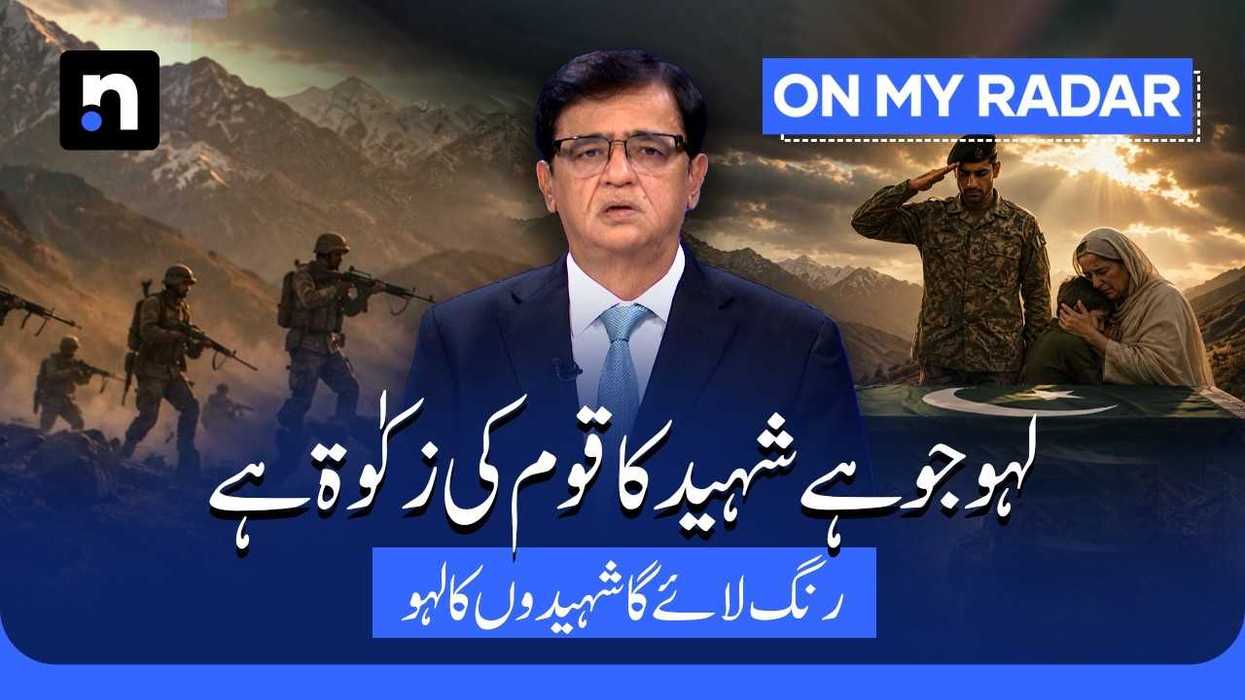
In the latest episode of On My Radar, Kamran Khan reflected on the debate by asking whether it is common in respected democracies for prominent political leaders to publicly describe the sacrifices of fallen security personnel as simply part of the job they are paid to do.
The discussion followed comments made by Jamiat Ulema-e-Islam (F) chief Maulana Fazlur Rehman during a public gathering last week. Referring to members of the security forces who have been killed in the line of duty, he said that soldiers are paid from taxpayers' money to perform that responsibility.
The remarks have sparked debate at a time when Pakistan continues to face a renewed wave of militant violence. According to official data, more than 1,300 personnel from the armed forces, police, Frontier Corps, Rangers and other law enforcement agencies have lost their lives in counterterrorism operations since 2024. Behind every statistic is a grieving family—a parent who buried a son, a widow left to raise children alone, or young children who will grow up without a father.
This raises a broader question: can the sacrifice of a soldier, police officer or any other member of the security forces be measured solely in financial terms? Does a monthly salary fully account for the risks they knowingly accept, or the price ultimately paid by the families they leave behind?
The debate extends well beyond military service. Those killed in the line of duty include soldiers guarding remote border posts, police officers protecting markets, mosques, schools and religious processions, and Frontier Corps personnel serving in some of the country's most volatile regions. Many spent successive Eids, Ramadans and family milestones away from home. Others left for duty each morning uncertain whether they would return.
The human cost of Pakistan's fight against terrorism cannot be understood through numbers alone. Among those who lost their lives were newly married men, young fathers and officers with decades of service still ahead of them. Their absence continues to shape the lives of the families they left behind.
Political criticism is an essential feature of every democracy, and public officials have every right to question government policies, military strategy or national security decisions. Robust debate strengthens democratic institutions. However, the conversation becomes more sensitive when it concerns those who have lost their lives while performing official duties.
Terrorism has affected every segment of Pakistani society. Members of the armed forces, police, Frontier Corps, Rangers and civilians have all paid a heavy price over the past two decades. Their sacrifices form part of Pakistan's collective national experience, regardless of political affiliation or institutional differences.
Ultimately, political opinions may differ, governments may change and policies may be debated. Yet for many Pakistanis, respect for those who died in the line of duty remains a shared national value. Their graves, medals and the families they left behind serve as enduring reminders that security is never without cost, and that the burden of protecting a nation is often carried by those who never return home.




Comments
See what people are discussing