

Political tensions deepen in Khyber Pakhtunkhwa amid security crisis
Kamran Khan examines governor’s rule debate, rising violence and widening tensions between Islamabad and Peshawar

News Desk
The News Desk provides timely and factual coverage of national and international events, with an emphasis on accuracy and clarity.
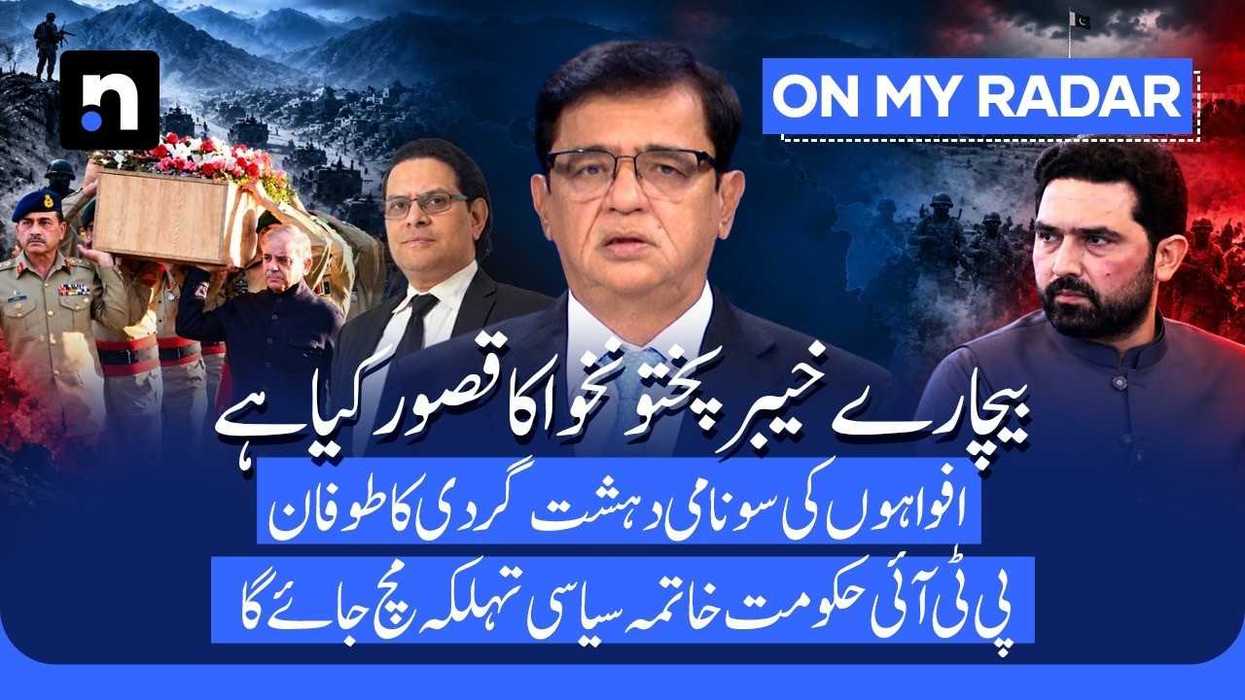
Political tensions between Pakistan’s federal and Khyber Pakhtunkhwa governments are intensifying as the province faces a worsening security crisis and renewed debate over the possible imposition of governor’s rule or an emergency.
The issue gained momentum after federal officials said constitutional and legal options were being considered for the province. But senior national security officials have since described reports of an imminent decision on governor’s rule as fake news. No decision has been announced.
In the latest episode of “On My Radar,” Kamran Khan examined the growing tensions between Islamabad and Peshawar, saying Khyber Pakhtunkhwa had become a critical fault line for Pakistan’s politics and security.
Chief Minister Sohail Afridi rejected threats of governor’s rule or an emergency, saying he would not accept a position that forced him to abandon his ideology. His comments came as the federal government and the Pakistan Tehreek-e-Insaf-led provincial government remained at odds over security policy and the party’s plans for political protests.
Federal Interior Minister Mohsin Naqvi had earlier said the government was considering legal options concerning Khyber Pakhtunkhwa in consultation with the Ministry of Law. That triggered discussion about governor’s rule, which was further fueled by Law Minister Azam Nazeer Tarar’s remarks that governor’s rule could be imposed if constitutional conditions required it.
“If such conditions, where the Constitution demands governor’s rule to be implemented or an emergency declared, are there or they arise, it can and will definitely happen,” Tarar said, according to reports.
Khyber Pakhtunkhwa Governor Faisal Karim Kundi has also said the Constitution provides for governor’s rule or an emergency, although he has not said that such a measure is currently being imposed. He said a presidential order would be implemented if one were issued.
The latest dispute comes as Khyber Pakhtunkhwa faces severe violence. According to the Center for Research and Security Studies, Pakistan recorded 774 violence-linked deaths in the second quarter of 2026, including 475 in Khyber Pakhtunkhwa. The province accounted for more than 61% of the national total and recorded 151 violent incidents. Fatalities in the province rose by about 53% from the previous quarter.
The figures have intensified concerns about the political dispute between the federal and provincial governments at a time when security remains a major challenge in the province.
Another important factor has entered the political equation: Jamiat Ulema-e-Islam-Fazl chief Maulana Fazlur Rehman and his increasingly critical stance toward the federal government.
Fazl has warned that closing Islamabad with shipping containers and using force to stop political protests could encourage rebellious sentiments among people. He has also said PTI’s right to protest should be respected and called for important issues involving national security and the regional situation to be brought before Parliament.
The development is politically significant because PTI and JUI-F have been longstanding rivals in Khyber Pakhtunkhwa. Any greater convergence between the two parties over provincial rights, terrorism, federal intervention and political freedoms could broaden the political response to the federal government beyond the existing PTI-versus-federal-government confrontation.
The debate also centers on the Constitution. Article 234 provides a mechanism for federal intervention when a provincial government is unable to perform its constitutional functions, while Article 232 deals with emergencies arising from war, external aggression or severe internal disturbances that are beyond a provincial government’s control.
However, the constitutional provisions do not mean that every terrorist attack, protest, dispute between governments or political crisis automatically provides grounds for governor’s rule or an emergency.
The immediate concern, therefore, extends beyond the possibility of governor’s rule itself. Khyber Pakhtunkhwa is facing a serious security threat, tensions along the Afghanistan border remain a major issue, the provincial government has a strained relationship with the federal government, and the ruling PTI is pursuing a protest campaign.
In this environment, a major terrorist attack, violent political confrontation or an extraordinary constitutional step could further escalate the crisis.
Khyber Pakhtunkhwa has therefore emerged not only as a frontline in Pakistan’s fight against terrorism but also as a major test of the country’s federal system, political relations and security policy.




Comments
See what people are discussing